.webp)

Have you ever noticed that every new Layer-2 project claims to be faster, cheaper, and more scalable than what came before? Most of the time, it's just marketing. But MegaETH is a different story. The numbers are genuinely wild. It launched its public mainnet in February 2026 and already has serious DeFi infrastructure. That says something real about where this project is headed.
Here's everything you need to know about MegaETH, the mega crypto project that's been turning heads since its seed round.
MegaETH is a next-generation Ethereum Layer-2 blockchain. But calling it just an "L2" honestly undersells it. The team calls it the first real-time blockchain, and that framing isn't just for show.
MegaETH aims to deliver a theoretical streaming throughput with 10-millisecond latency and up to 100,000 transactions per second. To put that in perspective, the Ethereum mainnet processes roughly 15 to 30 TPS. Even well-funded L2 networks typically cap out in the low thousands. MegaETH is operating in a completely different league.
The goal isn't just to be faster than Ethereum. MegaETH was also designed to be fully EVM-compatible, so developers don't have to rewrite their Solidity code. Existing tools like MetaMask and Hardhat work out of the box.
MegaETH was developed by MegaLabs, a team with strong academic and engineering credentials. The project gained early momentum quickly.
The team raised $20 million in a seed round led by Dragonfly Capital in June 2024, followed by a $10 million community round on Cobie's Echo platform in December 2024. The project has raised $450 million total and counts Vitalik Buterin, Joseph Lubin, and EigenLayer founder Sreeram Kannan among its backers. That's the who's-who of Ethereum infrastructure.
The public sale that ended in October 2025 was impressive. It attracted over $1.39 billion in bids and reached its hard cap of nearly $50 million at a final price of $0.0999 per $MEGA token. It was oversubscribed by nearly 28x. That demand shows a strong appetite for credible Ethereum scaling solutions.
Most blockchains process transactions in batches: a block fills up, then gets validated, and the cycle repeats. This batch model creates an inherent latency floor that cannot be optimized away architecturally.
MegaETH throws that model out entirely. It manages transactions continuously instead of in block batches, achieving sub-second finality and removing traditional throughput limits. Think of it less as a batch processor and more as a real-time data stream.
The architecture separates execution, consensus, and validation across different node types. High-end sequencers handle the heavy lifting. Validators don't need that hardware level, keeping the system accessible. MegaETH also uses a custom C++-based EVM called evmone and a new state trie to reduce I/O bottlenecks in smart contract execution.
Recently, the team announced SALT, which stands for Small Authentication Large Trie. It keeps the entire authentication structure in RAM to eliminate disk I/O. This is a meaningful architectural breakthrough not yet done by other chains.
Security is delegated upward to Ethereum and EigenDA. So you're getting raw speed at the execution layer without giving up Ethereum's battle-tested security guarantees. That trade-off is actually pretty elegant.
This is where things get interesting. Because MegaETH isn't just a "fast chain for DeFi swaps" story.
DeFi and high-frequency trading are the obvious starting points. The Global Token Exchange (GTE) is MegaETH's native DEX, delivering instant swaps with CEX-level execution speed while remaining fully decentralized. Practically, you get the non-custodial security of a DEX with the execution speed of Binance or Coinbase. That's a new product category.
Gaming and interactive apps are another big unlock. Traditional blockchains are too slow for real-time state updates like games, prediction markets, and live social feeds. These have required design compromises due to latency. MegaETH removes that constraint.
AI-native applications are also emerging on the network. Projects like Nectar AI are building on MegaETH precisely because real-time state execution opens up things that were previously impossible on-chain.
The USDm stablecoin integration with Ethena brings yield-bearing stablecoin infrastructure natively to the network. The yield from USDm reserves is designed to subsidize network operational costs. Users could effectively get cheaper transactions funded by stablecoin yield. That's clever protocol design.
There's no shortage of "high-performance blockchain" projects. So how does MegaETH actually stack up?
These are the established L2s. They have reduced Ethereum fees significantly and have deep liquidity. But they were built to reduce costs, not eliminate latency. MegaETH prioritizes speed and UX, achieving web-level responsiveness even during high demand. It's a different design goal.
Base benefits from Coinbase's distribution: 110 million verified users and $80 billion in assets in the ecosystem. That's a moat MegaETH lacks. But Base runs on Optimism's OP Stack and hasn't made real-time performance its core priority. It's a different product solving a different problem.
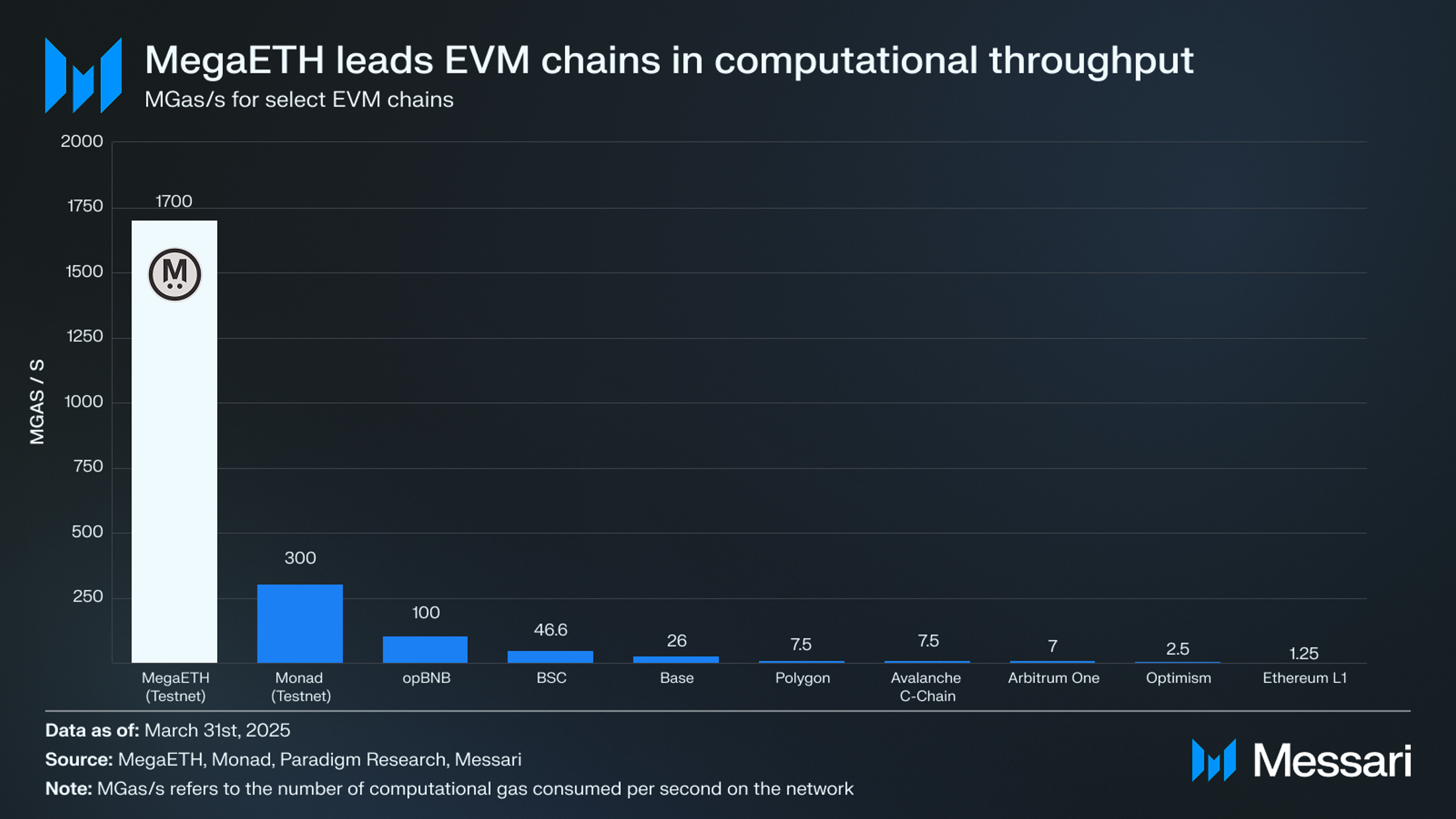
This comparison comes up often. Monad is a Layer-1 with 10,000 TPS targets and 400-millisecond block times. MegaETH targets 100,000 TPS with 10-millisecond block times. As of March 2025 testnet results, MegaETH demonstrated 1,700 MGas/s computational throughput versus Monad's 300 MGas/s. That's a meaningful gap. Both are high-performance EVM chains, but MegaETH aims higher.
A fast blockchain without ecosystem connections is just a fast island. MegaETH has been adding integrations quickly since the mainnet.
On February 7, 2026, MegaETH joined the Chainlink SCALE program. That gives the network immediate access to Chainlink oracle services and connectivity to major DeFi applications like Aave and GMX, plus roughly $14 billion in flagship DeFi assets. That's a big unlock for composability.
The Ethena partnership for USDm was announced in September 2025 and adds native yield-bearing stablecoin infrastructure to the network.
The MegaMafia builder collective is worth watching. It's a group of early-stage founders co-building with the MegaETH core team. Projects like CAP, Aeon, Lemonade, and Euphoria are stress-testing what's possible when blockchain performance constraints are removed. The MegaMafia model is more interesting than most corporate ecosystem funds because the teams are genuinely co-located and building in real time.
The native token is $MEGA, the mega coin that will power the MegaETH network once it enters circulation. Currently, $MEGA is still in its pre-launch phase.
The total supply is confirmed at 10 billion MEGA tokens. At least 5% of that, or 500 million MEGA, is reserved for Fluffle NFT holders as part of the early community reward program. The public token sale ended in October 2025 at $0.0999 per token, setting the early price benchmark. However, tokens sold then are subject to vesting schedules and are not immediately liquid.
When $MEGA enters circulation, it will serve several functions across the network. Gas fees will be the first utility, as users need MEGA to pay for transactions. Staking is planned as a core feature, but won't be available until up to 18 months after mainnet launch. Yield-seeking investors should factor this timeline into their expectations. Governance rights and broader ecosystem incentive programs are also on the roadmap to keep long-term contributors engaged as the protocol matures.
The Fluffle NFT collection was central to early distribution. Spread across two phases of 5,000 NFTs each, Phase 1 rewarded over 80,000 early community supporters. Fluffle holders will receive 50% of their allocation unlocked at the Token Generation Event (TGE), with the remaining 50% vesting over six months. The TGE timing is still anticipated, with most observers expecting mid-2026 since the mainnet launched in February and most protocols require months of network stability before full token distribution.
Because $MEGA isn't circulating yet, there is no live spot market price on major exchanges. Any figures you see represent pre-market or OTC pricing, reflecting sentiment and demand but not an established liquid market. Treat those numbers accordingly.
Buying locked MEGA tokens is different from buying on a spot exchange. You are not purchasing immediately tradable tokens. Instead, you acquire an allocation (often a SAFT or Simple Agreement for Future Tokens) from an early investor, team member, or backer holding tokens subject to a vesting schedule. This distinction matters because the mechanics, risks, and minimum ticket sizes differ from regular retail trading.
The most structured way to buy locked MEGA tokens is through a crypto secondaries marketplace like Acquire.Fi, which operates a dedicated OTC desk for this kind of transaction. We connect verified buyers directly with early backers and MegaETH team members looking to sell before full public circulation. However, the marketplace is designed for institutional buyers or serious investors, not retail participants.
The marketplace also works in the opposite direction. If you hold MEGA tokens and want liquidity before they fully vest, you can list a sell offer and connect with buyers who are actively seeking allocations.
Before going this route, understand that locked tokens carry vesting risk, execution risk, and counterparty risk that liquid spot purchases do not. The unlock schedule for Fluffle NFT holders (50% at TGE, 50% over six months) is documented, but SAFT agreements can vary depending on the round. Always get specific vesting terms in writing and, if the ticket size justifies it, have legal counsel review the agreement before committing capital.

With deep roots in traditional finance and the digital asset industry, Acquire.Fi operates as a specialist M&A advisory firm. Coverage spans M&A, secondaries, OTC, and capital markets advisory across digital assets and frontier tech. Decades of combined experience across every stage of the deal lifecycle.


.webp)