.webp)

Something quietly changed in how the world measures public opinion. Not polls, surveys, nor Twitter sentiment. Something with actual skin in the game. Prediction markets have been around for a while, but they became impossible to ignore in the past two years. Tens of billions in combined trading volume had passed through major platforms. Mainstream brokerages embedded them while venture capitalists poured billions into them.
But what is a prediction market, exactly? Here’s the full breakdown.
What is a prediction market, and why have they become popular?
A prediction market is a financial marketplace where participants buy and sell contracts based on the probability of a real-world event occurring. The price of each contract reflects the crowd's collective estimate of whether something will happen. If a contract is trading at $0.65, it means the market collectively thinks there's roughly a 65% chance that outcome occurs.
Think of it as crowd-sourced probability. Instead of asking a pundit what they think will happen, you look at where informed people are putting real money.
The contracts are typically binary. Either the event happens, or it doesn't. Win or lose. Yes or no. If you're right, you collect a fixed payout. If you're wrong, you lose your stake. This structure is simple but powerful because it forces honesty. People are less likely to say something they don't believe when money is on the line.
What are prediction markets covering? Pretty much everything at this point. Federal Reserve interest rate decisions. Election outcomes. Sports results. Inflation figures. Oscar winners. Whether a specific CEO will still be in their role by year's end. Predictive markets have expanded far beyond politics and into every corner of public life.
The growth story is honestly kind of wild
Polymarket went from $73 million in total trading volume in 2023 to roughly $9 billion in 2024. A single event, the U.S. presidential race between Trump and Harris, attracted more than $3.3 billion in wagers alone. By late 2025, Polymarket's cumulative volume had crossed $20 billion.
Kalshi, the leading regulated U.S. exchange, processed over $52 billion in cumulative volume by the end of March 2026. Robinhood reported that $12 billion in contracts were traded on Robinhood in 2025, and another $4 billion already in 2026.
This is not a niche anymore. These are mainstream financial products with projected annual revenues of $10B by 2030.
Are prediction markets betting platforms?
Technically, prediction markets are betting platforms. But the people building these prediction markets would really rather you didn't call it that.
When you buy a Yes contract on whether the US invades Iran next month, you are staking money on an uncertain outcome. If you're right, you profit. If you're wrong, you lose. That is, by most plain English definitions of the word, a bet. The math and the emotional experience are probably the same as making a bet. Prediction market contracts are basically bets dressed in financial language.
But "betting" carries legal baggage. Gambling is regulated at the state level in the US. Sportsbooks need state licenses. There are age restrictions, deposit limits, the whole thing. So the platforms and their legal team made an argument, which we’ll cover next.
How are they even legal?
This is where it gets interesting. And frankly, it's been one of the more contentious fights in fintech in recent years.
In the United States, the answer hinges on one key regulator: the Commodity Futures Trading Commission, or CFTC. The CFTC oversees derivatives and futures markets. If a prediction market can classify its contracts as event contracts under the Commodity Exchange Act, it falls under federal jurisdiction instead of state gambling laws.
The core legal argument is about who sets the prices. On Kalshi and similar platforms, contract prices are dictated by customers entering and exiting positions, exactly like a commodity futures market. Sportsbooks, by contrast, have their lines set by the house, and customers cannot exit their positions. That structural difference is the basis for the claim that prediction market contracts are financial instruments and not wagers.
The fight has not been easy. Kalshi spent years battling the CFTC before winning regulatory approval. State governments in Nevada, New Jersey, and others pushed back hard, arguing these products are gambling regardless of what federal regulators say. In November 2025, Robinhood and Kalshi defeated a preliminary injunction from three California Native American tribes, with a judge ruling that federal commodities law governs these contracts. But the legal landscape is still very much evolving.
Decentralized platforms operating outside the U.S. jurisdiction create a different set of legal considerations depending on the country and user location.
They're more useful than most people realize
Prediction markets may be a speculative tool, but the applications are genuinely broader than that.
Corporate decision-making
Companies can use internal prediction markets to aggregate employee forecasts on product launches, sales targets, and project timelines. The logic is the same: people with real stakes make more honest forecasts.
Real-time polling alternative
Journalists, researchers, and analysts have increasingly turned to prediction market prices as complements to traditional polling. Polymarket data was cited repeatedly during the 2024 election cycle because it updated in real time as news broke, while polls lagged by days.
Hedging tools
A business with significant exposure to interest rate decisions can use Fed rate contracts as a hedge. If rates go up and hurt your business, your "yes" position profits and offset some of the damage.
Research and forecasting
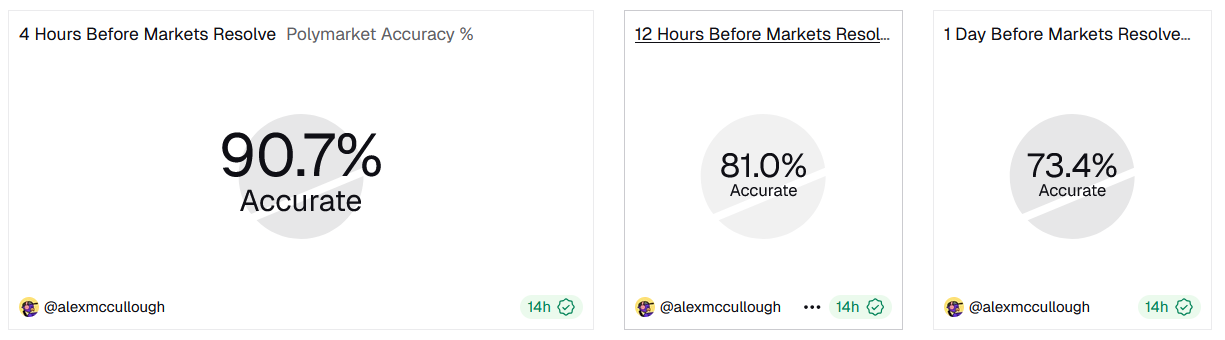
Intelligence communities and policy research groups have experimented with prediction markets internally as forecasting tools. Independent research shows Polymarket’s historical accuracy is 73 to 90%, depending on the time frames prior to resolution. That's significantly better than most polling results.
How they actually work, step by step
Here's the mechanics in plain terms.
A market is created around a specific binary question with a defined resolution date and clear resolution criteria. For example: "Will the Fed raise rates by the end of 2026?" Shares for "Yes" and "No" are issued. Together, one Yes share and one No share always equal exactly $1.
Traders buy the side they believe is underpriced. If you think the market underestimates the chance of a rate hike, you buy "Yes" shares at, say, $0.40. If a hike happens, your share settles at $1. If it doesn't, it settles at $0.
Prices fluctuate constantly as new information enters the market. War and economic uncertainty can cause Yes shares to change because traders are reweighting the probability. You can sell before resolution and lock in the gain, or hold to settlement.
The crowd's aggregated buying and selling pressure continuously reprices the probability. This is what economists call the "wisdom of crowds" formalized into a tradable instrument.
The three main prediction market models
There are three broad mechanisms that dominate the industry today.
- Order book markets: These work like stock exchanges. Buyers and sellers post limit orders, and trades execute when bids and asks match. It's more familiar to traders used to traditional financial markets and tends to attract institutional liquidity.
- Automated Market Makers (AMMs): A liquidity pool sets prices algorithmically based on supply and demand rather than relying on a traditional order book. This makes it easier to bootstrap liquidity in new or obscure markets.
- Request for Quote (RFQ): Kalshi pioneered RFQs as a way for people to craft custom multi-leg wagers within the prediction market framework, something exchanges had previously failed to accomplish. Retail traders signal the multi-leg wagers they want to place, and market makers in a back-end exchange interface offer odds for the requested bet, typically arriving instantaneously.
Risks associated with prediction markets
Predictive markets are not without serious problems. The biggest risk that gets the most attention? Insider trading.
If someone with material non-public information buys contracts in a prediction market, they are front-running the crowd. A trader with advance knowledge of a central bank decision, an unreleased economic report, or the outcome of a private vote could profit before the market adjusts. The decentralized nature of some prediction markets makes this hard to police. There is no central authority monitoring unusual position sizes as the SEC does in equity markets.
And honestly, it's not theoretical anymore. The Iran war in early 2026 turned prediction market insider trading from an abstract concern into a very public controversy.
Independent researchers tracked dozens of accounts placing large, well-timed bets just before critical events. One on-chain analyst identified 38 accounts believed to belong to a single person who netted more than $2 million by correctly betting on the February 2026 Israeli airstrikes on Iran. Each account had nearly a 100% success rate. The accounts received cryptocurrency transfers on February 22 before bets were placed on February 27, one day before the strikes.
That's not a lucky streak. That's a pattern.
Other real risks include market manipulation through large coordinated positions, thin liquidity on obscure markets that makes prices easy to move, and the psychological risks of addictive trading behavior.
Regulatory uncertainty is another live risk. The state vs. federal jurisdiction fight is not settled. A bad court ruling could meaningfully restrict which products are available to U.S. users overnight.
What is Polymarket?
Polymarket is the largest decentralized prediction market in the world. It was built on the Polygon blockchain, allowing anyone to trade contracts using USDC without needing a bank account or broker. Each contract is structured as a yes-or-no question, with share prices ranging from a fraction of a cent up to nearly a dollar, reflecting the crowd's real-time estimate of an outcome's probability.
What is Polymarket specifically good at? Global, permissionless access. Because it runs on blockchain infrastructure, anyone with a crypto wallet can participate regardless of geography or brokerage status. Markets span politics, sports, entertainment, macroeconomics, and breaking news.
What is Kalshi?
Kalshi is the first federally licensed prediction market in the United States. The name is an Arabic word translating to "everything," which reflects the company's stated goal of making virtually any difference of opinion into a tradable instrument.
Rather than offering traditional securities or sports gambling, Kalshi lists "event contracts," binary instruments priced between one cent and 99 cents that resolve based on whether a specific outcome occurs. Traders can take positions on topics including Federal Reserve interest rate decisions, inflation data releases, election results, sports outcomes, and macroeconomic indicators.
This structure gives Kalshi a dual market: retail traders who want to speculate on events they follow closely, and professionals who use the contracts as hedging tools or real-time sentiment indicators.
Kalshi received CFTC approval to operate as a Designated Contract Market in 2020 and began accepting users in 2021, becoming one of the first platforms in the United States to offer federally regulated prediction markets without the strict stake limits that constrained earlier competitors.
Unlike Polymarket, Kalshi is fully accessible to U.S. users. That regulatory clarity has been its defining competitive advantage and also the source of its ongoing legal battles with state governments.
Robinhood and the prediction market land grab
Robinhood's entrance into prediction markets is maybe the clearest signal of how mainstream this category has become. In March 2025, Robinhood launched a dedicated Prediction Markets Hub directly within its app, initially powered by Kalshi's CFTC-regulated exchange, allowing users to trade contracts on Fed rate decisions and the College Basketball Tournament.
The partnership grew fast. Robinhood expanded the hub across sports, economics, culture, and more, positioning prediction markets as a regulated alternative to traditional sportsbooks, where the house sets the lines rather than buyers and sellers setting prices in open competition.
But Robinhood didn't stay content just distributing Kalshi's products. In November 2025, Robinhood and Susquehanna International Group announced a joint venture to acquire 90% of MIAX Derivatives Exchange, a CFTC-licensed designated contract market and clearing house, with a new proprietary prediction market exchange expected to launch in 2026.
Can you buy stocks of prediction market companies?
Short answer: not publicly. Neither Polymarket nor Kalshi trades on any public exchange as of early 2026. But there are ways to get exposure.
For Polymarket, Acquire.Fi operates a secondary market where accredited investors can buy Polymarket pre-IPO stock, Special Purpose Vehicle (SPV) units, and equity plus token rights. The marketplace connects buyers directly with early backers and team members who want to exit before a public listing. Minimum ticket sizes vary, with current listings starting at $5 million for direct equity and $10 million for SPV Layer 1 access.
For Kalshi, Acquire.Fi similarly facilitates OTC transactions. Qualified users can buy Kalshi pre-IPO stock from active sellers who are offering exposure at valuations benchmarked to the company’s recent valuation at $11 billion.
The publicly traded option is Robinhood itself (HOOD). Robinhood is a listed company with meaningful prediction market revenue and growing infrastructure exposure through its Rothera joint venture with Susquehanna. For investors who want regulated, liquid access to the prediction market theme without OTC complexity, Robinhood stock is honestly the most accessible entry point right now.
FanDuel's parent Flutter Entertainment (FLUT) is another listed name that has moved into this space, having launched FanDuel Predicts in partnership with CME Group in late 2025.
Where this is all going
Prediction markets are not a fad. The economic logic is too strong. In December 2025, Kalshi, Coinbase, Robinhood, Crypto.com, and Underdog launched the Coalition for Prediction Markets. It’s a national organization dedicated to preserving federal oversight of the category and pushing back against state-by-state regulatory fragmentation.
The coalition is making a broader argument that these markets democratize access to financial tools that were previously only available to professional traders and institutions. That's a framing that resonates politically and commercially.
The infrastructure is maturing. The legal framework is slowly clarifying. The user base is growing fast. And the line between financial markets, information markets, and sports betting is about to get redrawn in ways that will create real opportunities for early movers.
Whether you're looking to trade, invest in the companies building this infrastructure, or just understand where financial products are heading, prediction markets deserve a place in your mental model right now.




.webp)