.webp)

Perpetual swaps, also called perpetual futures and perp swaps, are derivative contracts that let you trade leveraged exposure to an asset’s price without an expiration date. No settlement deadline. No forced rollover. Just continuous leveraged price exposure held as long as your margin holds.
The concept behind perpetual swaps originated with Nobel Prize-winning economist Robert Shiller in 1992, who proposed the instrument as a way to create derivatives markets for assets that rarely trade, like real estate. But it sat mostly theoretical for over two decades. BitMEX brought it to life in 2016 when the exchange launched the first Bitcoin perpetual swap contract, and the product spread across every major crypto derivatives exchange within two years.
Perpetual swaps have become one of the most traded instruments in crypto. If you’re a retail or institutional investor trying to understand where the market is heading, “What are perpetual swaps?” is the question you should have asked six months ago.
Perpetual swaps vs. traditional futures
Traditional futures expire. You open a position, and on a fixed date, the contract settles and closes. To stay in the trade, you must roll the position into a new contract, paying costs and managing timing pressure.
Perpetual swap contracts skip all that. There’s no expiry, no delivery of the underlying asset, and no mandatory rollover. The trade stays open as long as you keep enough margin in your account.
What is the purpose of perpetual swaps?
Perpetual swaps give traders something spot markets can’t: the ability to profit in both directions, at leverage, without time pressure. This makes them useful for three distinct groups.
- Directional traders use perpetual swaps to amplify returns on a price thesis, long or short, without buying or selling the underlying asset.
- Hedgers use them to offset risk in an existing position. A Bitcoin miner holding large BTC reserves can short a perpetual swap contract to protect revenue against price drops.
- Arbitrageurs use them to close price gaps between the perpetual swap and spot markets, collecting funding rate payments in the process.
The Cornell University research published in 2025 found that perpetual contracts materially improve market efficiency by enabling informed trading through leverage and short selling. But they also raise trading costs and introduce volatility risks, particularly in emerging markets where regulatory frameworks haven’t caught up. Acknowledge the nuance, but don’t let it obscure the utility.
How do perpetual swaps work?
The core mechanic is straightforward: you deposit margin as collateral, choose a direction (long if you expect prices to rise, short if you expect them to fall), apply leverage, and hold the position.
Without an expiry date to force convergence between the contract price and the real market price, perpetual swaps need a different anchoring mechanism: the funding rate.
The funding rate keeps prices honest
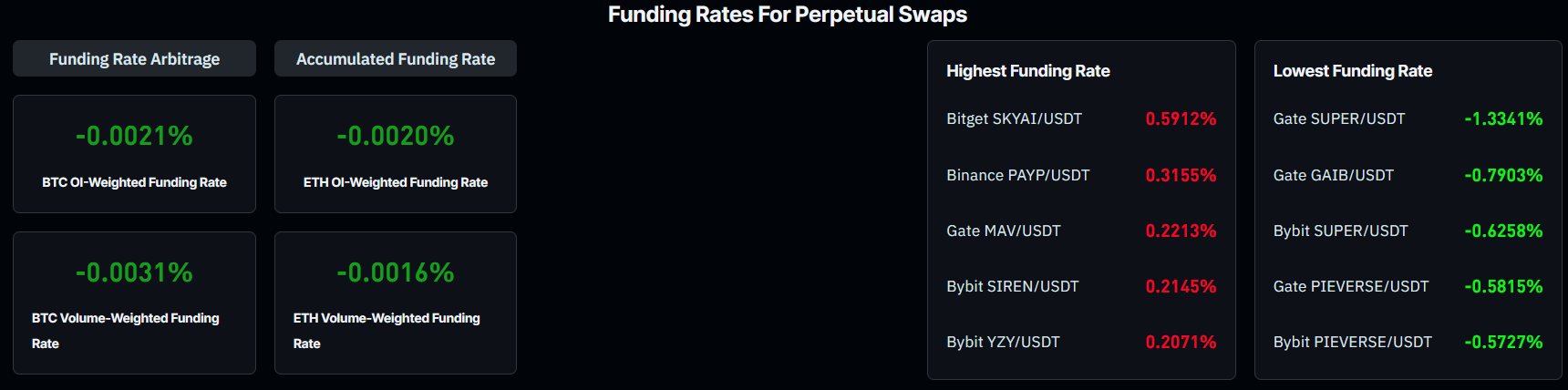
The perp swap funding rate is a small, periodic payment exchanged between long and short holders, typically every eight hours. When the perpetual swap price trades above the spot price of the underlying asset, long holders pay short holders. When it trades below spot, shorts pay longs. This ongoing incentive pushes the contract price back toward the real market price.
It’s an elegant system. The funding rate crowdsources price correction by making it financially rewarding to take the opposing side whenever a premium or discount opens.
Leverage amplifies everything
At 5x leverage, $1,000 in margin controls $5,000 in notional exposure. That cuts both ways: a 10% price move in your favor returns 50% on your margin, but a 10% move against you wipes out half of it.
Exchanges manage this risk with automated liquidation engines that close your position before losses exceed your margin, and insurance funds that absorb any shortfall if the price moves too fast for liquidation to act cleanly.
What platforms support perp trading?
The perp trading landscape splits into two categories: centralized exchanges (CEXs) and decentralized exchanges (DEXs). Both serve the same function but differ in custody, speed, and access.
Centralized perp exchanges
Binance, Bybit, OKX, and Coinbase International run the highest-volume CEX perp markets. These platforms offer fast execution, deep liquidity, and user-friendly interfaces, but they hold custody of your assets. However, over 90% of perpetual swap trading activity takes place offshore on unregulated or lightly regulated venues, according to a Coinbase request for comment to the CFTC. It remains a live regulatory risk for institutional participants.
Decentralized perp exchanges
DEXs settle trades on-chain, letting you keep custody of your assets. The tradeoff used to be speed and liquidity. That has changed dramatically.
Hyperliquid built its own Layer 1 blockchain, HyperCore, specifically for perpetual swap trading. It processes 200,000 orders per second with sub-0.2 second latency. In March 2026, it held over 30% of the total perp market, handling over $209.68 billion in monthly volume.
Other notable platforms include:
- dYdX: One of the earliest DEXs, founded in 2017, is now running on its own Cosmos-based blockchain. Supports 220+ markets with up to 50x leverage and a lifetime cumulative volume of $1.5 trillion.
- GMX: A liquidity-pool-based DEX favored by retail traders for its simple interface and multi-asset leverage. Maintained $401.5 million in total value locked as of late 2025.
- Aster: Emerged from a merger between APX Finance and Astherus, backed by YZi Labs. Hit $3.71 billion in volume on its first day of trading and grew to $408 billion in cumulative perpetual trading volume.
- Jupiter: The dominant perp DEX within the Solana ecosystem, which climbed to second place in the DEX market by the end of 2024.
How have perpetual swaps evolved?
Perp trading started purely as a crypto instrument. For the first decade, trading perpetual swaps meant trading Bitcoin, Ethereum, Solana, or some long-tail altcoin. That changed dramatically in the past 18 months.
RWA perps expand the playbook
Real-world asset perpetual swaps (RWA perps) are perpetual swap contracts written on traditional financial assets: stocks, commodities, equity indices, and currencies. A handful of DEXs began listing these in late 2024, and the category has grown faster than almost anyone expected.
By Q1 2026, weekly trading volume in tokenized asset perpetual swaps hit $30.7 billion, accounting for 1.72% of the total crypto derivatives market. Oil perpetual swaps drove $6.9 billion in a single week, fueled by geopolitical tensions. Stock perpetual swaps grew 908% to about $4.9 billion weekly.
RWA pairs made up as much as 44% of Hyperliquid’s total volume at certain points, and they’re now consistently among the highest fee-generating pairs on the exchange. Ostium, a DEX focused almost entirely on RWAs, has seen this category dominate its volume for months.
Why retail investors are driving this shift
The pattern isn’t random. Retail trading behavior across markets increasingly concentrates in short-dated, high-leverage, directional exposure. It’s the same impulse behind 0DTE options in traditional equity markets, where zero-day-to-expiry S&P 500 options reached 2.3 million contracts per day in 2025, up 51% year-over-year.
Perpetual swaps offer the same directional leverage in a format that trades 24/7 with no expiry. For a retail investor in South Korea or India who wants leveraged exposure to NVIDIA or crude oil outside U.S. market hours, a perpetual swap on a DEX is the most practical tool available.
What do 2025 and 2026 trading volumes tell us?
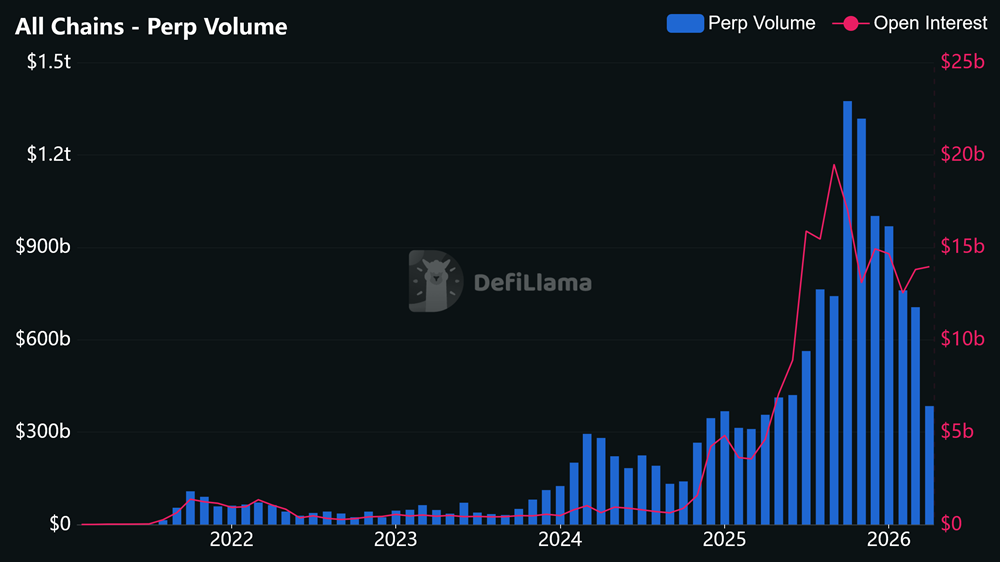
The numbers are hard to ignore. The top 10 perpetual swap exchanges processed $92.9 trillion in trading volume in 2025, a 64.6% increase from 2024. That includes both centralized and decentralized exchanges.
To put that in context: the $92.9 trillion in perpetual volume from the top 10 exchanges dwarfs total spot trading volumes across all crypto exchanges combined. CEX spot volume fell from $2.21 trillion in January 2025 to $950 billion in December 2025. Perp volumes held firm and grew during the downturn because volatility in either direction generates trading activity.
CEX perpetual swap dominance
On centralized exchanges, perpetual swap contracts accounted for 75% of total trading volume in 2025, reaching nearly $49 trillion. Spot trading on CEXs was $14.8 trillion. Options trading added $1.3 trillion. Perps weren’t just the biggest slice, they were nearly the whole pie.
DEX perpetual swaps: the real growth story
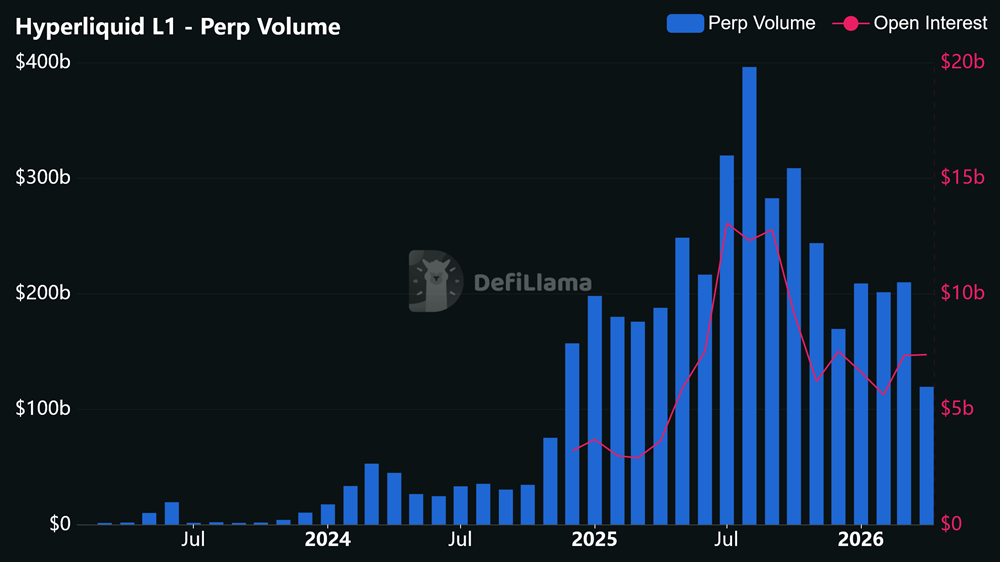
The more striking figure is on the decentralized side. Perp DEX trading volume exploded by 346% in 2025, reaching an all-time high of $6.7 trillion for the year. Monthly DEX perp volume crossed $1.2 trillion for the first time in October 2025.
Hyperliquid’s rise makes the point plainly: a decentralized platform outpaced Coinbase, a publicly traded and institutionally-backed exchange. Hyperliquid processed $2.9 trillion in 2025 against Coinbase International’s $1.4 trillion.
The direction of travel is clear. DEXs are taking share from CEXs, and perpetual swaps are taking share from everything else.
What investment opportunities exist in perp trading platforms?
If perpetual swaps are the dominant trading instrument in crypto, and DEXs are growing their share of that market at triple-digit rates, then perp trading infrastructure is where capital wants to be positioned.
Not every investor wants to operate infrastructure. For those who want direct exposure to a proven perp trading platform without running it, buying tokens OTC from early holders is a legitimate route.
Hyperliquid is the most compelling example in the perp space right now. Its eleven-person team generates millions in monthly profit without the support of venture capital investors or private funding rounds. The founders self-funded the project entirely and directed 76.2% of the total token supply to community initiatives instead of early investors.
The HYPE token launched on November 29, 2024, through one of the largest airdrops in crypto history. It distributed over 310 million tokens to approximately 94,000 users, worth more than $1.6 billion, and the price climbed from around $4 to $35 within weeks. The economic model links platform performance directly to token value: 99% of all trading revenue goes toward buying back and permanently removing HYPE from circulation.
Hyperliquid tokens from early holders and project members are listed for sale in Acquire.Fi, with a minimum ticket size of $2 million. Investors can buy HYPE tokens OTC by engaging with existing orders or submitting a new offer with their preferred valuation and token amount.
This is the pre-IPO stock equivalent for crypto infrastructure. You’re not buying a company or operating a platform. You’re buying exposure to a market leader that outpaced a publicly traded exchange in annual volume, at a price negotiated directly with early holders rather than through a liquid exchange order book.
Why the timing still makes sense
Decentralized derivatives platforms are projected to grow, and the competitive landscape is early enough that infrastructure acquisitions and token positions can still be genuinely differentiated rather than commodity purchases. Regulatory frameworks from the CFTC and SEC are actively evolving around perpetual futures, which means compliant infrastructure will increasingly matter to institutional buyers and exchange operators.
The window where early-stage and established perp trading platforms can still be accessed is narrowing. The trajectory of the market makes that plain.
If you’re evaluating perp trading platforms as an acquisition target, investment, or OTC token opportunity, browse active listings on our marketplace or reach out to our team to discuss buy-side search services tailored to crypto infrastructure.




.webp)