.webp)

We analyzed 720 M&A transactions publicly announced between April 1 and June 30, 2026 and cross-checked against primary company filings and press releases.
Key takeaways:
- Software owned the volume. 254 SaaS deals plus 135 AI-as-a-feature software deals made up 54% of all 720 transactions, even after January's "SaaSpocalypse" selloff repriced public software.
- The quarter started slow and then ran hard. April was the quietest month at 132 deals before May jumped to 299 and June landed at 289.
- Most values stayed hidden. Only 141 of the 720 deals disclosed a price, yet those alone totaled roughly $324 billion in upfront consideration.
- Buyers kept it simple and kept it local. 590 deals (82%) were straight full acquisitions, and 523 of 720 were domestic.
- Energy topped the leaderboard because electricity is the new bottleneck. NextEra Energy's roughly $67 billion combination with Dominion Energy led the quarter, and SWI Group paid $500 million for Bitcoin miner Genesis Digital Assets purely for its 1.3 gigawatts of grid hookups.
- Startups became acquirers. Sierra bought Fragment, Mistral AI bought Emmi AI, Cyera bought Ryft Data and Genie Security, and 1Password bought Apono.
- AI hardware M&A skipped the chipmakers entirely. Not one deal involved a GPU maker. The money went to power delivery, optical interconnect, and edge silicon.
- Blockchain M&A went institutional. Of 16 digital-asset deals, the largest checks bought regulated businesses, including Figure Technology Solutions paying $717 million for lender Kiavi and MoonPay making five acquisitions.
- Where smart money is heading: power, bandwidth, compute real estate, deployment talent, compliant financial rails, and cash-generative software marked down by the selloff.
The biggest surprise in M&A activity during the second quarter of 2026 was not the headline-grabbing energy megamergers. It was software changing hands faster than anything else and a wave of well-funded startups buying smaller startups to grow by acquisition instead of hiring.
That matters because it shows where deal volume actually lives. If you run a startup, back one, or study the market, the quarter shows the real action is in software consolidation and startup-on-startup buyouts, not the ten-figure transactions dominating the news.

The numbers back it up. Software was the most active category, with 254 SaaS plus 135 AI-as-a-feature software deals making up 54% of all transactions. That held even after a brutal software selloff earlier in the year, showing private buyers saw the crash as a discount rather than a warning.
How fast did M&A move in the second quarter of 2026?
The pace built through the quarter and then held. April was the quietest month with 132 announced deals. May jumped to 299, and June came close behind at 289.
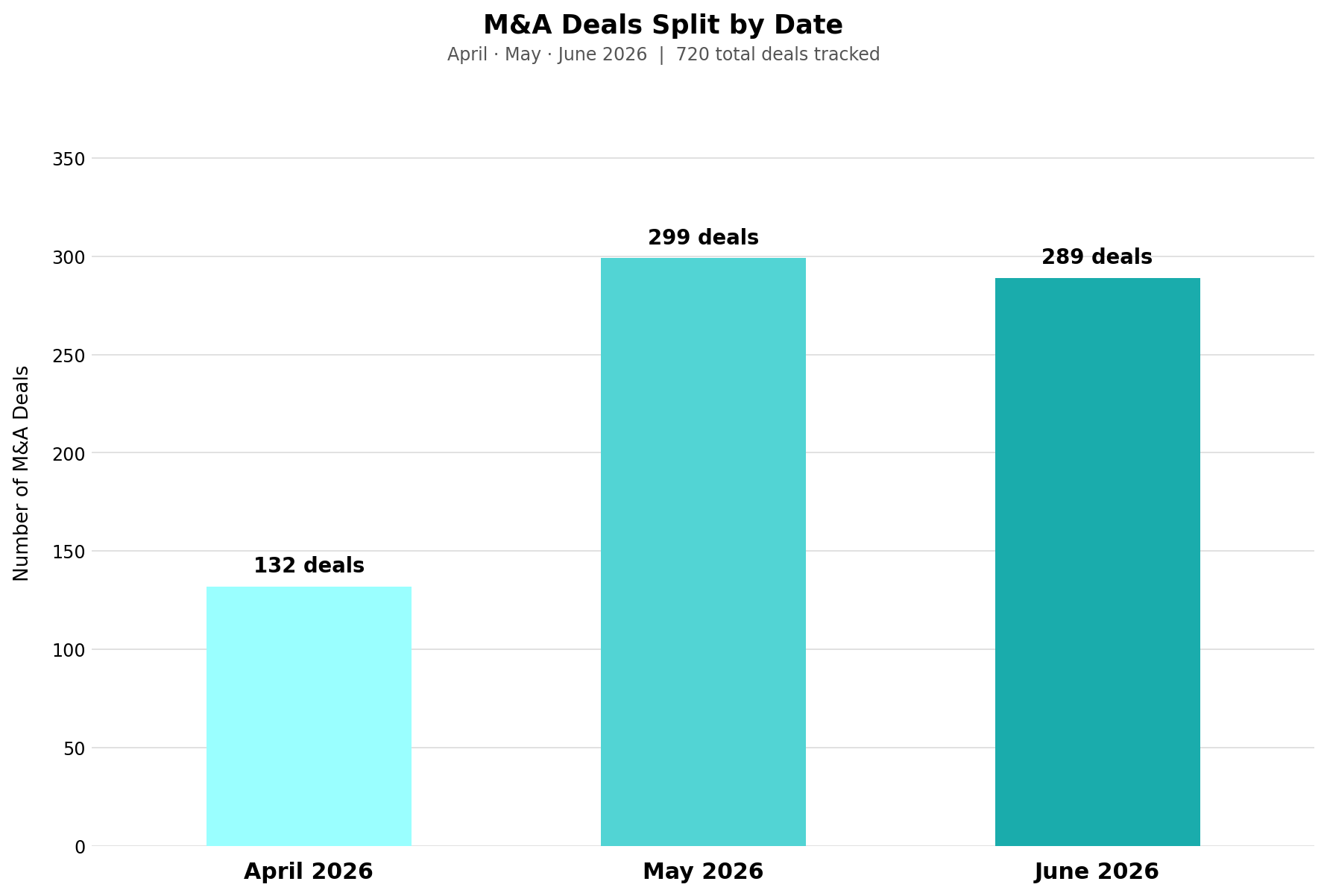
That trend is not random. Tariff headlines and rate uncertainty overshadowed April, so dealmakers waited. Once boards saw the volatility was survivable, they moved, and the back half of the quarter carried the volume.
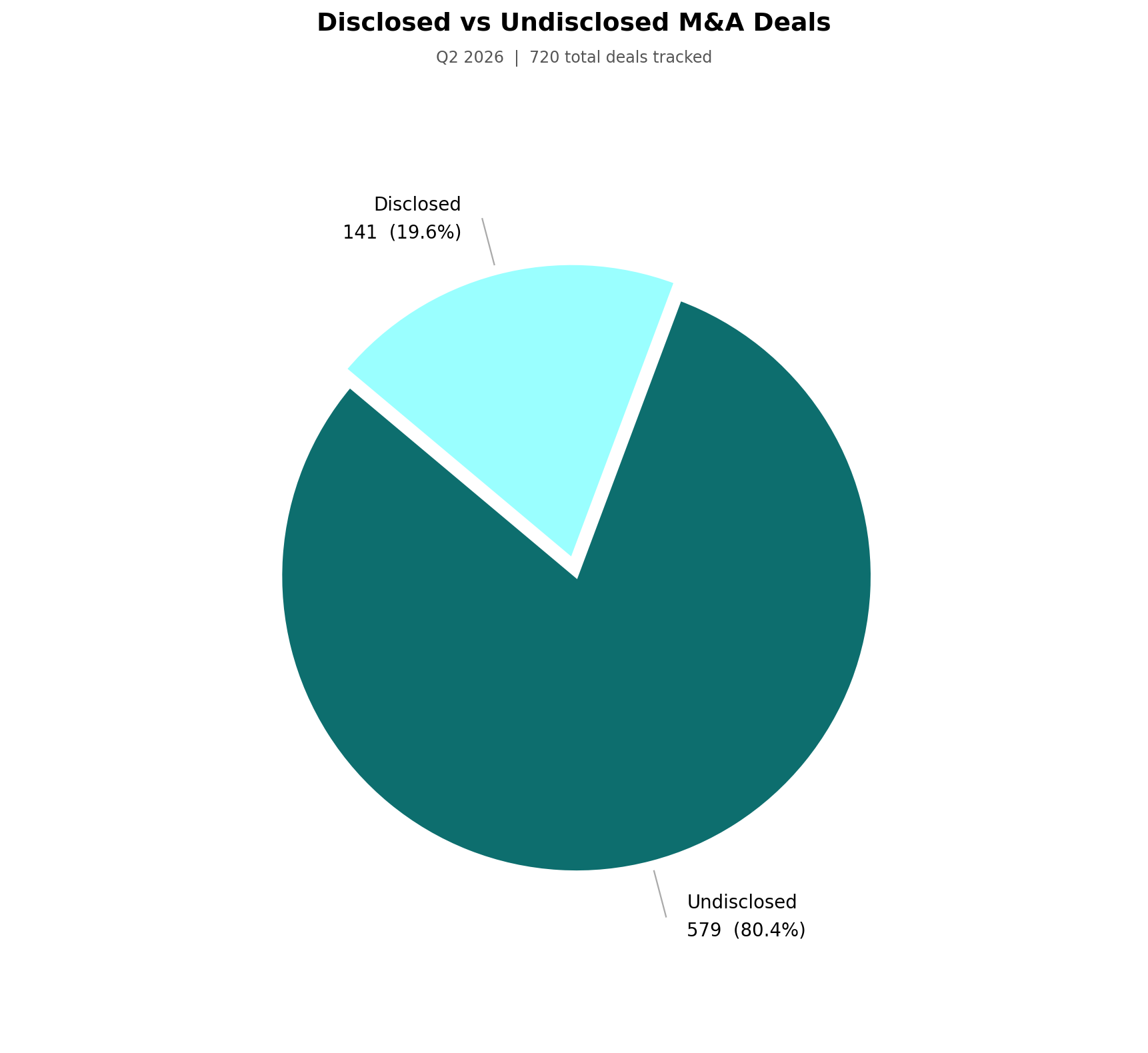
Only 141 of the 720 deals, about one in five, had a disclosed dollar figure. The rest were undisclosed, which is normal for the long tail of private equity bolt-ons and founder-led acqui-hires that make up most of any quarter's list. Even with most values hidden, the disclosed deals alone totaled about $324 billion in upfront consideration.
What deal structures defined the quarter?
Plain-vanilla full acquisitions dominated. Of the 720 transactions, 590 were straightforward acquisitions, about 82% of the total. When a buyer wanted an asset in the second quarter, they usually bought it outright.
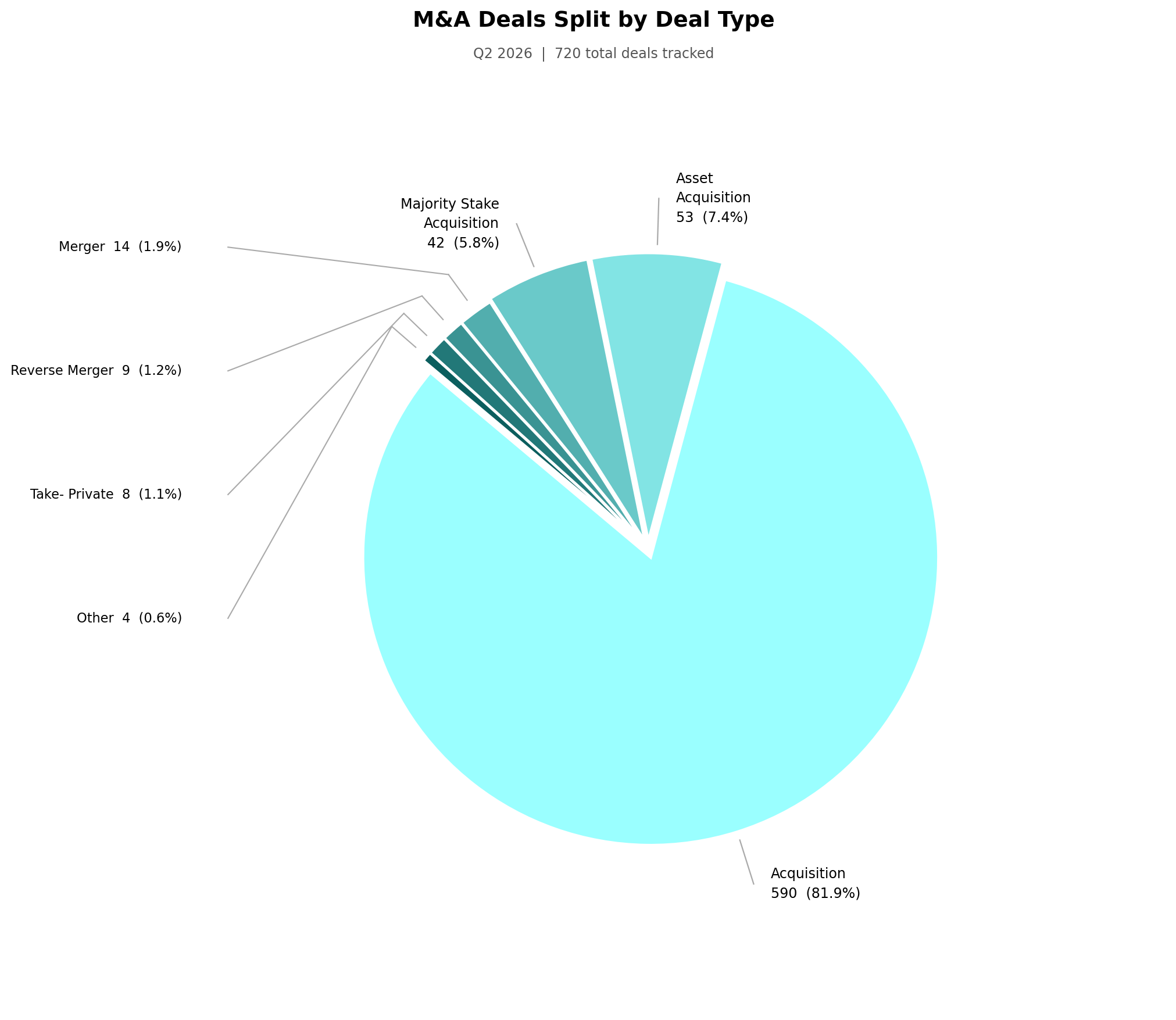
The rest of the structures fill in the strategy behind the numbers. There were 53 asset acquisitions, 42 majority-stake purchases, 14 mergers, 9 reverse mergers, and 8 take-privates. Each of those formats signals a different motive, from carving out a single business line to taking a beaten-down public company off the market entirely.
Reverse mergers and de-SPAC deals also showed up more than usual, with battery maker ProLogium, Terra Quantum, and EigenQ all using SPAC combinations to reach public markets. When traditional IPO windows feel narrow, a reverse merger becomes the side door onto a public listing.
Which countries drove M&A in the second quarter of 2026?
The United States drove almost everything. American companies were the acquirer in 408 of the 720 deals, about 56% of all activity, and American businesses were the target in 387 deals. On both sides of the table, the second quarter ran through the US.
Most deals stayed inside one country's borders. Domestic transactions outnumbered cross-border ones 523 to 197, so about 73% of the quarter's M&A involved buyers and sellers in the same nation. Companies reached for targets they knew in regulatory regimes they understood rather than betting on complex international integrations.
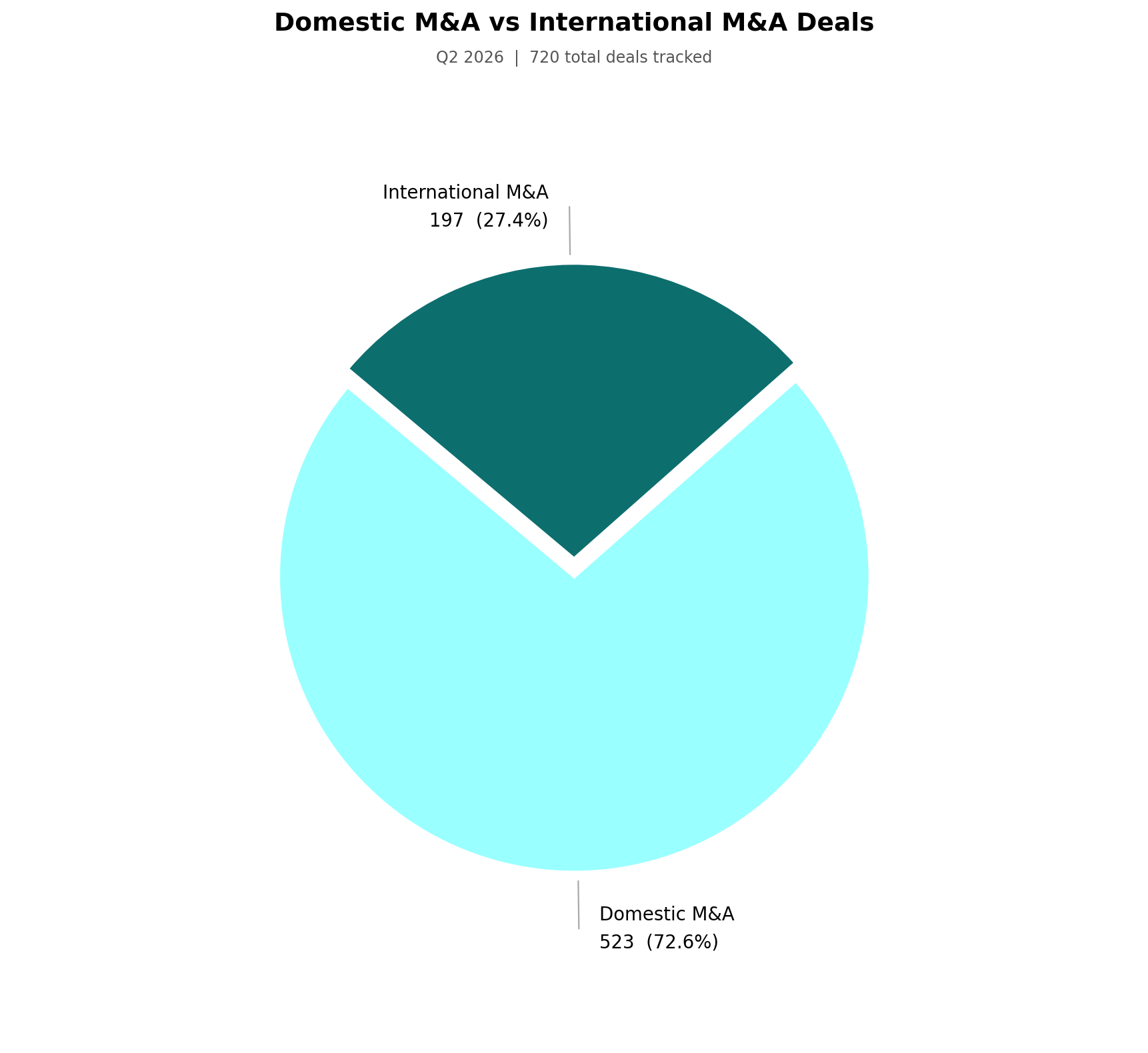
Outside the US, the United Kingdom led with 67 acquirers and 63 targets, followed by Germany with 29 acquirers and 30 targets. Israel punched above its size with 12 targets, many of them cybersecurity and AI startups bought by other Israeli firms.
This home-market bias is a direct response to geopolitics. With tariffs, export controls, and national-security reviews all in play, a domestic deal is faster to close, and speed has real value when a competitor might grab the same asset.
For a founder in Europe or Asia, the read-through is blunt. The deepest pool of well-capitalized buyers still sits in the US, and building relationships there widens your eventual exit options.
What were the biggest M&A deals in the second quarter of 2026?
Energy and AI sat at the very top. The largest deal of the quarter was NextEra Energy's roughly $67 billion all-stock combination with Dominion Energy. The deal was announced on May 18 and built to create the world's largest regulated electric utility, with about 10 million customer accounts and 110 gigawatts of generation.
Right behind it came the strangest entry on the list. SpaceX agreed to buy Cursor parent Anysphere for $60 billion in an all-stock deal, widely described as the largest acquisition of a venture-backed startup ever recorded. A private AI-coding company rivaling a public utility megamerger in size is not something you see in a normal quarter.
The rest of the top tier is a clean read of investor priorities. Here is how the ten largest disclosed deals stacked up:
- NextEra Energy and Dominion Energy, about $67.0 billion, energy and utilities
- SpaceX and Cursor (Anysphere), $60.0 billion, artificial intelligence software
- Fox Corporation and Roku, $22.0 billion, media and streaming
- ENGIE and UK Power Networks, $14.2 billion, energy and utilities
- Sun Pharmaceutical and Organon, $11.8 billion, pharmaceuticals
- Amazon and Globalstar, $11.5 billion, satellite connectivity
- Merck KGaA and Bio-Techne, $11.3 billion, life sciences
- AbbVie and Apogee Therapeutics, $10.9 billion, biotech
- Rocket Lab and Iridium Communications, $8.0 billion, space
- onsemi and Synaptics, $7.0 billion, AI hardware
Three of the top eight are energy or utility megamergers, and three more are pharma or biotech. That is no coincidence. Power and healthcare are the two sectors where scale still delivers durable pricing and cash flow, so they attract the biggest checks.
Why are startups buying other startups?
Well-funded startups became acquirers themselves, one of the defining moves of the quarter. Instead of building every capability in-house, a startup that had raised serious venture money used acquisitions to bolt on talent and technology fast.
The AI agent startup, Sierra, bought Fragment. Mistral AI bought Emmi AI. Data-security unicorn Cyera bought both Ryft Data and Genie Security. Password manager 1Password bought Apono. Each buyer was itself a startup, just a more mature one with capital to spend.
The logic is speed. In fast-moving categories like AI security and agent infrastructure, a year spent building internally can mean losing the market. So a startup pays cash and stock to skip the wait. For founders, that creates a real exit path that does not depend on a traditional strategic buyer or a public offering.
This is the venture ecosystem healthily eating its own young. Winners consolidate the field early, and the smaller teams get liquidity and a bigger platform.
Did SaaS M&A survive the SaaSpocalypse?
When Anthropic launched Claude Cowork in January 2026, investors started repricing the risk that AI agents could erode per-seat software revenue. The selloff that followed got nicknamed the "SaaSpocalypse."
Software M&A survived, but it changed character. SaaS was still the single most active category in the quarter, with 254 SaaS deals plus another 135 in AI-as-a-feature software, together 54% of all 720 transactions. So the deal engine kept running even after the public-market panic.

The crash landed on top of a pre-existing weakness rather than appearing from nowhere. Growth in software subscription revenue had been slowing for about three years, companies were cutting the number of apps they ran, and late-2025 earnings had already come in soft. Cowork was the spark, not the whole fire.
Public software equities took real damage. Salesforce traded down roughly a third from its highs during the worst stretch, and it was not alone across the sector. If you held a software index in early 2026, you felt it.
Yet the private M&A market never froze. Salesforce, even while its own stock was under pressure, went shopping and signed a $3.6 billion deal to acquire the AI customer agent company Fin, formerly Intercom, whose agent handles customer queries end to end across chat, messaging apps, phone, and Slack. The same buyer also agreed to acquire the content platform Contentful in the same window.
Other incumbents did the same. Autodesk agreed to buy the maintenance software company MaintainX for about $3.6 billion, a sign that legacy software players are paying up to add modern, AI-native workflows rather than watch startups take the market.
Public SaaS multiples compressed, private strategic and private equity buyers treated that as a discount, and deal value held up even as the market mood soured. A repriced public market is a buying opportunity for anyone with conviction and cash, and the software crash proved it again.
Why is energy industry M&A heating up?
Energy and power M&A is heating up because electricity, not silicon, is now the scarcest resource in AI. The buys in this category were about securing power and physical infrastructure, and the strategic logic traces straight back to the grid.
The numbers behind that demand are staggering. The International Energy Agency reports that data-center electricity demand rose 17% in 2025, with AI-focused facilities climbing 50%, and it expects total data-center consumption to double by 2030.
The United States is the epicenter of that demand. The US accounted for about 45% of global data-center electricity consumption in 2024, which is exactly why the quarter's largest deal was a utility merger. NextEra and Dominion combined specifically to serve large-load data-center customers in fast-growing states.
The cleverest energy deal of the quarter was disguised as a crypto deal. SWI Group paid $500 million for the Bitcoin miner Genesis Digital Assets purely for its electricity, since the miner controls 1.3 gigawatts of live and approved grid hookups spread across 15 US sites. The plan is to flip that mining capacity over to high-performance computing and AI work.
That deal captures the whole thesis in one sentence. Grid connections are now the prize, and buyers will acquire a company in an entirely different business to inherit its power contracts. If you want to understand where AI money flows next, follow the megawatts.
What is driving AI hardware M&A?
AI hardware and semiconductor M&A had almost nothing to do with chips themselves. Not one deal in the quarter involved a GPU maker. The real theme was AI infrastructure enablement, the unglamorous supporting parts that let AI chips actually run.
Power delivery was the standout. Analog Devices agreed to acquire Empower Semiconductor for $1.5 billion to grab its work in voltage regulation and silicon capacitors, because feeding power to AI chips has become one of the hardest problems in data-center design. One rack of AI training silicon now pulls between 120 and 140 kilowatts, and next-generation racks are expected to run past 200 kilowatts, so getting clean power to the chips is now as important as the chips themselves.
Optical connectivity was the second theme. Marvell acquired the plasmonics photonics company Polariton Technologies to push optical interconnects toward 3.2 terabits and beyond, its second acquisition of 2026. As AI workloads explode, moving data between chips fast enough becomes a bottleneck, and light beats copper for that job.
The biggest chip-adjacent deal was about edge intelligence. onsemi agreed to buy Synaptics for $7 billion, positioning the combined company at the intersection of power, sensing, connected compute, and control, the pillars of what the industry calls "physical AI." onsemi framed the deal as growing its addressable market by $30 billion by 2030.
Notice the recurring corporate logic. Component vendors are climbing toward becoming full systems providers, moving from selling parts to selling complete intelligent systems.
For an investor, the takeaway is to stop watching only the chipmakers. The value in this cycle is accruing to the companies that solve the power, bandwidth, and packaging bottlenecks around the chips.
How are AI platforms consolidating?
AI platform consolidation ran on four distinct plays, and each one tells you something about the state of the market. The common thread is that buyers are racing to own the layers where lock-in and margin live.
The first play is chip companies buying the software layer. Qualcomm agreed to acquire Modular for about $3.9 billion, a company whose software lets AI models run across different chip architectures without rewriting code. Silicon vendors have concluded that the software layer is where customers get locked in, so they are buying their way into it.
The second play is the rush to buy deployment talent. Model labs and IT services firms both spent the quarter acquiring engineers who can actually get AI systems running inside enterprises. When OpenAI bought the consultancy Tomoro for roughly 150 engineers, it was buying hands-on deployment muscle, not a product, because wrangling AI agents in the real world is still hard and scarce.
The third play is agent consolidation in customer-facing work. The Salesforce deal for Fin anchors this trend, folding an autonomous customer-service agent and its 30,000-plus business customers into a legacy platform. One reading is that per-seat software is acquiring its path to results-based pricing before the old seat model erodes.
The fourth play is securing AI as its own deal category. Roughly eight transactions in the quarter, from 1Password buying Apono to Databricks buying Panther Labs, were about protecting AI systems and the data around them. A new technology always spawns a new security market, and buyers move early to claim it.
AI M&A also skewed more domestic than international, with cross-border deals making up only about 15% of AI software transactions versus 20% file-wide. When talent and IP are the assets, buyers prefer targets in their own jurisdiction. For founders in AI infrastructure, security, or deployment services, that concentration of buyers is your exit map.
What is happening in the space industry M&A?
Space M&A in the quarter was a public-market activity built almost entirely on vertical integration. Disclosure ran unusually high, around 75% of space deals named a price, because nearly every buyer was a listed company with filing obligations. Rocket Lab, York Space Systems, Voyager, Gilat, and Intuitive Machines all reported numbers.
The deals were small and componentry-focused rather than headline-grabbing platforms. Buyers picked up subsystems and supply chains, from robotic arms to space solar cells to ground stations, with a median disclosed value around $58 million. The strategy was to pull scarce parts in-house rather than depend on stretched suppliers.
Vertical integration was the dominant thesis. Rocket Lab acquired Motiv Space Systems to bring supply-constrained spacecraft components like solar array drive assemblies in-house, then went much bigger with its $8 billion agreement to acquire the satellite operator Iridium Communications and own an entire network. Voyager took the same logic toward a full-stack lunar business with its purchase of Astrobotic.
Supply-chain sovereignty was the second thesis, and it was explicitly about China. York Space Systems framed its purchase of the space-solar-cell maker Solestial as securing a domestic source for a capability where the industry remains exposed to Chinese-controlled gallium, germanium, and polysilicon. National security is now a deal rationale, not a footnote.
Private equity showed up in space for what looks like the first time, with EQT acquiring Berlin-based Exolaunch through its flagship fund. When buyout firms enter a sector, it is a signal that the cash flows have matured enough to underwrite, and defense demand from programs like Golden Dome and Artemis is doing exactly that.
Where is blockchain M&A headed?
Blockchain M&A is heading toward regulated financial infrastructure, and the buyers are increasingly traditional. We flagged 16 blockchain and digital-asset deals across sectors, and the money went overwhelmingly into tokenization and compliant rails rather than speculative protocols.
The most acquisitive buyer in Q2 2026 was a crypto payments company. MoonPay made five separate acquisitions in the quarter, and it opened with a $100 million all-stock deal for the key-management firm Sodot that became the foundation of a new institutional division led by a former acting chair of the US Commodity Futures Trading Commission. That is a fiat on-ramp deliberately rolling up into full-stack, institution-grade infrastructure ahead of a reported IPO.
Tokenization is where the largest checks landed, and it means buying conventional regulated businesses. Figure Technology Solutions agreed to pay $717 million for the lending platform Kiavi, and expects the platform to bring roughly $7 billion of yearly volume to a company that already handles a large share of real-world asset tokenization. Nobody is paying these prices for protocols. They are buying transfer agents and loan originators.
Traditional buyers arriving is the tell. Deloitte rolled the infrastructure firm Blocknative into its enterprise blockchain division and put a Big Four name into the crypto column for the first time in Q2 2026.
What are founders, investors, and dealmakers saying about 2026 M&A?
We polled the people actually closing M&A deals, who describe a market where talent is the prize and valuation is the fight. Their view from the front lines matches the data: buyers want AI-native teams fast, and the biggest thing slowing deals down is that nobody can agree on what an AI startup is worth.
The biggest surprise is buyers purchasing teams, not products
The standout shock of 2026 has been acquisitions that are really talent grabs. Runbo Li, co-founder and CEO of Magic Hour, saw it up close:
"The volume of acqui-hires disguised as acquisitions. I expected more traditional product acquisitions, but what's actually happening is larger companies buying 3-to-8 person AI teams purely for talent, then shelving the product entirely. A founder I know sold his company for north of $20M in Q1. The acquirer killed the product within 45 days. They wanted the engineers who knew how to ship AI-native products fast."
That trend is changing how founders think about their own companies. Sahil Agrawal, founder and head of marketing of Qubit Capital, sees it in who walks through his door:
"30 early-stage founders sit down with us in a normal month before we take them to investors, so the thing that surprised me this year is who is asking about being bought. Founders who came to us in January wanting a seed round are asking in July how to look acquirable."
In the lower middle market, the surprise ran the other way. Joe Braier, CEO and president of Lake Country Advisors, watched sellers finally accept realistic pricing:
"The sellers finally got the message. Owners played for 2021 multiples for three years. This year listings are priced within half a turn of EBITDA of where deals actually close and it took 30 months to close that half turn."
The biggest challenge is valuations nobody can agree on
Valuation gaps stalled deals through the first half. Here is Runbo Li again:
"Sellers are anchored to 2021 multiples because their AI metrics look explosive on paper. Buyers are looking at retention curves and saying 'prove this isn't a novelty.' I've watched at least three deals in our orbit stall for months because neither side could agree on what 'growth' means when your product is six months old and riding a wave of curiosity traffic."
The spread is widening, not closing. Rick Elmore, CEO of Simply Noted, sees it in his inbound:
"Valuation expectations are completely disconnected from fundamentals for anything with 'AI' in the pitch deck. We get inbound from aggregators and roll-up funds pretty regularly at Simply Noted. The spread between what buyers want to pay and what sellers expect has gotten wider, not smaller, in 2026."
Once a deal closes, the talent war makes integration its own battle. Vera Sun, CEO of Wonderchat, learned that the hard way:
"We bought a few small teams to plug product holes, and it worked. But the first six months were a grind. Due diligence and merging workflows was a pain, mostly because everyone is fighting for AI talent right now. If you do this, figure out the team structure fast. If you don't, your best engineers will quit."
AI as a feature is fueling a bolt-on wave
Incumbents are buying small AI teams to bolt a capability onto products they already sell. Kevin Lourd, founder of Distribute.You, sees the demand directly:
"Because our own platform handles outbound sales volume autonomously, I see firsthand how hungry legacy software platforms are for that exact hands-off capability. Instead of trying to build agentic workflows and training models from scratch, larger incumbents are just buying smaller, specialized AI teams to bolt automated reasoning directly onto their existing products."
In the lower middle market, buyers pay for results rather than the technology itself. Joe Braier makes the distinction plainly:
"In my market it's not the same as the headlines. Buyers pay more for distributors and manufacturers that have automation in quoting or scheduling. No one in the low middle market purchases AI. They purchase margin proof already created by AI."
What the operators expect in the second half of 2026
Expect more of the same, with a warning attached. Kevin Lourd predicts the acqui-hire streak continues:
"We will likely see a continued streak of acqui-hires and strategic bolt-ons, where legacy tech companies quietly swallow up early-stage AI startups specifically to plug automation gaps in their own legacy platforms."
Joe Braier expects the gap between clean and marginal businesses to widen through year-end:
"Volume increases slightly, while quality spreads increase. Recurring revenue companies will be clean in no time. Marginal businesses will sit for 9-12 months. The second half is the long run, which is for the prepared seller, not the hopeful seller."
Hayat Amin, founder of Beyond Elevation, expects most AI-as-a-feature deals to disappoint:
"I have sat on both sides of a deal table, and the number that matters is not the headline price, it is how much of the target walks out the door inside 18 months. Most of these AI as a feature buys will quietly get written down, because the acquirer bought a roadmap slide, not a moat. My call for Q3 and Q4 is fewer megadeals and a lot more quiet tuck ins, because boards have stopped believing that bolting AI onto an old product creates value."
Where is smart money going next?
Smart money is heading toward the foundations of the AI economy and toward software it can buy at a discount. Read the quarter as a whole and the destinations are clear: power, bandwidth, compute real estate, deployment talent, compliant financial rails, and cash-generative software marked down by the selloff.
The energy thesis is the strongest signal. When the two largest deals of the quarter, an all-stock utility merger and a Bitcoin miner bought for its grid connections, both come down to electricity, the market is telling you that whoever controls power controls the pace of AI. Capital is chasing megawatts.
The second destination is the picks-and-shovels layer around AI chips. Buyers are paying premiums for power delivery, optical interconnect, edge silicon, and the software that ties architectures together, because that is where the durable bottlenecks and lock-in sit. The same PwC mid-year analysis found AI cited in only 17% of the top 100 first-half deals, down from about a third in 2025, which means buyers are getting selective about where AI actually creates lasting value.
The third destination is software the market just put on sale. Public SaaS multiples compressed hard after the January selloff. Yet private equity firms and strategic buyers kept acquiring software companies with real recurring revenue, treating the drop as a buying window. When a single category makes up 54% of all deal activity even during a crash, the money is signaling that durable software cash flow is cheap right now, not finished.
Here is the practical playbook for the rest of 2026. If you invest, lean toward the enablers of AI infrastructure and discounted software with real recurring revenue, rather than speculative apps that still burn cash.
If you are a founder in AI security, deployment services, power technology, or profitable SaaS, buyers are actively hunting in your lane, so build with an exit in mind.
If your focus is crypto and fintech specifically, the consolidation wave is only starting, and having a dedicated deal platform is now table stakes. Acquire.Fi runs a marketplace purpose-built for crypto and fintech M&A, connecting qualified buyers and sellers so you can act on this window while it is open. The quarter proved that fortune favors the acquirer with conviction and cash, and the next quarter will reward the ones who moved first.
Sources
- NextEra Energy and Dominion Energy to Combine - https://newsroom.nexteraenergy.com/2026-05-18-NextEra-Energy-and-Dominion-Energy-to-Combine,-Creating-the-Worlds-Largest-Regulated-Electric-Utility-Business-and-North-Americas-Premier-Energy-Infrastructure-Platform-Benefiting-Customers
- SpaceX to Buy Cursor Parent Anysphere for $60 Billion - https://www.cnbc.com/2026/06/16/spacex-spcx-cursor-acquisition-ipo.html
- Fox Corporation to Acquire Roku - https://www.foxcorporation.com/news/corp-press-releases/2026/fox-corporation-to-acquire-roku-in
- Salesforce Signs Definitive Agreement to Acquire Fin - https://www.salesforce.com/news/press-releases/2026/06/15/salesforce-signs-definitive-agreement-to-acquire-fin/
- Salesforce Signs Definitive Agreement to Acquire Contentful - https://www.salesforce.com/news/stories/salesforce-signs-definitive-agreement-to-acquire-conten/
- Autodesk to Acquire MaintainX - https://adsknews.autodesk.com/en/news/autodesk-to-acquire-maintainx-advancing-unified-platform-
- onsemi to Acquire Synaptics - https://www.onsemi.com/company/news-media/press-announcements/en/onsemi-to-acquire-synaptics-to
- Analog Devices to Acquire Empower Semiconductor - https://investor.analog.com/news-releases/news-release-details/analog-devices-acquire-empower-s
- Marvell Acquires Polariton, Advancing the Future of Optical Interconnects - https://www.marvell.com/company/newsroom/marvell-acquires-polariton-advancing-future-of-optical
- Qualcomm Acquires Modular - https://www.manufacturingdive.com/news/qualcomm-acquires-modular-AI-data-centers-semiconductors
- SWI Group Expands Transatlantic Digital Infrastructure (Genesis Digital Assets) - https://www.prnewswire.com/news-releases/swi-group-expands-transatlantic-digital-infrastructure
- Rocket Lab to Acquire Robotics Leader Motiv Space Systems - https://rocketlabcorp.com/updates/rocket-lab-to-acquire-robotics-leader-motiv-space-systems/
- Rocket Lab to Acquire Iridium Communications - https://www.globenewswire.com/news-release/2026/06/29/3318842/0/en/Rocket-Lab-to-Acquire-Iridium
- MoonPay Acquires Sodot, Launches MoonPay Institutional - https://www.moonpay.com/newsroom/moonpay-institutional
- Figure Enters Agreement to Acquire Kiavi - https://investors.figure.com/news-releases/news-release-details/figure-enters-agreement-acquire




.webp)