.webp)

Real-world asset perpetual futures, also called RWA perpetuals, are futures contracts whose underlying price comes from a real-world asset rather than a cryptocurrency. Think gold, the S&P 500, crude oil, Apple stock, or the euro/dollar currency pair. Instead of buying the underlying asset or a token that represents it, you take a leveraged position on its price movement using a crypto-native derivatives structure.
The keyword is perpetual. Unlike traditional futures on the Chicago Mercantile Exchange, these contracts have no expiration date. You can hold them as long as your margin holds up. Think of them as a continuous bet on price direction, the same mechanics as crypto perpetual swaps but applied to real-world markets.
Settlement happens in stablecoins, typically USDC. The price feed comes from blockchain oracles, which are data providers that relay real-time market prices on-chain. No broker. No clearing house. No expiry date to manage.
What problem does RWA perpetuals solve?
Traditional financial markets are built for institutions, not people. Getting into a CME gold futures contract means clearing a brokerage application, meeting capital thresholds, and trading within a window that closes every evening and stays shut all weekend. The system was designed that way on purpose and has always favored players already inside it.
RWA perpetuals break that model entirely.
Access was always the barrier
More than half the world’s adult population has no access to regulated securities markets. Even in developed markets, retail traders face restrictions on leverage, short selling, and after-hours trading that institutional desks do not. Real-world assets perpetual futures remove those gatekeepers by running on permissionless blockchain infrastructure, so anyone with a wallet and USDC can use them.
Traditional markets close but global events don’t
Gold hit an all-time high above $5,500 per ounce in early 2026. Silver broke $121 per ounce. Both moves happened over weekends and overnight sessions when traditional futures exchanges were closed. On Hyperliquid alone, daily precious metals perps volume topped $1.3 billion during those spikes. Traders reacted in real time to macro events traditional market participants had to sit out until Monday morning.
That timing asymmetry is not a minor inconvenience. It is a structural disadvantage that RWA perpetuals directly fix.
Who is this for?
RWA perpetuals are built for a specific kind of trader. These products are a strong fit for you if any of the following apply:
- Crypto-native traders who want macro exposure without opening a separate brokerage account. You already understand perp mechanics; you just need new markets.
- DeFi users who hold stablecoin positions and want to hedge purchasing power against inflation or currency risk via RWA swaps and perpetual contracts.
- Retail investors outside the US who face restrictions on direct equity or commodity investing. Kraken’s xStocks perpetual futures are available to eligible clients in over 110 countries.
- Professional traders looking for basis trades, carry strategies, or cross-asset hedging tools that bridge on-chain and traditional finance exposure.
You don’t need a Bloomberg terminal, a prime brokerage relationship, or a six-figure minimum. A wallet and a stablecoin balance is enough.
How does it work?
RWA perpetuals run on the same mechanical foundation as crypto perps, with a few asset-specific layers added on top.
The oracle layer feeds the contract price
Instead of a crypto exchange order book, the price reference for an RWA perpetual comes from a blockchain oracle. Providers like Stork Network pull real-time data from global markets and push it on-chain with millisecond latency. The smart contract uses this feed to mark positions, calculate unrealized gains and losses, and trigger liquidations.
RWA oracle design is complex. Gold has trading hours. Stocks have earnings blackouts. Currency pairs have bid-ask spreads that widen at low-liquidity windows. A well-built oracle embeds market hours, spread data, and asset-specific logic directly into its price reports as core infrastructure.
The funding rate keeps perp price tethered to spot
Perpetual contracts use a funding rate mechanism to stop the perp price from drifting too far from the underlying asset’s spot price. Think of funding as a periodic payment between longs and shorts. When the perp price runs above spot, longs pay shorts. When it falls below, shorts pay longs. This creates a continuous economic pull toward fair value. It works like crypto perps but applied to commodities or equities.
Positions settle in stablecoins
You deposit USDC as collateral. Your profit and loss is denominated in USDC. There is no wrapped version of the underlying asset to manage, no custody, and no transfer restrictions. The contract is purely synthetic. If you are long gold perps and gold rises 5%, your USDC balance reflects that gain directly.
How does it differ from regular tokenized RWAs?
This distinction trips up many people and matters because the two products serve completely different purposes.
Tokenized RWAs, like tokenized Treasury bills or tokenized gold on Ethereum, give you actual on-chain ownership of the underlying asset. Kraken’s xStocks framework is a good example: each tokenized security maps directly to a real equity position held in custody, so what you hold on-chain represents something physically secured off-chain.
RWA perpetuals are different. You don’t own anything. You hold a leveraged synthetic position on the asset’s price movement. The underlying is never on-chain. Only the price feed is.
Here is the simplest way to frame the difference: tokenized RWAs are for asset holders. RWA perpetuals are for traders. The tradeoffs break down like this:
- Tokenized RWA: Real ownership, no leverage, often requires KYC and custody infrastructure.
- RWA perpetual: Synthetic exposure, up to 100x leverage on some platforms, permissionless entry, no expiration date, USDC-settled.
If you want yield from a Treasury bond, buy the tokenized version. If you want to trade the bond market direction with leverage, the perp is your tool.
What are the risks of RWA perpetuals?
RWA swaps and perpetuals carry real risks. Going in without understanding them is genuinely a bad idea.
Liquidation risk is fast and unforgiving
Leverage amplifies losses as much as gains. Use 20x leverage on a gold position and gold drops 5%, your position is gone. On-chain liquidations are automated and immediate. There is no margin call, no grace period. Know your liquidation price before you open anything.
Oracle risk can create bad fills
The entire contract depends on the oracle being accurate and manipulation-resistant. If a price feed is exploited or goes stale during a low-liquidity window, your position can be liquidated at an inaccurate price. This is not theoretical. Research the oracle infrastructure behind any platform before depositing capital.
Funding rates compound against long-term holders
In trending markets, funding rates on the dominant side can become expensive over time. If you are long gold in a sustained bull run and positive funding persists, costs compound. RWA perpetuals are built for active trading, not passive holding.
Regulatory uncertainty is still real
Many platforms restrict Americans from accessing RWA perpetuals. Kraken’s xStocks perps are offered through Payward Digital Solutions Ltd., a Bermuda Monetary Authority-licensed entity. This shows the industry is moving toward regulated structures, but the legal landscape is not fully settled. Know the rules in your jurisdiction before dabbling in RWA perps.
Smart contract risk applies to every platform
Every RWA perpetuals DEX runs on code that could have bugs. Most established platforms have public audit reports, but that does not eliminate risk entirely. Only use platforms with transparent audit history and a live track record.
Why trade RWA perpetuals?
Beyond solving access problems, RWA perpetuals give you capabilities that traditional derivatives don’t.
24/7 markets create real trading advantages
When a Fed announcement drops on a Sunday or a central bank raises rates overnight, traditional futures traders sit on their hands. You don’t. The ability to react immediately to macro events is a structural edge that compounds over time for disciplined traders.
Capital efficiency changes the math on exposure
Traditional CME gold futures require significant margin and minimum contract sizes that put them out of reach for most retail participants. Real world assets perpetual futures let you control meaningful notional exposure with a fraction of the capital. Used responsibly, that is a powerful tool for hedging or speculative positioning.
You stay inside the DeFi ecosystem
If your capital already lives in DeFi, moving it into a traditional brokerage means friction, delays, and potential tax events. RWA perpetuals let you hedge, speculate, or diversify without leaving your wallet. The composability with the rest of the on-chain ecosystem is one of the most underrated advantages of this product category.
The asset universe keeps expanding
Gold and silver perps were the entry point. Equity index perps on the S&P 500 and Nasdaq 100 are live. Forex perps on major currency pairs are available. Individual stock perps on Nvidia, Apple, and Tesla are trading. Platforms are actively building out industrial metals, energy markets, and eventually agricultural commodities. The pace of expansion in 2026 has been faster than most analysts predicted.
Where can you trade RWA perpetuals?
Platforms worth knowing fall into two categories: centralized exchanges with regulated offerings and decentralized protocols.
Centralized platforms with regulated products
Kraken launched what it describes as the world’s first regulated, tokenized equity perpetual futures in February 2026. Built on the xStocks framework, the contracts cover the S&P 500, Nasdaq 100, gold, and NYSE stocks. Up to 20x leverage is available to eligible non-US clients in 110+ countries.
Binance added gold (XAUUSD) and silver (XAGUSD) perpetual futures contracts in January 2026 through its regulated entity. Total RWA perpetual futures volume on Binance exceeded $153 billion across several months of trading, with over 113 million individual trades executed. Daily gold and silver perp volume each ran above $3.7 billion.
MEXC offers gold and silver perpetual futures with zero trading fees, which makes it an accessible entry point for traders newer to the space.
Decentralized platforms and RWA perpetuals DEX options
Hyperliquid is the dominant perp DEX by volume and a major venue for RWA perpetuals. Its HIP-3 protocol upgrade, launched in October 2025, allows anyone to permissionlessly deploy perp markets on-chain. Precious metals perp volume on Hyperliquid topped $1.3 billion per day during the peak volatility period in early 2026.
Ostium is the leading RWA perpetuals DEX by asset focus. The platform handles asset-specific complexities like market hours, futures roll schedules, and bid-ask spreads. Stork Network’s custom oracle infrastructure powers Ostium’s price feeds. RWA contracts make up the majority of Ostium’s total trading volume.
RWA perpetuals trade volume is growing
The 2026 data makes one thing clear: this is not a niche product anymore.

Binance reported total RWA perpetual futures volume exceeding $153 billion across several months of trading, with peak activity reaching 6.3 million trades in a single session.
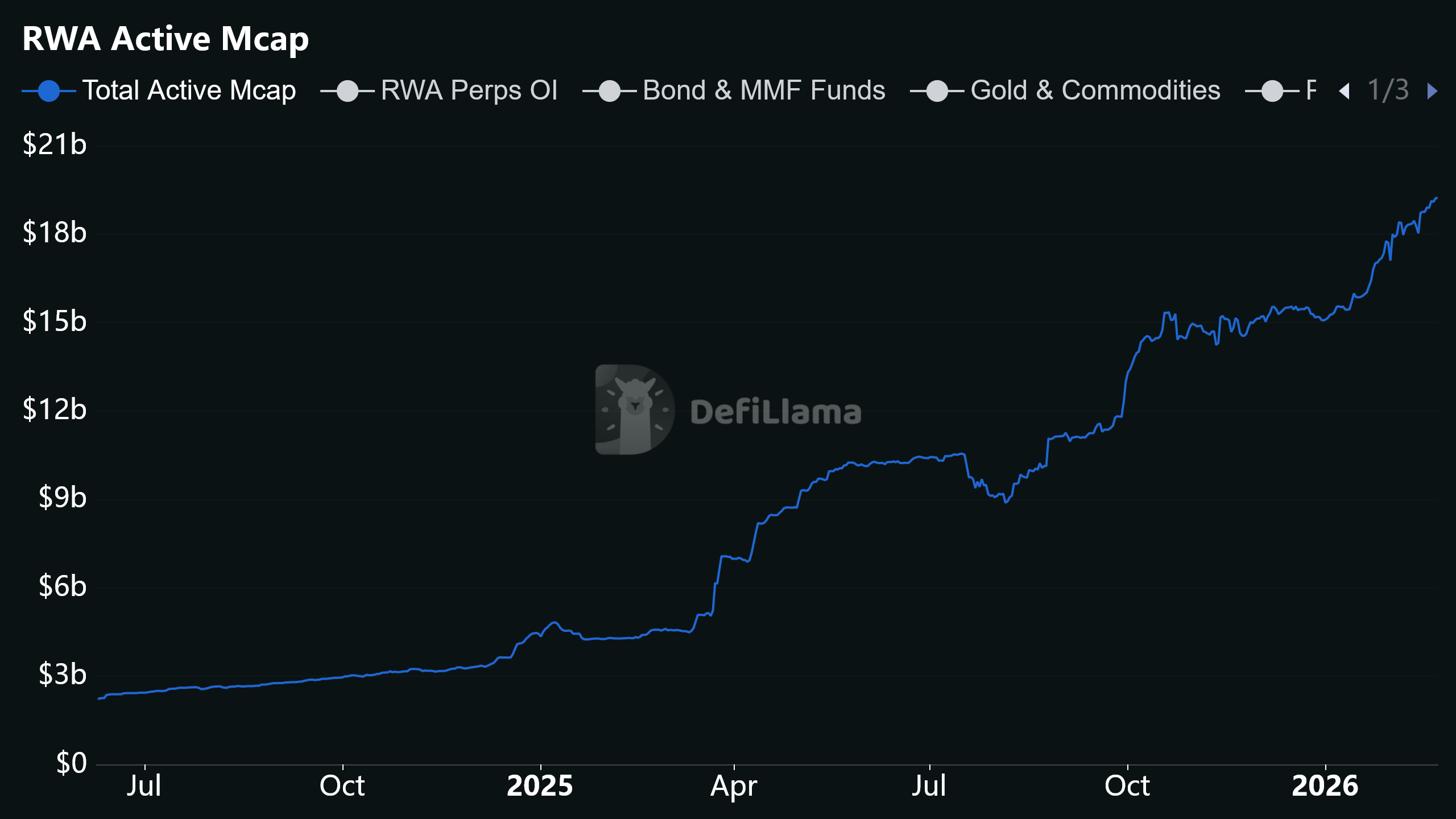
Separate from Binance, the broader RWA perpetuals market crossed $15 billion in cumulative volume as gold and silver hit all-time highs. This reflects deliberate positioning by traders who knew exactly what they were doing.
The broader context matters here too. Combined crypto perpetual futures trading volume rose 75% in two years, reaching $7.24 trillion in January 2026. RWA perpetuals are growing within an already fast-growing market. The tailwinds are stacking.
What’s next for RWA perpetuals?
The numbers behind the forecasts are worth considering. Block Scholes ran a conservative growth scenario where Hyperliquid repeats its prior year’s 4x volume growth rate. Under that assumption, average daily RWA perp volume moves from around $1 billion to $4 billion. That is the floor estimate, not the bull case.
Coinbase Ventures named expanding RWA perpetuals beyond crypto assets as a top 2026 investment priority, citing demand for on-chain macro exposure tied to oil, inflation breakevens, credit spreads, and volatility. When Coinbase Ventures makes a call like that in a public investment thesis, it is worth treating it as a signal about where serious capital is moving.
The product universe is expanding fast
Gold and silver led the charge, but the next wave is already forming. Industrial metals, including copper, aluminum, and zinc, are coming to several RWA perpetuals DEX platforms. Energy perps on crude oil and natural gas are in development. Agricultural commodities like corn and soybeans are further out but clearly on the roadmap.
Regulation is moving toward clarity
The RWA industry is actively building within regulatory frameworks rather than around them. More regulated structures bring more institutional capital, more liquidity depth, and eventually broader market access.
RWA perps could reshape global derivatives markets
Perpetual contracts have long been the most popular derivatives instrument in crypto by notional daily volume, exceeding spot, futures, and options combined. The underlying thesis for real-world assets perpetual futures is that the same mechanics can capture a meaningful share of global derivatives activity as they extend into traditional finance assets. That is not a small market. It is an enormous one.
If you are serious about trading or investing in digital assets in 2026, understanding RWA perpetuals is not optional. Start with the mechanics, pick one platform, and trade small until you understand how funding rates, liquidation prices, and oracle behavior work in practice. The infrastructure is here. The liquidity is building. The window to develop an edge before this market gets significantly more crowded is still open, but it will not stay that way for long.
Disclaimer: This article is for informational purposes only and does not constitute financial advice. Perpetual futures trading involves significant risk, including the potential for liquidation of your entire position. Always conduct your own due diligence and never trade more than you can afford to lose.




.webp)