.webp)

Key takeaways:
- The GE LM2500 gas turbine delivers about 37 MW at nearly 40% efficiency with a five-minute start. It is backed by roughly 140 million fleet operating hours. That track record makes it one of the lowest-risk aeroderivatives you can buy.
- It earns its keep in four markets: naval propulsion, power generation, AI data centers, and oil and gas.
- Against the Siemens Energy SGT-A35 and the Mitsubishi Power Aero FT8, the LM2500 leads on fleet experience and published efficiency. The SGT-A35 is stronger on hydrogen and offshore service, and the FT8 MOBILEPAC is quicker to get running on site.
- Analysts put aeroderivative equipment near $1,800 per kW, which works out to roughly $65 million for a 36.3 MW LM2500XPRESS+G5. GE Vernova is booking 2031 slots, and prices keep climbing.
- Refurbished LM2500 units can arrive in about 12 months, while new gas turbines take three to four years. For hyperscalers, utilities and investors, buying used is the fastest way to get firm power on site.
If you need 30 to 37 MW of firm, fast-starting power before 2028, the GE LM2500 gas turbine is one of the few machines you can realistically get. It has roughly 140 million fleet operating hours behind it. A deep secondary market means you don't have to wait in an OEM queue to own one.
Why should you care? AI data centers, utilities, and industrial plants need megawatts next year, but heavy-duty turbine slots are now sold for 2031 delivery. For hyperscalers, utilities, and their investors, a turbine spinning in 2027 beats a better one still sitting years deep in a factory queue.
What is the GE LM2500 gas turbine?
The GE LM2500 gas turbine is an aeroderivative engine: a jet engine core reworked to spin a generator, compressor, or ship's propeller shaft instead of pushing an airplane. This gas turbine model has about 37 MW of simple-cycle output, close to 40% efficiency, and a five-minute start for today's power generation models.
Three companies put the engine in front of buyers, which trips up many first-time purchasers. GE Vernova packages the land-based power generation units. GE Aerospace builds the marine version for navies, and Baker Hughes packages the engine for oil and gas duty under the PGT25 name.
So what does "aeroderivative" actually get you? Light weight, quick starts and an engine you can swap out in days rather than rebuild in place. These three traits explain why the General Electric LM2500 gas turbine keeps showing up wherever downtime is expensive.
Where did the LM2500 come from?
The first LM2500 started running in 1969 aboard the U.S. Navy cargo ship GTS Admiral Wm. M. Callaghan, as GE's history of the engine's technological evolution recounts. GE Aerospace says its engineers built the design around the core of the CF6 airliner engine, the turbofan family that flew the DC-10 and Boeing 747.
What followed is a pretty good playbook for stretching one design across five decades:
- 1975 to 1980: The engine lands its first offshore platform and first power generation jobs, and the fleet crosses 1 million operating hours, per GE's 75-million-hour milestone release.
- 1983: GE uprates the engine from 27,500 to 29,500 shaft horsepower, according to the 40th anniversary announcement with the U.S. Navy.
- 1998: The LM2500+ enters service at a cogeneration plant in Dordrecht, the Netherlands, with 25% to 30% more power than the original.
- 2005: GE introduces the LM2500+G4 for industrial users. GE Aerospace dates the marine LM2500+G4 to 2012.
- 2015: The family passes 75 million combined operating hours.
- 2026: GE Vernova cites roughly 140 million hours for the LM2500 family, including the LM2500XPRESS.
That history matters for one reason. A design this old and widely deployed has had most of its weak points found and engineered out.
Which LM2500 variants can you buy in 2026?
You can buy the LM2500 family in four engine ratings and two power plant packages. The ratings differ mostly in airflow and firing temperature. The packages differ in how fast they go up on site.
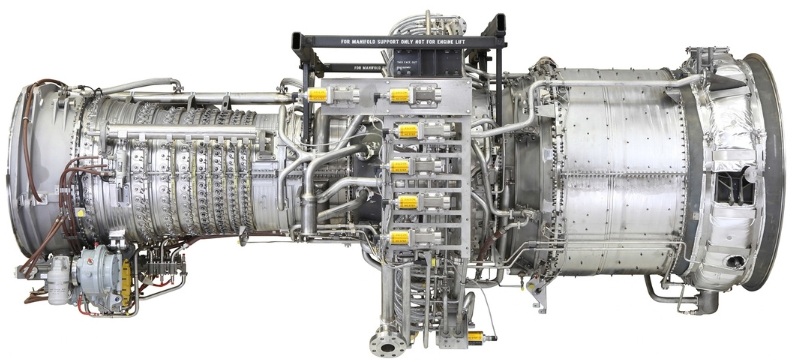
Here's the lineup, with output figures from the Baker Hughes PGT25+/LM2500+ datasheet for 50 Hz power generation at ISO conditions:
- LM2500 (base): The original two-shaft design, rated at 22.6 MW and 35% efficiency for power generation.
- LM2500+: Uses a 17-stage high-pressure compressor and lifts output to 30.5 MW at 37.3% efficiency.
- LM2500+G4: Pushes a third more airflow through the engine than the original and runs at higher turbine temperatures without growing the package, according to GE Aerospace's KDDX destroyer announcement. It delivers 32.5 MW at 37%.
- LM2500+G5: The current top rating, at up to 36.8 MW and 40% efficiency.
- LM2500XPRESS: GE Vernova's modular plant, up to 95% factory-assembled in 10 modules with 27 electrical connections instead of 130 or more. It installs in under 30 days.
- TM2500: The trailer-mounted mobile version, which GE Vernova says installs in about 14 days.
For a hyperscaler, the XPRESS and TM2500 packages are the interesting part. Fewer site connections mean fewer construction crews and fewer things that can go wrong before first power.
Where does the LM2500 gas turbine earn its keep?
The LM2500 gas turbine works in four very different markets: AI data centers, warships, power plants, and oil and gas facilities. Each one stresses the engine differently, and each one feeds the parts and service network you'll lean on as an owner.
AI data centers
AI data centers are the newest and fastest-growing home for the LM2500. Crusoe, an AI infrastructure company, ordered 29 LM2500XPRESS packages with selective catalytic reduction to power a Texas campus with nearly 1 GW of electricity.
Crusoe's founder says on-site turbines energize a campus far sooner than waiting for a standard grid interconnection. RaboResearch adds that Crusoe's Abilene site mixes LM2500XPRESS units with Caterpillar turbines, a fleet approach that spreads supply risk across two manufacturers.
The fit comes down to three traits. The five-minute start follows AI loads that swing hard between training and inference. The XPRESS package cuts site wiring to 27 electrical connections. A modular engine swap keeps a campus powered while one unit is serviced. If gigawatt-scale speed to power is your goal, that combination is hard to beat.
Naval propulsion
Navies are the engine's oldest and most loyal customers. GE Aerospace's LM2500 marine engine page says 39 navies use it, across more than 1,500 installations and with a reliability record above 99%.
The latest win landed on September 1, 2026. The Republic of Korea Navy chose 12 LM2500+G4 engines for six KDDX destroyers, two per ship in a full electric propulsion layout, and GE Aerospace says that navy has now bought 163 of its marine gas turbines for 95 ships. The U.S. Navy also selected the LM2500+G4 for its Constellation-class frigates and its DDG(X) land-based test site.
Power generation
On land, the LM2500 makes money as a peaker, a grid-firming unit and a backbone for utilities retiring coal.
Utilities run them at scale too. Ireland's ESB contracted eight units for 264 MW at Shannonbridge, and CS Energy's Brigalow peaking plant in Queensland delivers about 400 MW. For your planning team, that track record shortens internal approval cycles because the engineers have seen this machine before.
Oil and gas
In oil and gas, the engine drives pipeline compressors and powers offshore platforms. Baker Hughes sells a lean offshore power package with a 12-month delivery target and a pipeline compression package built around a 48-hour engine swap. For an upstream operator, that delivery target means the difference between first oil this year and first oil next year.
How is the LM2500 built, and what are the GE LM2500 gas turbine specifications?
The LM2500 is a two-shaft machine. A gas generator compresses air, burns fuel in an annular combustor, and drives itself, while a separate free power turbine turns that hot gas into shaft power for your generator or compressor.
GE Aerospace lists the core building blocks as the gas generator, power turbine, attached fuel and lube oil pumps, and a fuel control and speed governing system. GE Vernova adds an open package layout on the power generation side, making the engine easier to reach and faster to pull for replacement.
Key GE LM2500 gas turbine specifications
These are GE Vernova's published 50 Hz figures for the current LM2500XPRESS ratings, with inlet and exhaust losses included:
- Net output: 34.5 MW (+G4 dry low emissions) and 36.3 MW (+G5 dry low emissions)
- Net efficiency (lower heating value): 39.4% and 39.0%
- Net heat rate: 8,669 and 8,751 Btu/kWh (9,146 and 9,233 kJ/kWh)
- Start time: about 5 minutes from a cold stop to full load
- Package footprint: 28.5 m by 3.04 m, 8.2 m tall
- Heaviest single lift: 72,000 kg
- Reliability: above 99.8%, per GE Vernova
On the marine side, GE Aerospace rates the base LM2500 at 33,600 shaft horsepower (25,060 kW) with a 3,600 rpm power turbine. Why care about the 72-tonne heaviest lift? A machine that light opens up sites, roads and cranes that a heavy-duty frame turbine could never use.
What fuels can an LM2500 burn?
The LM2500 burns natural gas, diesel, aviation fuel, naphtha, liquefied petroleum gas, ethane, ethanol and biodiesel. This range keeps you from being stranded by a single fuel supplier.
Hydrogen is the headline, but read the fine print. GE Vernova says the family has logged about 2 million hours on hydrogen blends from 5% to 95% by volume and quotes up to 75% hydrogen capability. Baker Hughes clarifies that the 75% figure applies to the single annular combustor, while the dry low emissions combustor tops out around 5%.
Emissions and the 2026 federal rule
GE Vernova says it is the only aeroderivative supplier offering dual-fuel dry low emissions, which holds nitrogen oxides to 15 ppm on gas. That matters more after January 15, 2026, when the EPA's revised performance standards for stationary combustion turbines took effect under 40 CFR part 60, subpart KKKKa.
The new subpart treats combustion controls as the best system of emission reduction for most new turbines. It also creates a separate subcategory for temporary turbines. Your state air permit can still ask for more, though. Crusoe's data center units, for example, ship with catalytic reduction on top.
What does it take to operate and maintain an LM2500?
Running an LM2500 is mostly about managing starts, hours, and engine swaps. GE Vernova designed the engine for several starts and stops a day. This suits grids with lots of wind and solar and AI loads that swing hard between training and inference.
Inspection intervals
Baker Hughes publishes the clearest maintenance schedule for the family. A hot gas path inspection comes due every 25,000 hours and a major inspection every 50,000 hours on most ratings, stretching to 36,000 and 72,000 hours on the LM2500+G5 extended-interval version.
To put that in perspective, 25,000 hours is close to three years of nonstop baseload running. A peaker running a few thousand hours a year can go much longer between shop visits.
Engine swaps instead of teardowns
The real trick is that you rarely fix an LM2500 where it sits. GE Vernova can cut an outage to roughly two days by dropping in a replacement module or engine. It will lease you an engine while yours is overhauled. Baker Hughes quotes a 48-hour engine swap on its packages.
On ships, GE Aerospace uses a split casing that crews can lift open in place so they can repair the engine without craning it off the vessel. In practice, that turns a major overhaul into a scheduling exercise rather than a long gap in output.
How reliable is the LM2500, and can you still get parts?
GE Vernova rates the LM2500 family above 99.8% reliability and claims its aero fleet has logged more run time than every rival aeroderivative fleet put together, several times over. GE Aerospace reports a record above 99% on the naval side.
Scale is the underrated benefit here. With thousands of engines spread across navies, utilities, and oil fields, there is constant demand for LM2500 parts and repair capacity. That steady demand supports what your unit is worth when you sell it.
Where parts come from
GE Vernova runs global parts distribution centers tied to regional supply chains, plus long-term service agreements and repair programs it pitches on predictable costs. On the marine side, GE Aerospace leans on licensed partners: Hanwha Aerospace will build components and assemble, test, and service KDDX engines inside Korea.
The weak link isn't the LM2500 itself. Wood Mackenzie calls the casting of single-crystal turbine blades the tightest choke point in the industry because very few companies worldwide can make them in volume. When you buy, ask who holds your hot-section spares, not just who sells the engine.
How does the GE Vernova LM2500 compare with the Siemens Energy SGT-A35 and the Mitsubishi Power Aero FT8?
The LM2500 leads on fleet experience and published efficiency. The Siemens Energy SGT-A35 leads on hydrogen and offshore pedigree, and the Mitsubishi Power Aero FT8 MOBILEPAC leads on raw speed to site.
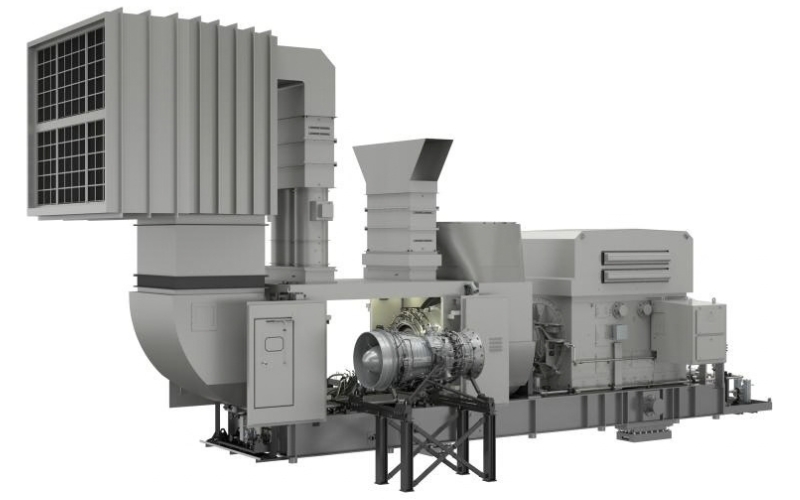
The Siemens Energy SGT-A35 is a twin-spool machine with more than 900 units sold and over 50 million operating hours, built mainly for oil and gas service onshore and offshore. Its gas generator can be swapped on site within 24 hours, and Siemens Energy says you can relaunch it right after a shutdown with no cool-down delay.
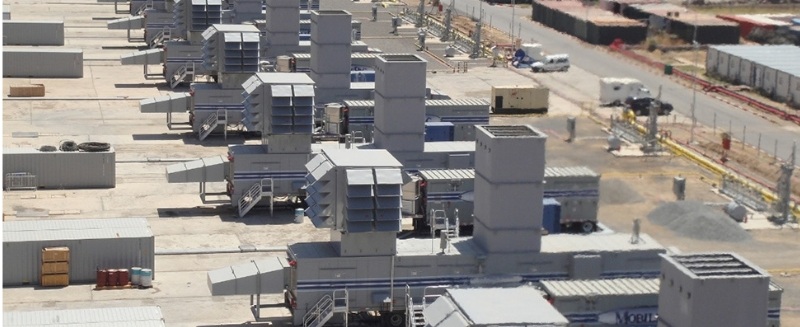
The Mitsubishi Power Aero FT8 MOBILEPAC is a two-trailer, dual-frequency package that can produce power within a day of arriving on site when it ships pre-commissioned. Its FT8 engine traces back to Pratt & Whitney's JT8D, and Mitsubishi Power Aero's company history shows how Mitsubishi Heavy Industries bought Pratt & Whitney Power Systems in 2013 and renamed it in 2021.
One caution before you compare efficiency figures. GE Vernova publishes net numbers after inlet and exhaust losses, while Siemens Energy publishes gross numbers before them. This makes the SGT-A35 look better on paper than it would on the same basis.
The FT8 MOBILEPAC is also a trailer package. That makes GE Vernova's TM2500, not the stationary LM2500XPRESS, its most direct rival when you need emergency or bridge power in weeks.
Why are aeroderivative gas turbines in such demand in 2026?
Data center developers are chasing aeroderivatives because few other machines deliver this much firm power inside an AI construction schedule. RaboResearch's May 2026 report on data center power puts grid interconnection at 36 to 84 months, while a data center goes up in 12 to 24 months.
That gap is pushing buyers behind the meter. Rabobank counts more than 130 GW of on-site energy resources proposed for U.S. data centers, with gas making up over 80% of the pipeline. Aeroderivative lead times are one to two years, against three to seven years for heavy-duty turbines and combined-cycle plants.
The money behind the rush
The five largest cloud and AI companies plan to spend roughly $745 billion to $775 billion on capital expenditure in 2026, per the same report. Rabobank estimates an idle GPU cluster represents $3 billion to $5 billion a year in depreciation and lost revenue. Next to numbers like that, paying a premium for on-site power is an easy call.
Order books back this up. Between April and June 2026, aeroderivatives outnumbered heavy-duty machines in GE Vernova's new contracts, 61 units to 52, as Turbomachinery Magazine's breakdown of GE Vernova's second quarter reports.
Why the grid can't close the gap fast enough
New gas capacity on the grid is thin. The U.S. Energy Information Administration's 2026 capacity outlook shows developers planning a record 86 GW of additions this year, but only 6.3 GW of that is natural gas. Combustion turbines account for just 2.8 GW.
So who fills the firm-power hole for a 200 MW campus coming online in 2027? Mostly reciprocating engines, smaller frame turbines, and aeroderivatives like the GE LM2500 gas turbine.
How much does an LM2500 cost in 2026, and when can you get one?
There's no public list price for the LM2500, so analyst estimates are the best yardstick you have. BNP Paribas estimated about $1,800 per kW for GE Vernova's aeroderivative turbines in July 2026, compared with about $790 per kW for heavy-duty units, according to Utility Dive's coverage of GE Vernova's 116 GW backlog.
Multiply that by the 36.3 MW rating of an LM2500XPRESS+G5 and the hardware alone comes to about $65 million. That's simple arithmetic on an analyst's estimate, so real bids will move with scope. Site works, the grid hookup, and emissions equipment all sit outside that figure.
Why waiting costs you money
GE Vernova's new gas turbine orders in the first half of 2026 were tracking 10 to 20 points higher per kW than its fourth-quarter 2025 orders, CEO Scott Strazik told analysts, per Power Engineering's report on GE Vernova's first quarter. Wood Mackenzie projects gas turbine prices reaching $600 per kW by the end of 2027, up 195% since 2019.
Every quarter you wait, the LM2500 gas turbine price you pay likely moves up, not down.
The queue is long and getting longer
Contracted gas equipment at GE Vernova, counting firm orders and paid slot reservations, stood at 116 GW on June 30, 2026, and management wants it above 125 GW by December, per GE Vernova's second-quarter 2026 results. Factory capacity is set to climb from a 20 GW annual pace this autumn to 24 GW in 2028 and 30 GW by 2030.
None of that extra capacity reaches a project that must be live in 2027. Slots for 2031 are already being booked. Bobby Noble of EPRI puts even smaller turbines at 18 to 36 months between order and delivery. Stack site work and grid approvals on top of the shipping date, and a new unit you order this year will realistically be running in 2029 or 2030.
Is a pre-owned GE LM2500 gas turbine worth buying?
It is when the calendar matters more than the sticker price. Expect a refurbished LM2500 on your pad in 12 months or less. A brand-new gas turbine ordered through the OEM channel today typically needs three to four years to arrive.
Pre-owned isn't a polite word for tired. Plenty of units on offer have zero or very few hours, including packages built for offshore developments that got shelved and fleets mothballed to OEM standards after a peaking plant closed. Since the engine is modular, a worn gas generator can be traded for a freshly overhauled one while the rest of the package stays put.
How do I buy a used or refurbished LM2500 with Acquire.Fi?
This sequence covers how to buy a refurbished GE LM2500 using the Acquire.Fi Gas Turbine Order Book:
- File your brief: List the capacity, 50 or 60 Hz frequency, site location, target delivery date, and unit count in a short form. It costs nothing, creates no obligation, and stays out of public view.
- Clear screening and review matches: Our team confirms your identity and that your mandate is genuine, then compares it with our own listings and with units held by owners, liquidators, repair houses, and shelved projects. A reply lands within one business day, even if it only says nothing fits yet.
- Review the asset under an NDA: Once both parties pass screening and you approve the introduction, you sign a mutual NDA. The seller then chooses when to release the spec pack, inspection reports, hours logs, and photos.
- Inspect, contract and close. Your engineers run the on-site inspection, borescope the engine, and check the hours before you sign the sale agreement and arrange transport. Your own legal and technical advisers stay involved, and our team supports the deal through commissioning.
Treat the capacity, hours, and condition listed up front as the owner's claims. Verification happens in step four, which is why your own engineer should lead it.
Posting is free, names stay private until you approve a specific match. Acquire.Fi only earns a success fee when a deal closes. Need five to ten identical units? We can combine inventory from several owners so one seller doesn't have to cover the whole order. That structure is what makes the 12-month delivery window possible.
If you’re sitting on a GE LM2500 you won't run, Acquire.Fi lets you sell without revealing your name until you sign off on a buyer. There are no fees until the deal closes.
Sources
- LM2500 & LM2500XPRESS Gas Turbines | GE Vernova - https://www.gevernova.com/gas-power/products/gas-turbines/lm2500
- The Technological Evolution Of A Popular Aeroderivative Gas Turbine | GE Aerospace News - https://www.geaerospace.com/news/press-releases/marine-industrial-engines/technological-evolution-popular-aeroderivative-gas-turbine
- Tested, Tried, and True: GE Aerospace's LM2500 Continues to Set the Standard in Marine Propulsion | GE Aerospace News - https://www.geaerospace.com/news/articles/tested-tried-and-true-ge-aerospaces-lm2500-continues-set-standard-marine-propulsion
- Setting a New Standard: GE's LM2500 Gas Turbine Achieves 75 Million Combined Operating Hours | GE Aerospace News - https://www.geaerospace.com/news/press-releases/setting-new-standard-ges-lm2500-gas-turbine-achieves-75-million-combined-operating
- GE and U.S. Navy Celebrate 40th Operating Anniversary of LM2500 Gas Turbine | GE Aerospace News - https://www.geaerospace.com/news/press-releases/marine-industrial-engines/ge-and-us-navy-celebrate-40th-operating-anniversary-lm2500
- PGT25+/LM2500+ | Baker Hughes - https://dam.bakerhughes.com/m/3a189c2b916a5e01/original/PGT25-LM2500.pdf
- ROKN Selects GE Aerospace to Power New KDDX Destroyer | GE Aerospace News - https://www.geaerospace.com/news/press-releases/rokn-selects-ge-aerospace-power-new-kddx-destroyer
- LM2500 Gas Turbine Engine | GE Aerospace - https://www.geaerospace.com/military-defense/engines/lm2500
- New Source Performance Standards Review for Stationary Combustion Turbines and Stationary Gas Turbines | Federal Register - https://www.federalregister.gov/documents/2026/01/15/2026-00677/new-source-performance-standards-review-for-stationary-combustion-turbines-and-stationary-gas
- SGT-A35 aeroderivative gas turbine | Siemens Energy - https://www.siemens-energy.com/global/en/home/products-services/product/sgt-a35.html
- FT8® MOBILEPAC® | Mitsubishi Power - https://power.mhi.com/products/aerogasturbines/lineup/ft8mp
- History | Mitsubishi Power Aero LLC - https://power.mhi.com/group/aero/company/history
- Data centers are building a parallel energy system in the US | Rabobank - https://www.rabobank.com/knowledge/d011524694-the-sprint-data-centers-are-building-a-parallel-energy-system-in-the-us
- GE Vernova's Gas Turbine Backlog Hits 116 GW as Power Orders More Than Double | Turbomachinery Magazine - https://www.turbomachinerymag.com/view/ge-vernova-gas-turbine-backlog-hits-116-gw-as-power-orders-more-than-double
- New U.S. electric generating capacity expected to reach a record high in 2026 | U.S. Energy Information Administration - https://www.eia.gov/todayinenergy/detail.php?id=67205
- GE Vernova gas turbine backlog climbs to 116 GW | Utility Dive - https://www.utilitydive.com/news/ge-vernova-gas-turbine-backlog-climbs-to-116-gw/826039/
- Data centers drive record surge in GE Vernova power equipment orders as turbine slots tighten through 2030 | Power Engineering - https://www.power-eng.com/gas/turbines/data-centers-drive-record-surge-in-ge-vernova-power-equipment-orders-as-turbine-slots-tighten-through-2030/
- Gas turbine supply crunch set to raise prices 195% by 2027: WoodMac | Utility Dive - https://www.utilitydive.com/news/gas-turbine-supply-crunch-set-to-raise-prices-195-by-2027-woodmac/816904/
- GE Vernova reports second quarter 2026 financial results and raises 2026 financial guidance | GE Vernova News - https://www.gevernova.com/news/press-releases/ge-vernova-reports-second-quarter-2026-financial-results-raises-2026-financial




.webp)