You can still put a mobile gas turbine on your site before the end of the decade, but often not by ordering a new large frame and waiting your turn. In 2026, the fastest megawatts are in rental fleets, converter shops, authorized packagers, and privately held secondary inventory that never appears in a manufacturer’s backlog.
That matters because your GPUs, cogeneration host, or industrial load won’t wait for a 2032 delivery slot. Pick the wrong sourcing channel and your capital sits idle for years. Pick the right one and mobile gas turbine power can bridge you to the grid or run as your primary supply while the grid catches up.
What types of mobile gas turbine gensets can you buy today?
Mobile gas turbine gensets come in four physical formats: containerized, trailer-mounted, skid-mounted, and enclosure-based modular packages. The format determines how fast you install, how easily you relocate, and how much civil work your site requires.
Here’s the catch. Sellers use these labels loosely, so “mobile” on a spec sheet can mean anything from a road-legal trailer to a module with a 72-tonne heaviest lift. Always ask how the unit ships and how many crane picks it needs.
Containerized gas turbine systems
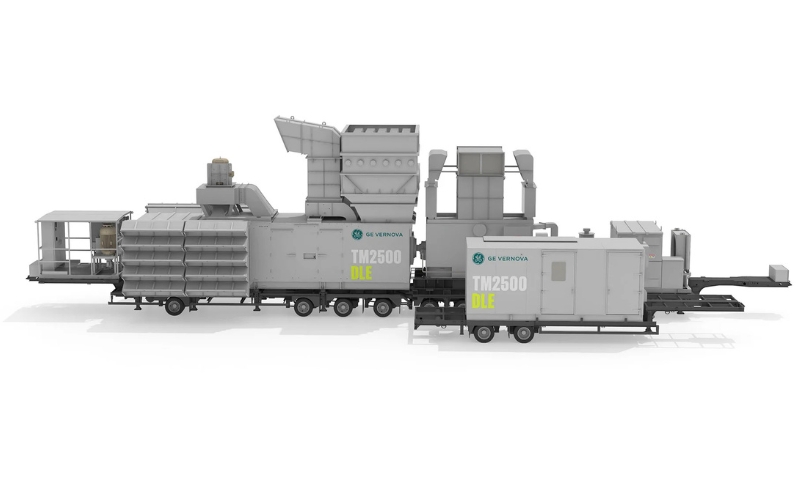
Containerized systems pack turbine, generator, or balance-of-plant equipment into ISO-style containers that move on standard freight. The GE Vernova TM2500 shows the most common split: a trailer-mounted turbine generator set paired with containerized balance of plant.
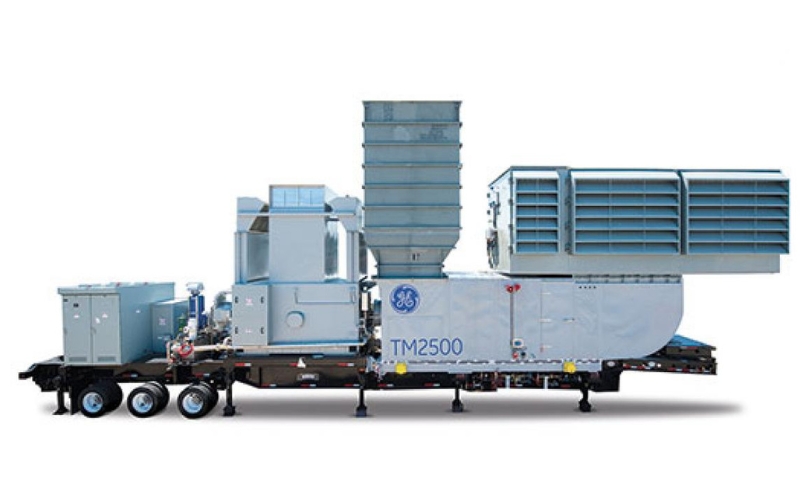
If you’re figuring out where to buy containerized gas turbine systems, expect that split rather than one sealed box. The turbine core rides on its own trailer or skid, while controls, fuel handling, and electrical gear travel in containers. That modularity is the whole point because you can stage containers ahead of the turbine and save weeks on site.
Trailer-mounted mobile gas turbine generators
Trailer-mounted units carry the gas turbine and generator on road trailers, usually two or three per set. They are the classic mobile gas turbine generator for bridge power, emergency response, and sites you plan to leave after the utility connection arrives.
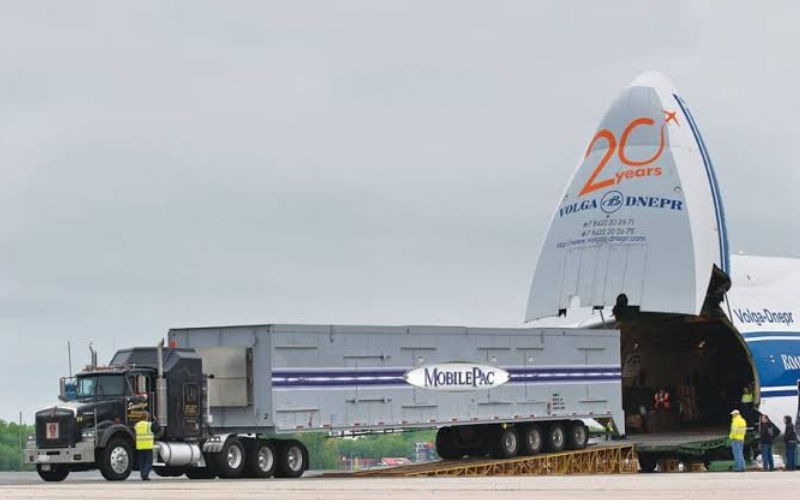
The Mitsubishi Power FT8 MOBILEPAC is a good example of how far this format goes. It splits into two trailers that run on public roads, can skip the concrete pad on ground with strong load-bearing soil, and can generate power within one day of arrival when the unit is pre-commissioned and the site is ready.
Skid-mounted packages
Skid-mounted packages put the turbine, generator, and auxiliaries on a steel base frame that is trucked in and craned onto a foundation. You trade some mobility for a sturdier, longer-life installation that suits cogeneration and industrial prime power.
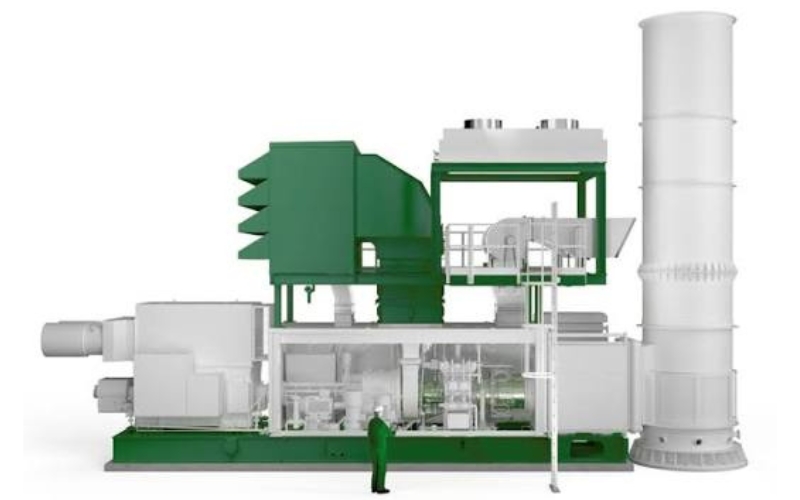
Smaller industrial machines often ship this way. The Baker Hughes NovaLT family covers machines up to 20 MW, requires about 45 days for installation, and reaches up to 85% efficiency in cogeneration configuration. That cogeneration number makes skids attractive to hosts that can use the exhaust heat.
Enclosure-based modular packages
Enclosure-based modular packages arrive as a set of factory-built modules that bolt together on site. They behave like a small permanent power plant but install on a timeline closer to that of a mobile unit.
The GE Vernova LM2500XPRESS package shows the logic. It ships in 10 simplified modules with up to 95% of assembly done in the factory. It uses 27 electrical interconnects instead of 130 or more in a traditional plant. A crew of 20 can install it in about 14 days.
Which size class fits your load?
The mobile gas turbine generator models covered here fall into three size bands: roughly 5 to 20 MW, 29 to 37 MW, and 44 to 50 MW per unit. Your block size determines redundancy, footprint, and how many interconnections your electrical team must manage.
Smaller blocks give you finer redundancy. With 16 MW units, losing one machine costs a small slice of a 100 MW campus, while a 50 MW unit outage takes out half of it. Bigger blocks win with fewer units, trailers, and fuel and grid tie-ins.
At the small end, Solar Turbines’ mobile power lineup pairs two packages. The single-trailer SMT60 runs on the 5.7 MW Taurus 60 and sets up in under six hours, while the 16 MW SMT130 is built around the Titan 130. The Titan 130 PG generator set carries an ISO rating of 16,530 kWe, making it a familiar building block for data center developers and industrial hosts.
The middle band belongs to aeroderivatives. The TM2500 delivers up to about 37 MW, starts in 5 minutes, and has over 350 installations worldwide. The GE Vernova LM2500 family carries roughly 140 million operating hours. GE Vernova is also delivering 29 LM2500XPRESS packages to Crusoe’s AI data centers, nearly 1 GW combined.
Where do Siemens Energy mobile gas turbines fit?
Siemens Energy mobile gas turbines sit at the top of the trailer-mounted size band. The Siemens Energy SGT-A45 TR data sheet lists up to 44 MW at ISO conditions with 50 Hz or 60 Hz operation. It burns liquid and gas fuel and keeps NOx emissions below 25 vppm.
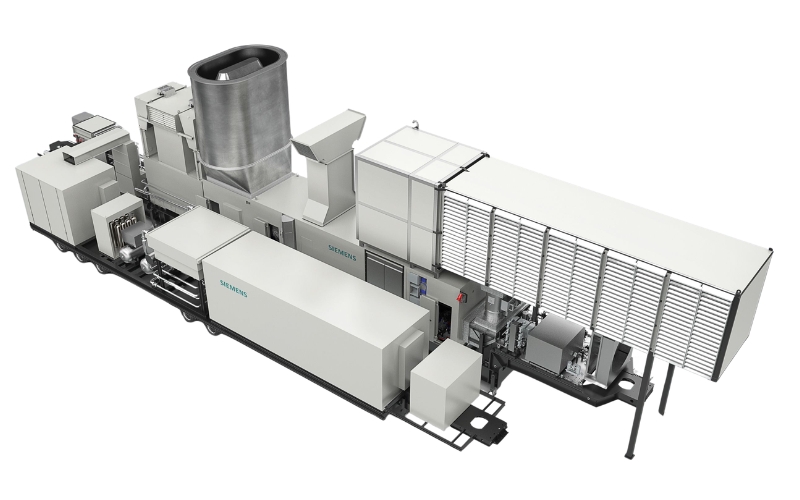
The package splits into three trailers. One carries the generator, another the gas turbine with its fuel and lube systems, and the third the control system, motor control center, and switchgear. The design also avoids a “hot lockout” or “hot standby” period, which matters if your load forces unplanned restarts.
New supply is the hard part. Siemens Energy’s gas turbine backlog nears 70 GW, and new orders face waits of at least three years. If you’re shopping for Siemens Energy mobile gas turbines on a 2027 schedule, you’ll likely search the secondary market and rental fleets alongside any new-build quote.
Where can you buy a mobile gas turbine in 2026?
You can buy a mobile gas turbine through six channels: OEMs directly, authorized packagers, jet-engine converters, rental and power-as-a-service fleets, used equipment dealers, and private secondary markets. Each channel trades speed, price, and risk differently.
Serious buyers often work several channels at once, whether they need trailers or are still researching where to buy containerized gas turbine systems. Why bet a GPU deployment on a single quote when the market is tight?
OEM direct
Buying direct from GE Vernova, Siemens Energy, Mitsubishi Power, Solar Turbines, or Baker Hughes gets you the newest emissions technology, a full factory warranty, and a clear path to a long-term service agreement. The TM2500 DLE, for example, needs no water and cuts NOx, CO, and particulates enough to skip aftertreatment equipment.
The trade-off is the queue. OEM factory slots are reserved years out, and data center demand competes directly with utility orders for the same production lines.
Authorized packagers and integrators
Packagers buy turbine cores from OEMs and wrap them in their own mobile platforms, controls, and balance of plant. You get a custom mobile gas turbine generator without negotiating for an OEM slot.
The scale here is large. In July 2026, Baker Hughes booked an order for 76 NovaLT16 turbines from Dynamis totaling about 1.3 GW. Dynamis will package those engines in its DT17 hypermobile platform to supply North American data centers and oilfield operations.
Jet-engine converters
Converters rebuild retired aircraft engine cores into land-based gas turbines. ProEnergy’s PE6000, for example, uses CF6-80C2 cores matched with new aeroderivative parts.
In April 2026, ProEnergy contracted to deliver 13 PE6000 units totaling 650 MW to Crusoe by summer 2027. That works out to 50 MW per unit and a timeline of roughly 15 months from announcement to delivery target.
Used equipment dealers and OEM pre-owned programs
Dealers hold or broker used, refurbished, and surplus units. Some OEMs run their own pre-owned programs too; Solar Turbines, for instance, maintains a pre-owned equipment section on its site.
This channel can save money, but documentation quality varies from unit to unit. Budget time and money for independent inspection before you commit.
Acquire.Fi Private Gas Turbine Market
The Acquire.Fi Private Gas Turbine Market is a matched order book for unused, lightly run, and mothballed turbines, plus reciprocating gas sets and complete operating stations. It covers 50 Hz and 60 Hz equipment ranging from single sets of about 8 MW to a combined-cycle portfolio of 2,310 MW, with roughly 3.4 GW of equipment and sites mapped.
Here’s what makes it different from a listings site. We screen both sides before any introduction, work buyer requirements against inventory that isn’t publicly advertised, and about 50% of the deals we handle are never advertised anywhere. If your project needs a fleet of matching units, we pool them across multiple owners instead of turning you away.
Rental and power-as-a-service fleets
Rental providers own turbine fleets and sell you electricity or capacity instead of hardware. You avoid upfront capital and hand off operations, which suits crypto miners converting to HPC who need power before financing closes.
APR Energy’s data center offering is typical of the model. APR keeps its own turbines, transformers, fuel handling, and spares, so it controls the whole plant. Its plants can be running within roughly a month of mobilization, and it has delivered 375 MW to a major U.S. AI training system.
How much does a mobile gas turbine generator cost in 2026?
No OEM publishes a list price for a mobile gas turbine generator, but 2026 benchmarks point to turbine equipment climbing toward roughly $600/kW by late 2027 and installed 50 MW gas projects landing around $1,200 to $1,800/kW. Used and refurbished equipment often comes well below new, and whole operating plants trade at their own discount or premium.
Treat every number below as a planning range, not a quote. Site conditions, frequency, emissions controls, fuel compression, and balance of plant affect the final figure.
New equipment pricing
New turbine pricing has climbed sharply. Wood Mackenzie’s April 2026 gas turbine supply chain outlook expects turbine prices to nearly triple from 2019 levels, reaching about $600/kW as 2027 closes.
OEM order books tell the same story. On its October 2026 earnings call, GE Vernova expected 2026 gas order prices per kW to be about 50% above 2025. A heavier mix of aeroderivatives lifted its Q3 prices more than 20% over Q4 2025. So if your budget relies on a 2025 quote, it’s probably stale.
Installed project cost
Equipment is only part of the bill. A 2026 EPC cost breakdown from secondary-market supplier USP&E places 50 MW natural gas projects at $1,200 to $1,800/kW installed.
Here’s some illustrative math. At $600/kW, turbine equipment for a 35 MW unit costs around $21 million. At $1,200 to $1,800/kW installed, a 35 MW project runs roughly $42 million to $63 million. That range covers extras: generator integration, controls, fuel compression, switchgear, civil work, and commissioning.
Used and refurbished pricing
In that same 2026 USP&E breakdown, refurbished equipment typically costs 30% to 50% of new and suits peaking or bridge duty over a three-to-seven-year horizon. That discount shrinks fast if a unit is close to a major overhaul.
The same source budgets aeroderivative major overhauls at $4 million to $8 million every 25,000 to 35,000 operating hours. A cheap high-hour unit can cost more than a pricier low-hour one, so always price the next overhaul into your offer.
Whole operating plants
Sometimes the best deal is a running station, not a single machine. In April 2026, ProEnergy sold the Braes Bayou and Brotman generating stations to South Texas Electric Cooperative for $768 million. Those quick-start plants total 768 MW and run on PE6000 turbines, which works out to roughly $1,000/kW for operating capacity, with O&M continuing under ProEnergy.
Rental pricing
Rental and power-as-a-service pricing is negotiated contract by contract and rarely published. Expect terms tied to capacity, contract length, fuel responsibility, and emissions controls.
How long will you wait for mobile gas turbine power from each channel?
Your wait ranges from about 30 days for a rental fleet to roughly five years for a large new frame. Mobile gas turbine power from smaller new units, converters, and the secondary market usually falls between a few months and three years.
The channel you pick sets the clock. In 2026, permitting can add its own delay.
OEM new-build queues
Large OEM frames carry the longest waits. GE Vernova had 122 GW of gas turbine capacity under contract after the third quarter of 2026 and is already booking slots for 2032. Siemens Energy has no open capacity before fiscal 2028, with 2029 and 2030 slots filling quickly.
Smaller turbines move faster but still take time. The Wood Mackenzie outlook estimates delivery of a big turbine ordered today at about five years and a small turbine at 18 to 36 months. With 70% of gas turbine units ordered in 2025 under 100 MW, you’re competing with many buyers for those smaller slots.
Packagers and converters
Packagers and converters often beat large-frame timelines because they control their assembly lines. ProEnergy’s April 2026 Crusoe contract targets delivery by summer 2027, and Dynamis booked its NovaLT16 turbines in the second quarter of 2026 for its mobile platform.
Rental fleets
Rental fleets are the fastest route when units are available. APR Energy can bring a plant online in about a month, and pre-commissioned trailer units like the FT8 MOBILEPAC can generate power within a day of arriving at a ready site.
Secondary market
Secondary-market timelines depend on the match, not a factory. When an existing unit fits your capacity, frequency, and location, manufacturing is removed from the timeline. The clock then runs on inspection, contracting, transport, and recommissioning.
That’s where our desk focuses. Every requirement gets a reply within one business day, showing either units that fit or an honest note that none fit yet. We can’t promise a specific delivery date before diligence, but an existing unit removes the factory queue from your critical path.
Permitting can be the real bottleneck
Air permitting can stall a turbine already on site. The U.S. Environmental Protection Agency’s January 2026 final rule on stationary combustion turbines set new subpart KKKKa limits for turbines whose construction, modification, or reconstruction began after December 13, 2024.
The rule also added a subcategory for temporary turbines. As summarized in the EPA’s fact sheet on the final rule, that subcategory covers small and medium turbines up to 850 MMBtu/h in temporary applications. It requires combustion controls and sets a 25 ppm NOx standard on natural gas. Confirm your permitting pathway with state regulators before you sign because a unit that can’t meet your local limits isn’t available to you.
How do you buy a low-hour or refurbished mobile gas turbine with Acquire.Fi?
You buy a low-hour or refurbished mobile gas turbine with Acquire.Fi by posting a requirement, clearing screening, meeting the seller under NDA, and closing after your own inspection. Submitting a requirement costs nothing and commits you to nothing; our fee is earned only if a deal completes.
The process runs in four steps.
- Post your requirement: Tell us how many megawatts and units you need, at what frequency, where, and by when. It takes a couple of minutes and stays confidential.
- Get screened and matched: We verify your entity and mandate, then work your requirement against the book. We also canvass unadvertised equipment held by IPPs, plant owners, liquidators, overhaul shops, and decommissioning teams.
- Meet the seller under NDA: After screening clears on both sides, the seller shares specs, inspection findings, run-hour logs, and photos step by step.
- Inspect, contract, and close: Your own engineers and lawyers inspect the unit, scope the hot section, and confirm the run hours. Then you move to the sale agreement, escrow, and logistics.
We remain involved until the unit is commissioned. Nobody learns who you are until you approve a particular introduction, which matters when your competitors are hunting the same units.
Demand on the book is real. Our energy desk currently tracks 4 GW or more of aggregate stated demand. That includes hyperscaler-backed mandates for matched LM6000, LM2500, and TM2500 fleets, plus multi-gigawatt programs that buy matching units in batches of up to ten.
What should you verify before you buy a low-hour unit?
Owners supply the run-hour and condition figures, and your diligence is where those figures get proven or disproven. Run through this checklist with your engineering adviser before any money moves.
- Operating hours and starts: Match logbooks against controller data, because starts drive wear on aeroderivatives as much as hours do.
- Preservation records: Zero-hour and preserved units should come with OEM preservation documentation covering storage conditions and intervals.
- Borescope findings: Ask for recent borescope reports on the hot section, then commission your own inspection.
- Overhaul position: Check where the unit sits against its next major overhaul, since that work can cost $4 million to $8 million on an aeroderivative.
- Frequency match: Confirm 50 Hz or 60 Hz compatibility; some packages, like the FT8 MOBILEPAC and SGT-A45 TR, can be configured for either.
- Combustion system and emissions: Compare the unit’s combustion system and NOx performance against the federal subpart KKKKa standards and your state permit limits.
- Package completeness: Confirm controls, switchgear, fuel gas compression, and balance of plant ship with the unit, not separately.
What should you do next?
Power procurement is now a strategic decision, not a purchasing task. Buyers who secure mobile gas turbine power in 2026 run several sourcing channels in parallel, price new and secondary units side by side, and start permitting before the equipment arrives.
Start by mapping your load to a size class, then pressure-test every quote against the 2026 price and lead-time benchmarks above. If you’re still deciding where to buy containerized gas turbine systems or trailer-mounted fleets, request pricing from at least one OEM, one rental provider, and one secondary-market source to compare apples to apples.
If you’re a buyer, post your turbine requirement on the Acquire.Fi Private Gas Turbine Market and expect a reply within one business day. If you’re holding a preserved, low-hour, or idle fleet, list your units with Acquire.Fi so screened, active buyers can see it without your name ever going public.
Prefer to talk first? Email team@acquire.fi with your megawatt target, 50 Hz or 60 Hz need, location, and deadline.
Sources
- LM2500 & LM2500XPRESS Gas Turbines | GE Vernova - https://www.gevernova.com/gas-power/products/gas-turbines/lm2500
- LM2500XPRESS Aeroderivative Package Fact Sheet | GE Vernova - https://www.gevernova.com/content/dam/gepower-new/global/en_US/downloads/gas-new-site/products/gas-turbines/gev-aero-fact-sheets/GEA35746-GEV-LM2500XPRESS-Product-Factsheet.pdf
- TM2500 Aeroderivative Gas Turbine | GE Vernova - https://www.gevernova.com/gas-power/products/gas-turbines/tm2500
- Titan 130 | Solar Turbines - https://www.solarturbines.com/en_US/products/power-generation-packages/titan-130.html
- Solar Mobile Turbomachinery | Solar Turbines - https://www.solarturbines.com/en_US/solutions/oil-and-gas/solar-mobile-turbomachinery.html
- FT8 MOBILEPAC | Mitsubishi Power - https://power.mhi.com/products/aerogasturbines/lineup/ft8mp
- NovaLT Gas Turbines for High Performance | Baker Hughes - https://www.bakerhughes.com/gas-turbines/novalt-technology
- SGT-A45 TR Mobile Unit Data Sheet | Siemens - https://assets.new.siemens.com/siemens/assets/api/uuid:2f68d394-fe3c-49b0-b78f-646987696386/datasheet-sgt-a45-tr-e.pdf
- Siemens gas turbine backlog nears 70 GW as company expands manufacturing | Utility Dive - https://www.utilitydive.com/news/siemens-gas-turbine-backlog-nears-70-gw-as-company-expands-manufacturing/827390/
- Siemens Energy lifts global gas turbine outlook on data center demand | S&P Global Commodity Insights - https://www.spglobal.com/energy/en/news-research/latest-news/electric-power/063026-siemens-energy-lifts-global-gas-turbine-outlook-on-data-center-demand
- Baker Hughes wins major gas turbine order for data center, oil and gas power | World Oil - https://worldoil.com/news/2026/7/29/baker-hughes-wins-major-gas-turbine-order-for-data-center-oil-and-gas-power/
- PROENERGY To Deliver Major Generating Equipment To Power Crusoe AI Factories | PR Newswire - https://www.prnewswire.com/news-releases/proenergy-to-deliver-major-generating-equipment-to-power-crusoe-ai-factories-302743533.html
- PROENERGY Closes Agreement With South Texas Electric Cooperative to Divest Braes Bayou and Brotman Generating Stations | PROENERGY - https://www.proenergyservices.com/2026/04/proenergy-closes-agreement-with-south-texas-electric-cooperative-to-divest-braes-bayou-and-brotman-generating-stations/
- Data Centers | APR Energy - https://www.aprenergy.com/industry-solutions/data-centers/
- Gas turbine supply crunch set to raise prices 195% by 2027: WoodMac | Utility Dive - https://www.utilitydive.com/news/gas-turbine-supply-crunch-set-to-raise-prices-195-by-2027-woodmac/816904/
- GE Vernova in $9B deal to buy high-voltage manufacturer as gas turbine orders slow | Utility Dive - https://www.utilitydive.com/news/ge-vernova-in-9b-deal-to-buy-high-voltage-manufacturer-as-gas-turbine-orde/873223/
- Gas Turbine EPC Costs 2026: Complete Breakdown by Project Size, Region & Fuel Type | USP&E Global - https://uspeglobal.com/articles/gas-turbine-epc-costs-2026/
- New Source Performance Standards Review for Stationary Combustion Turbines and Stationary Gas Turbines | Federal Register - https://www.federalregister.gov/documents/2026/01/15/2026-00677/new-source-performance-standards-review-for-stationary-combustion-turbines-and-stationary-gas
- Fact Sheet: New Source Performance Standards for Stationary Combustion Turbines: Final Rule | U.S. EPA - https://www.epa.gov/system/files/documents/2026-01/final-rule_fact-sheet-nsps-stationary-combustion-turbines_0.pdf