Key takeaways:
- A Vera Rubin NVL72 delivers about 2.3 times the dense FP4 compute and roughly 2.4 times the memory bandwidth of a GB300 NVL72. Both still hold 72 GPUs and 36 CPUs.
- Market estimates put this year’s shipments at 60,000 to 70,000 GB300 racks versus 5,000 to 10,000 Vera Rubin racks. Blackwell capacity available now earns revenue sooner.
- 2026 estimates put a Vera Rubin rack near $7.8M to $8M versus $3M to $4M for a GB300, driven largely by memory costs. Power rises from 132 kW to over 200 kW per rack.
- The GB300 NVL72 offers a liquid-to-air cooling option that needs no facility water loop. Vera Rubin’s higher power density usually means a bigger facility upgrade.
- Vera Rubin lists 2,400 TFLOPS of FP64 per rack against just 100 TFLOPS on the GB300. That makes Vera Rubin far better suited to hosting scientific simulation work.
- Both run the same CUDA stack, so tenants’ existing code should work on either without a rewrite.
- UOB’s June 2026 data shows rental rates rising across B200, H100, and even A100 GPUs. Still, model your returns at four, five, and six-year book lives.
- The Acquire.Fi GPU Allocation Order Book offers B300 and GB300 systems with delivery dates set at quote, and Vera Rubin slots with first deliveries in February 2027.
Nvidia Vera Rubin vs Blackwell is the rack decision every serious AI buyer faces in 2026. Nvidia’s spec sheets show a Vera Rubin NVL72 delivers about 2.3 times the dense FP4 compute of a GB300 NVL72 and roughly 2.4 times its memory bandwidth. But it costs more, draws more power, and ships in far smaller numbers this year.
For your business, that tradeoff is the whole decision. You either deploy Blackwell capacity available now or wait in a longer line for Vera Rubin and build a facility that can power it.
What is Vera Rubin?
Vera Rubin is Nvidia’s 2026 rack-scale AI platform and the direct successor to Blackwell. The flagship rack packs 72 Rubin GPUs and 36 Vera CPUs into a single NVLink 6 domain, per the Nvidia Vera Rubin NVL72 specifications.
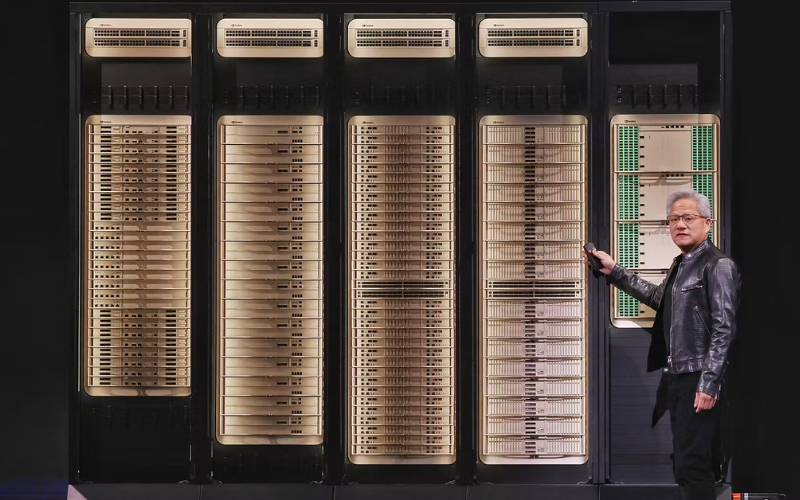
Nvidia sells Vera Rubin as a family of racks rather than one box. The Vera Rubin platform page groups five rack types into one system:
- Vera Rubin NVL72: The GPU rack that trains and serves models.
- Vera CPU rack: Packs 256 Vera CPUs to run the sandboxes and tool calls that AI agents depend on.
- Groq 3 LPX: Adds SRAM-based inference chips beside Rubin for low-latency answers on huge contexts.
- BlueField-4 STX: Handles AI storage and data movement.
- Spectrum-6 SPX: Connects every rack in the pod over Ethernet.
Where is Vera Rubin in production?
Vera Rubin reached full production in 2026. Nvidia announced the milestone at GTC Taipei on May 31, 2026. Hundreds of supply chain partners in 30 countries are ramping output, per Nvidia’s Vera Rubin production announcement.
So what is Vera Rubin to a buyer? It’s a rack built for agentic AI, where one prompt can trigger hundreds of reasoning and tool steps. That workload punishes slow memory and slow networking, which is exactly where Nvidia spent its design budget.
What is Blackwell?
Blackwell is the Nvidia GPU architecture behind the bulk of Nvidia’s 2026 rack shipments. Each Blackwell GPU fuses two dies into a single chip with 208 billion transistors, built on a custom TSMC 4NP process, per Nvidia’s Blackwell architecture overview.

The current flagship is Blackwell Ultra. Its GB300 NVL72 rack joins 72 Blackwell Ultra GPUs with 36 Grace CPUs, and it adds 1.5 times the dense FP4 math and twice the attention-layer speed of first-generation Blackwell, per the Nvidia GB300 NVL72 product page.
Why does Blackwell still matter in 2026?
It’s the proven, shipping platform with deep supply and a mature software stack. Nvidia still carries an “Available Now” banner on the GB300 NVL72, and Wistron’s Texas plant builds Grace Blackwell Ultra systems today.
That matters because a rack you can energize this quarter earns revenue this quarter. A faster rack in next year’s queue earns nothing until it lands.
How do the rack architectures compare?
In any Nvidia Vera Rubin vs Blackwell rack comparison, the shell looks almost identical. Both generations put 72 GPUs and 36 CPUs into one NVLink domain on Nvidia’s MGX NVL72 rack design. The real differences sit inside each compute tray.
Inside the GB300 NVL72
The GB300 NVL72 pairs Blackwell Ultra GPUs with Grace CPUs, for 2,592 Arm Neoverse V2 cores per rack. Each 1U compute tray carries two GB300 Grace Blackwell Ultra superchips.
Inside the Vera Rubin NVL72
The Vera Rubin NVL72 swaps Grace for Vera, with 3,168 custom Olympus cores per rack. A Vera Rubin superchip pairs one Vera CPU with a pair of Rubin GPUs, and the trays slide in without cables.
Nvidia built the Vera Rubin NVL72 on its third-generation MGX rack as a smooth step from earlier NVL72 systems. Your technicians’ rack-handling skills should mostly carry over, but your power and cooling plant may need a rebuild.
How do rack forms and SKUs compare?
Both generations ship in three main shapes: a full 72-GPU rack, an 8-GPU server, and a 4-GPU board for scientific work. The SKU names change, but the buying choices look familiar.
Blackwell SKUs
On the Blackwell side, you can choose the GB200 NVL72 or the newer GB300 NVL72 rack. For 8-GPU servers, there’s the HGX B300, which Nvidia tuned for AI reasoning with more compute and memory. The GB200 NVL4 targets converged HPC and AI.
Vera Rubin SKUs
Vera Rubin mirrors that lineup. You get the Vera Rubin NVL72 and the turnkey DGX Vera Rubin NVL72 at rack scale. At server scale, there’s the DGX Rubin NVL8 and the HGX Rubin NVL8, which can pair with Vera CPUs or x86 host boards.
For scientific computing, the Vera Rubin NVL4 links four Rubin GPUs to two Vera CPUs. Nvidia rates it at up to 8 times Hopper-generation performance for AI-for-science inference.
Which shape fits a converted mining site?
If you’re converting a Bitcoin mining site, the 8-GPU server is often the realistic entry point. It lets you start smaller and spread heat over more floor space while your liquid cooling build catches up.
How does compute performance compare?
The Vera Rubin NVL72 delivers 2,520 petaflops of dense NVFP4 against 1,080 petaflops of dense FP4 on the GB300 NVL72. That’s about 2.3 times the 4-bit math in the same rack footprint.
On sparse math, the gap is wider. Nvidia lists 3,600 petaflops for Vera Rubin and 1,440 petaflops for the GB300 NVL72, or about 2.5 times.
Why the FP8 numbers don’t line up
Nvidia publishes FP8 on different bases for each rack. The GB300 NVL72 shows 720 petaflops with sparsity, while the Vera Rubin NVL72 shows 1,260 petaflops dense. Ask for dense figures on both before you compare.
The HPC surprise for converters
Here’s the number most AI buyers skip. Double-precision FP64 math sits at 2,400 teraflops per Vera Rubin rack, against just 100 teraflops per GB300 NVL72.
That gap is huge for HPC hosting. If you’re a miner planning to rent capacity for scientific simulation, Blackwell Ultra is honestly the wrong tool, and Vera Rubin brings double-precision math back.
Nvidia’s own efficiency figures
Nvidia’s headline efficiency figures for Vera Rubin are tenfold more tokens from each megawatt and a 75% cut in GPUs needed for mixture-of-experts training. Both figures compare against the GB200 NVL72, not the GB300, so the gap against Blackwell Ultra is smaller than those headlines suggest.
How do memory specs compare?
Memory capacity barely moves, but memory speed jumps. Both racks hold about 20 TB of GPU memory with 288 GB per GPU. The Vera Rubin NVL72 moves to HBM4 at 1,400 TB/s per rack, against up to 576 TB/s of HBM3E on the GB300 NVL72.
Think of memory bandwidth as the width of the road between the GPU and its data. Reasoning models read large amounts of data for every token, so a wider road usually means faster answers.
The CPU memory tier triples
The CPU side changes even more. Vera Rubin racks hold as much as 54 TB of LPDDR5X system memory, more than triple the 17 TB in a GB300 NVL72.
The link between CPU and GPU also doubles. Each Vera Rubin superchip moves 1.8 TB/s between CPU and GPUs, while Blackwell’s Grace link tops out at 900 GB/s of bidirectional bandwidth.
That extra memory isn’t free. Memory now drives a large share of the price gap between the two racks, which we cover in the pricing section.
How does networking compare?
Vera Rubin raises bandwidth both inside and between racks. Inside the rack, aggregate NVLink bandwidth climbs from 130 TB/s on the GB300 NVL72 to 216 TB/s on Vera Rubin.
Per GPU, that’s 3 TB/s on Rubin against 1.8 TB/s on Blackwell. For models split across all 72 GPUs, faster links mean less time waiting and more time computing.
Scale-out between racks
Between racks, the GB300 NVL72 uses ConnectX-8 SuperNICs at 800 Gb/s per GPU. The Vera Rubin NVL72 moves to ConnectX-9 SuperNICs and BlueField-4 data processing units, with 32.4 TB/s of bidirectional networking per rack.
Both generations run on Quantum-X800 InfiniBand or Spectrum-X Ethernet. New with Vera Rubin are Spectrum-X Ethernet Photonics switches, which build the optics into the switch package and cut network power fivefold versus pluggable transceivers, by Nvidia’s figures.
The so-what for your budget is that a Vera Rubin cluster probably means new network cards and switches, and possibly new optics. Get the network bill of materials quoted alongside the racks, not after.
How do the software ecosystems compare?
Both generations run the same CUDA software stack, so code written for Blackwell carries over to Vera Rubin. That’s the single biggest reason upgrade risk inside the Nvidia family stays low.
What Blackwell brought
Blackwell introduced a second-generation Transformer Engine with micro-tensor scaling, which made 4-bit AI math practical. It works with TensorRT-LLM and the NeMo framework, and Nvidia benchmarks the GB300 NVL72 using Dynamo for disaggregated serving. Mission Control handles rack operations.
What Vera Rubin adds
Vera Rubin adds a third-generation Transformer Engine with adaptive compression to push NVFP4 inference further. It extends Nvidia Confidential Computing across the whole rack and adds a second-generation reliability engine.
Above the rack, the Nvidia DSX platform gives you reference blueprints for designing and running a whole AI factory. DOCA software enforces tenant isolation and security on the BlueField-4 chips themselves.
What that means for your tenants
So what is Vera Rubin from a developer’s seat? Mostly the same CUDA world with more speed. Your tenants’ existing CUDA code should run on either generation without a rewrite. The real work is tuning for NVFP4 and new serving tools, which is a nice problem compared with a full platform migration.
How do power requirements compare?
A Vera Rubin NVL72 draws far more power than a GB300 NVL72. Supermicro rates the GB300 NVL72 rack at 132 kW total, fed by eight 33 kW power shelves, per the Supermicro GB300 NVL72 rack specification.
Vera Rubin pushes a single rack well past 200 kW, per Tom’s Hardware’s visit to Nvidia’s engineering lab. GIGABYTE sizes each rack in its Vera Rubin NVL72 pod design for up to 240 kW, fed by four 110 kW power shelves.
How power delivery changes
Nvidia has also shown Vera Rubin racks running on an 800-volt DC power sidecar. High-voltage DC pushes more power through less copper, which matters once racks pass 200 kW.
What it means per megawatt
The math per megawatt is simple. One megawatt of IT load fits roughly seven GB300 NVL72 racks at 132 kW, but only four Vera Rubin racks at 240 kW.
Fewer racks per megawatt doesn’t mean less output. Nvidia’s tokens-per-megawatt gains mean each Vera Rubin rack produces far more work per kilowatt than the racks it replaces.
See why AI support infrastructure creates a bottleneck as much as chips do.
How do cooling and support systems compare?
Liquid cooling at the chip is mandatory for both, but Blackwell offers more options for sites without a facility water loop. Supermicro offers the GB300 NVL72 with an in-rack coolant unit rated at 250 kW or a liquid-to-air sidecar unit up to 200 kW that needs no facility water.
That sidecar option is important if you’re converting an air-cooled Bitcoin mining hall. You can run liquid at the chip without building chillers and a plant-wide water loop first.
Cooling for Vera Rubin
Nvidia specs Vera Rubin for coolant entering at 45°C. Water that warm can often be cooled by dry coolers instead of chillers, saving power in many climates.
Vera Rubin trays also go fully fan-free. GIGABYTE’s pod design adds redundant pumps and dual A/B power feeds for uptime.
Support systems around the rack
Both generations include a dedicated reliability, availability, and serviceability engine that flags failing parts before they cause downtime. Vera Rubin upgrades it and pairs it with rack-wide confidential computing.
Nvidia is also selling more of the building around the rack. The DSX Pod packs seven Vera Rubin racks into a single shipping container, and Nvidia’s goal is a two-week path to first tokens instead of half a year, per CNBC’s coverage of the DSX Pod launch.
What does the availability and ramp timeline look like?
Blackwell is the volume platform in 2026, and Vera Rubin is the ramp. Market estimates put 2026 shipments at roughly 60,000 to 70,000 GB300 racks against about 5,000 to 10,000 Vera Rubin NVL72 racks, per DIGITIMES’ Computex 2026 analysis.
The same analysis expects Vera Rubin volumes to grow every quarter from 2027. Vera Rubin uses a 3nm process with CoWoS packaging, so TSMC capacity stays a tight gate.
Where Vera Rubin shipments stand
By late August, CoreWeave and Google Cloud were among the partners with live Vera Rubin racks, per Futurum’s analysis of Nvidia’s Q2 FY2027 results. Futurum’s read is that Nvidia can sell everything it can build.
Supply follows commitment. The largest buyers sign earliest and get served first, pushing everyone else further back.
What the secondary market shows
B300 systems and GB300 NVL72 racks carry a delivery date set at the time of quote, while early Vera Rubin slots point to first racks arriving in February 2027.
Find out why packaging and HBM keep AI chips scarce in 2026 and what it means for lead times.
What do Blackwell and Vera Rubin racks cost in 2026?
On price, Nvidia Vera Rubin vs Blackwell is a gap of roughly two to one. Nvidia doesn’t publish rack prices, but 2026 estimates put a Vera Rubin NVL72 at about double a GB300 NVL72. Morgan Stanley Research estimates about $7.8 million per Vera Rubin rack for hyperscalers against about $4 million per GB300 NVL72, per Tom’s Hardware’s report on rising rack memory costs.
Other 2026 estimates land in the same zone. DIGITIMES put a Vera Rubin rack near $8 million against a GB300 level of about $3 million plus. By October, analysts cited by CNBC placed a single Vera Rubin rack above $7 million.
Why memory drives the gap
Memory is the main culprit. The same Morgan Stanley figures put memory at about $2 million per Vera Rubin rack, roughly a quarter of its cost and up 435% from the memory content of a GB300 NVL72.
Memory pricing hits Blackwell buyers too. Some have been told to expect AI server bills over 15% higher as memory gets pricier, per Futurum’s quarterly analysis.
Price per rack vs price per token
A higher rack price doesn’t automatically mean pricier output. Nvidia puts Vera Rubin’s cost per million tokens at a tenth of the GB200 NVL72’s. The real question is how many tokens your workload produces per dollar on each rack.
How do depreciation and residual value compare?
Microsoft depreciates its servers and network equipment over two to six years, and where you land in that range shapes your earnings. Microsoft’s latest annual report puts servers and network equipment at two to six years, per the Microsoft Form 10-K for fiscal year 2026.
Why does that range matter? A GB300 bought in 2026 competes against Vera Rubin, which reached full production the same year. The useful-life assumption in your model carries real weight.
What 2026 rental data shows about residual value
So far, older GPUs keep earning. Rental prices rose across B200 and Hopper-era GPUs, and even across older A100s, per UOB Private Bank’s June 2026 CIO note.
UOB put B200 rentals at $5.42 per GPU-hour, H100 and H200 near $2.65, and A100 at $1.6 and rising. That’s encouraging if you worry Blackwell gets stranded once Vera Rubin ships. After all, what is Blackwell worth in 2028 if nobody rents it? It isn’t proof, but strong evidence that older GPUs still find paying work.
The risks to residual value
UOB also lists what could break that pattern. Customers could optimize their models, hyperscalers could keep capacity in-house, and custom chips could pull value away from GPUs.
How to model it
Run your returns at three book lives: four, five, and six years. If the deal only works at six, you’re betting rental strength holds through two more Nvidia generations.
UOB’s payback figures count only the GPU price. They leave out servers and networking, plus power and cooling. Financing and downtime aren’t included either, so your real payback will run longer.
How do you buy Nvidia Vera Rubin and Blackwell AI racks through the secondary market?
At Acquire.Fi, you can buy Nvidia AI racks ahead of the queue. Tell our desk which platform you want and how many units. Add the destination site and deadline. We look for a holder whose allocation or inventory fits that request. Both parties go through screening, and we stay involved through delivery and power-on.
What can you order?
We cover three Nvidia platforms today:
- HGX B300 servers: Eight GPUs per server, sold in lots of at least 32 servers, with 64- and 128-server clusters available.
- GB300 NVL72: Fully integrated 72-GPU racks, starting from a single rack.
- Vera Rubin: Pre-order slots from a single rack, with builds scheduled around the turn of the year.
You can also add the surrounding infrastructure to any platform. That includes networking, storage, and optics. Power and cooling gear can ship with it as one validated package.
How does the process work?
Buying works in four stages:
- Place the order: It takes a couple of minutes, costs nothing, and does not commit you until identity and funding checks clear.
- Get qualified: Within roughly one working day, you get an indicative price and a likely delivery window. Then you clear know-your-customer checks and sign an end-use declaration.
- Secure your slot: Proof of funds plus a 30% USD deposit turns the request into a firm allocation. Larger Vera Rubin deposits move you forward in the queue, and every deposit applies to your purchase order rather than becoming our fee.
- Receive the racks: Top-tier manufacturers assemble and stress-test each rack before it ships. You can begin with one trial rack and grow into a full cluster on unchanged terms.
Nvidia’s allocation approval is our job, not yours. Eligible buyers are verified end users located in the U.S. and EU or in South Korea and Japan. Resellers may buy too, provided they name the end customer.
Why go through the secondary market?
Queue position decides your delivery date. Hyperscalers lock up manufacturer capacity first, leaving smaller buyers waiting even for previous-generation systems.
Committed slots don’t always get used. Projects slip, funding changes, and grid connections arrive late. Those orphaned allocations become your shortcut to hardware.
Regulation adds a second reason. The January 2026 Federal Register rule on advanced computing exports loosened China and Macau licensing only for chips below a fixed performance ceiling. Rack-scale Blackwell and Vera Rubin systems exceed it, so expect any credible counterparty to verify your identity and final destination.
Sitting on capacity you won’t use?
Sealed hardware, allocations not yet delivered, and Vera Rubin reservations you no longer need can be listed. Every buyer passes screening before seeing your offer. Your name stays confidential until you approve the match.
Sources
- Infrastructure for Scalable AI Reasoning | NVIDIA Vera Rubin Platform - https://www.nvidia.com/en-us/data-center/technologies/rubin/
- Rack-Scale Agentic AI Supercomputer | NVIDIA Vera Rubin NVL72 - https://www.nvidia.com/en-us/data-center/vera-rubin-nvl72/
- NVIDIA Vera Rubin Ramps Into Full Production to Power Agentic AI Factories Worldwide - https://nvidianews.nvidia.com/news/vera-rubin-full-production-agentic-ai-factory
- The Engine Behind AI Factories | NVIDIA Blackwell Architecture - https://www.nvidia.com/en-us/data-center/technologies/blackwell-architecture/
- Designed for AI Reasoning Performance & Efficiency | NVIDIA GB300 NVL72 - https://www.nvidia.com/en-us/data-center/gb300-nvl72/
- SuperServer SRS-GB300-NVL72 | Supermicro - https://www.supermicro.com/en/products/rack/srs-gb300-nvl72
- Behind the scenes at Nvidia’s Engineering SuperLab: Vera Rubin NVL72 running OpenAI workloads, 800VDC demonstrated, and more - https://www.tomshardware.com/tech-industry/artificial-intelligence/behind-the-scenes-at-nvidias-engineering-superlab-vera-rubin-nvl72-running-openai-workloads-800vdc-demonstrated-and-more
- AI DLC POD NVIDIA Vera Rubin NVL72 | GIGABYTE - https://www.gigabyte.com/Enterprise/GIGAPOD-Pod-Scale/AI-DLC-POD_NVIDIA-Vera-Rubin-NVL72
- Nvidia announces plug and play Vera Rubin racks that can be shipped on a truck - https://www.cnbc.com/amp/2026/10/21/nvidia-announces-vera-rubin-racks-that-can-be-shipped-on-a-truck-.html
- Commentary: How Nvidia turned Computex into its own annual coronation - https://www.digitimes.com/news/a20260609PD230.html?chid=12
- NVIDIA Q2 FY 2027: AI Infrastructure Demand Extends Into FY 2028 - https://futurumgroup.com/insights/nvidia-q2-fy-2027-ai-infrastructure-demand-extends-into-fy-2028/
- Nvidia’s memory costs soar 485%, latest AI systems now cost $7.8 million to build - https://www.tomshardware.com/tech-industry/artificial-intelligence/nvidias-memory-costs-soar-485-percent-latest-ai-systems-now-cost-usd7-8-million-to-build-memory-now-comprises-25-percent-of-the-total-cost-rubin-gpus-a-mere-usd50-000-apiece
- Microsoft Corporation Form 10-K for the Fiscal Year Ended June 30, 2026 - https://www.sec.gov/Archives/edgar/data/0000789019/000119312526323660/msft-20260630.htm
- Compute is revenue | UOB Private Bank CIO Insights - https://www.uob.com.sg/assets/web-resources/private/pdfs/compute-is-revenue.pdf
- Revision to License Review Policy for Advanced Computing Commodities - https://www.federalregister.gov/documents/2026/01/15/2026-00789/revision-to-license-review-policy-for-advanced-computing-commodities