
Key takeaways:
- A single 18V Wärtsilä 50 engine delivers up to 18,875 kW at 60 Hz with about 49% electrical efficiency. It can start daily with no start cost or wear penalty.
- Every 2026 Wärtsilä data center order, including the 282 MW and 790 MW projects, uses gas-fired Wärtsilä 50SG or 34SG engines. The diesel version fits backup, bridging, and sites still waiting on a pipeline.
- At 2026 diesel prices, a Wärtsilä 50 spends roughly $238 to $275 per MWh on fuel, compared to about $24 per MWh on gas. That gap makes diesel hard to justify for 24/7 prime power.
- The Wärtsilä 50DF lets you run on liquid fuel now and switch to gas later. Wärtsilä has already converted more than 100 engines from heavy fuel oil to gas.
- International Finance Corporation limits on nitrogen oxides tighten once a plant crosses 300 MW of thermal input, which happens at around eight Wärtsilä 50 engines. Selective catalytic reduction can add 20% to 30% to plant capital cost.
- Factory lead times run around two years. Many 2026 orders deliver between 2028 and 2030. Wärtsilä’s 65% capacity expansion won’t fully arrive until early 2029.
- Preserved and lightly used Wärtsilä 50 sets can energize a site years before a new-build slot opens. This only holds if you verify hours, preservation records, fuel history, frequency, and permit status first.
The Wärtsilä 50 engine is one of the largest and most efficient liquid-fuel generating sets you can put on a site in 2026. A single 18-cylinder unit delivers up to 18.9 MW at roughly 49% electrical efficiency, which is exactly why it keeps showing up on shortlists for firm, on-site power.
Why should you care right now? Because power, not chips, is setting the schedule for AI campuses, colocation halls, and cogeneration hosts. If you understand what the Wärtsilä 50 can do, what it costs to run, and where to find one, you can buy capacity while competitors wait in line.
What is the Wärtsilä 50?
The Wärtsilä 50 series engines are four-stroke, medium-speed generating sets built for power plants and sold in an 18-cylinder V configuration. Each cylinder has a 500 mm bore and a 580 mm stroke. The engine runs at 500 rpm on 50 Hz grids and 514 rpm on 60 Hz grids.
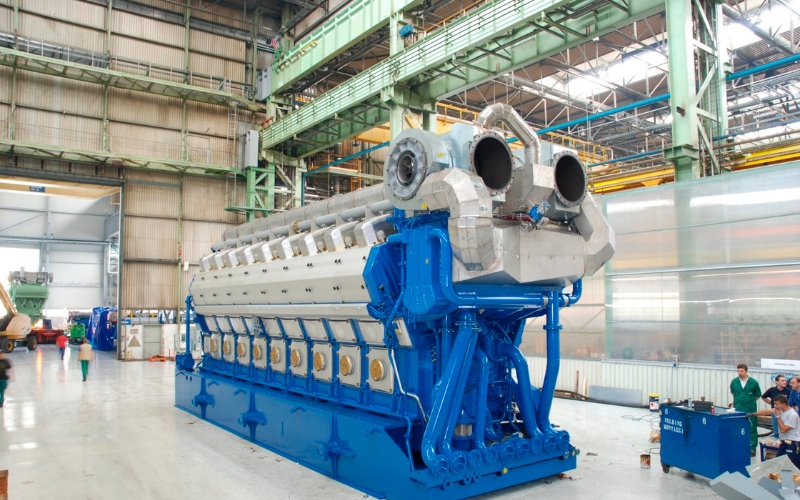
Wärtsilä built the engine to burn almost any liquid fuel, from light fuel oil to heavy fuel oil to liquid biofuels. Fuel goes straight into each cylinder at high pressure, a design that lets the engine squeeze more power from every liter while staying under the emission ceilings the World Bank and International Finance Corporation set for lenders.
So what does that mean for your project? You get one machine big enough to anchor a utility-scale plant that can start and stop every day. Starting the engine doesn’t shorten its service life or trigger extra maintenance. You can cycle it as often as your load demands, which is a big deal if your demand swings.
The installed base backs this up. Wärtsilä counts more than 3,500 MW of Wärtsilä 50 capacity in the field, and that matters when you think about parts, trained service crews, and resale value down the road.
Where is the Wärtsilä 50 used, and which deployments matter in 2026?
The Wärtsilä 50 platform runs flexible baseload plants, renewable balancing plants, island grids, mines, industrial sites, and a fast-growing number of AI data centers. The diesel version earns its keep wherever pipeline gas is missing, unreliable, or still years away.
Utility, balancing, and independent power plants
The Wärtsilä 50 platform’s compact footprint suits large plants on tight land. In Nebraska, Omaha Public Power District runs a 156 MW multi-fuel plant built around nine 18-cylinder Wärtsilä 50DF engines. In Australia, AGL Energy’s Barker Inlet Power Station uses 211 MW of Wärtsilä 50DF dual-fuel capacity for grid reliability.
Independent power producers are buying, too. In June 2026, Wärtsilä confirmed a 452 MW equipment contract plus a long-term operations agreement for the Pecos Power Plant in Texas. Mercuria Americas and Continental Resources own the plant, and commercial operation is expected in 2027.
AI data centers
Data centers are now the headline market for the Wärtsilä 50 platform. In the first quarter of 2026, Wärtsilä booked a 429 MW order for 24 Wärtsilä 50SG engines for a utility-owned plant serving a data center. In April, it added a 790 MW off-grid power plant for a Texas data center, its first data center project in that state.
The latest milestone landed on October 5, 2026. Wärtsilä will supply 15 Wärtsilä 50SG engines for a 282 MW onsite plant being developed by a major US independent power producer. That was Wärtsilä’s seventh US data center order, and it pushed the company’s total US data center capacity sold past 3 GW.
Notice something? Every one of those data center orders uses the gas-fired Wärtsilä 50SG, not the diesel model. That’s the 2026 picture. Hyperscalers want natural gas for prime power, and they reach for the Wärtsilä 50 diesel engine when liquid fuel is the practical answer: sites waiting on a pipeline, backup and bridging power, and campuses that want stored fuel on site for resilience.
Engine size is also becoming a design choice. A 412 MW Ohio hyperscale project marked the first data center use of the smaller Wärtsilä 34SG. Buyers are matching unit size to their block-loading and redundancy strategy, not just grabbing the biggest engine available.
Remote grids, mines, and industrial hosts
For islands, mines, and industrial hosts without gas, the Wärtsilä 50 diesel engine is one of the most efficient liquid-fuel options you can buy. Cogeneration hosts can also capture heat from the exhaust and cooling circuits, which pushes total site efficiency well above the electrical figure.
Which Wärtsilä 50 model variants can you buy?
The Wärtsilä 50 platform comes in three power plant variants: the Wärtsilä 50 liquid-fuel (diesel) engine, the Wärtsilä 50DF dual-fuel engine, and the Wärtsilä 50SG spark-ignited gas engine. All three use the same 18V layout, which keeps plant design and spare parts planning simpler.
The table below summarizes the published power plant ratings from Wärtsilä’s engine power plant product range.
Here’s the so-what: your fuel future should pick your variant. If gas could reach your site within a few years, the Wärtsilä 50DF dual-fuel engine lets you run on liquid fuel today and switch to gas without stopping the plant. If you will never get a pipeline, the liquid-fuel Wärtsilä 50 gives you the highest rated output of the three.
And if you already own liquid-fuel engines, conversion is a proven path. Wärtsilä has converted more than 100 engines worldwide from heavy fuel oil to gas, mostly to cut operating costs and meet tighter emission rules.
Combined-cycle setups raise the ceiling further. Wärtsilä’s Flexicycle configuration pairs the engines with a steam cycle and reaches up to 54% plant efficiency for the Wärtsilä 50DF and liquid-fuel versions.
What are the Wärtsilä 50 technical specifications?
The Wärtsilä 50 engine is a 17 to 18V, 500 mm bore unit rated at 18,434 kW at 50 Hz and 18,875 kW at 60 Hz, measured at the generator terminals. Here are the core numbers.
Start-up and load response
Speed is where the Wärtsilä 50 engine earns its reputation. These are the published loading figures you should design around:
- Grid connection: about 30 seconds from start, in both regular and fast start modes.
- Full load: about 10 minutes on a regular start, or down to about 2 minutes on a fast start.
- Stop time: about 1 minute.
- Hot ramp rate: 60% of load per minute.
- Minimum load: 10% per unit, and plant minimum load equals one unit’s minimum.
Rating conditions you need to read
Wärtsilä’s figures assume 100 kPa ambient pressure, 25°C intake air, 30% relative humidity, power factor 1.0, and no engine-driven pumps, with a 5% tolerance on efficiency. Hot, humid, or high-altitude sites will change those numbers. Always ask for project-specific performance data before you sign anything.
One more number worth knowing: each cylinder sweeps roughly 114 liters, based on the 500 mm bore and 580 mm stroke. That figure matters for US emission rules, which we cover below.
What fuel does the Wärtsilä 50 need?
The Wärtsilä 50 engine runs on any liquid fuel, including light fuel oil, heavy fuel oil, and liquid biofuels. Your fuel choice drives plant cost, maintenance intensity, and emissions far more than most first-time buyers expect.
Light fuel oil versus heavy fuel oil
Light fuel oil is simple to handle and kinder to the engine. Heavy fuel oil is cheaper per unit of energy in many markets but needs a full treatment plant: heated storage and lines, centrifugal separators, fine filtration, and viscosity control before the fuel reaches the injectors.
Which one fits you? If you plan to run a few hours a year, light fuel oil usually wins on simplicity. If you plan to run baseload on an island or mine with no gas, heavy fuel oil can make sense but only with disciplined fuel treatment.
Fuel quality at the engine inlet
Fuel quality problems cause a large share of medium-speed engine damage. Catalytic fines (hard aluminum and silicon particles left over from refining), water, and off-spec viscosity are the properties to watch on every delivery. Test each delivery and then again after treatment and at the engine inlet.
Catalyst compatibility
If you install a selective catalytic reduction system to cut nitrogen oxides, some fuel components can poison the catalyst. Wärtsilä limits those components in fuel specs for catalyst-equipped plants, so align your fuel contract with your emission control design from day one.
Biofuels and the gas upgrade path
Liquid biofuels give you a lower-carbon option without changing engines. And if gas arrives later, the Wärtsilä 50 platform’s track record of heavy fuel oil to gas conversions gives you a route that doesn’t strand your investment.
What emissions rules apply to the Wärtsilä 50?
The emission limits you face depend on where your plant sits, how much fuel it burns, and how many hours it runs. For a Wärtsilä 50 engine, nitrogen oxides are almost always the hardest pollutant to manage.
World Bank and International Finance Corporation guidelines
Many international lenders apply the International Finance Corporation thermal power guidelines to plants above 50 MW of thermal input. For liquid-fuel engine plants between 50 and 300 MW thermal, the nitrogen oxides limit is 1,850 mg/Nm³ for compression-ignition engines with bores of 400 mm or more in non-degraded airsheds. That limit drops to 400 mg/Nm³ in airsheds that already have poor air quality.
Plants at or above 300 MW thermal face a tighter nitrogen oxides guideline of 740 mg/Nm³, plus lower sulfur dioxide limits or lower-sulfur fuel. One Wärtsilä 50 burns roughly 37 MW of fuel energy at full load, so a plant of around eight engines can cross that 300 MW threshold. Plan your unit count with that line in mind.
The same guidelines show how expensive the fix can be. Selective catalytic reduction can cut nitrogen oxides by 80% to 95%, but it can add 20% to 30% to the capital cost of a reciprocating engine plant.
United States
In the US, stationary diesel engines fall under the EPA’s New Source Performance Standards for compression ignition engines, codified at 40 CFR Part 60 Subpart IIII. The rule regulates nitrogen oxides, particulate matter, sulfur dioxide, carbon monoxide, and hydrocarbons. Engines at 30 liters per cylinder or more sit in their own category, and the Wärtsilä 50’s roughly 114 liters per cylinder puts it squarely there.
Expect your state air permit to add requirements on top of the federal rule. In practice, that often means selective catalytic reduction and continuous emissions monitoring for prime power duty.
European Union
In the EU, the Medium Combustion Plant Directive covers engines between 1 and 50 MW of rated thermal input. It can also reach combinations of new units whose total input reaches 50 MW or more. Larger installations can also trigger Industrial Emissions Directive permitting, so have your environmental counsel map the exact pathway for your site.
Existing plants are not exempt either. Emission limits for existing medium combustion plants above 5 MW apply from January 1, 2025, which matters if you plan to buy and relocate a used unit inside Europe.
How much does it cost to run a Wärtsilä 50?
Fuel dominates the operating cost of a Wärtsilä 50 engine, and in 2026 fuel is expensive. At full load, one engine burns close to 1,000 US gallons of diesel per hour.
The fuel math
Here’s how we get there. At the rated heat rate of 7,282 kJ/kWh, and assuming diesel at 42.7 MJ/kg and 0.85 kg per liter, one megawatt-hour takes roughly 53 US gallons of fuel. Multiply by 18,434 kW and you land near 977 gallons per hour.
Now apply 2026 prices. The EIA’s October 2026 Short-Term Energy Outlook puts US retail diesel at an average of $5.19 per gallon for 2026 and $4.49 for 2027, after September 2026 averaged $6.29. This works out to roughly $238 to $275 per MWh in fuel alone.
Run one engine 8,000 hours a year and fuel costs land between $35 million and $41 million. Retail prices include road taxes that many stationary users don’t pay, so treat those figures as a conservative ceiling, not a quote.
Diesel versus gas
Compare that with gas. The same EIA outlook forecasts Henry Hub natural gas at $3.16 per million Btu in 2027. At Wärtsilä 50SG efficiency, that’s roughly $24 per MWh in fuel before pipeline and delivery charges.
That gap is the single biggest reason 2026 data center orders are going to gas engines. Diesel makes financial sense for backup, bridging, peaking, and sites with no gas option. For 24/7 prime power, it’s hard to justify unless gas is truly unavailable.
Everything else
Beyond fuel, budget for:
- Lubricating oil and filters, which scale with running hours and fuel quality.
- Scheduled maintenance and overhauls, often bundled into an OEM service agreement.
- Reagent for selective catalytic reduction, if your permit requires it.
- Operators and technicians, or a remote monitoring contract.
- Fuel treatment operating costs, which are much higher on heavy fuel oil.
Water is the one line item that stays small. The Wärtsilä 50 needs minimal water, which is a real advantage in drought-prone regions like Texas and the US Southwest.
What maintenance does the Wärtsilä 50 need, and what usually goes wrong?
The Wärtsilä 50 engine follows an hours-based maintenance schedule set by Wärtsilä. The intervals shorten as fuel quality drops. Running on heavy fuel oil generally means more frequent attention than running on light fuel oil.
Starts don’t eat into your maintenance budget the way they do on many gas turbines, where major maintenance is often tied to starts or equivalent hours. This is a quiet but meaningful advantage if your duty cycle involves daily cycling.
Service agreements
Wärtsilä offers lifecycle service agreements ranging from parts supply to full operations and maintenance. Roughly 35% of Wärtsilä Energy’s operating installed base runs under service agreements, which tells you how many owners prefer to hand over the risk.
Common watch items
These are the issues we see most often flagged in inspection reports on large medium-speed engines. None of them is unique to the Wärtsilä 50, but every one of them affects value:
- Fuel injection wear: Abrasive catalytic fines and poor filtration wear pumps and nozzles.
- Turbocharger fouling: Residual fuels leave deposits that cut airflow and efficiency.
- Exhaust valves and cylinder heads: heavy fuel oil operation raises the risk of valve seat wear and burning.
- Liners, rings, and lube oil: Fuel contamination and poor oil condition speed up wear, so oil analysis history is gold.
- Cooling water chemistry: Poor treatment drives corrosion and scaling.
- Long idle periods: Engines left without proper preservation can corrode internally.
- Control system age: Older automation can need upgrades before recommissioning.
The industry’s best reference for many of these topics is the CIMAC guideline on lubricating medium-speed diesel engines, which covers catalytic fines, oil treatment, and operating practice in depth.
Which safety standards apply to a Wärtsilä 50 installation?
The safety standards you apply depend on your country, your insurer, and your local authority having jurisdiction. A handful of references show up on almost every Wärtsilä 50 project.
Fire safety
In the US, NFPA 37 sets fire safety criteria for installing and operating stationary combustion engines and gas turbines on liquid or gaseous fuel. It covers engines used for emergency, standby, and peak power. If your plant serves life-safety loads, NFPA 110 for emergency and standby power systems usually applies too.
Generating set ratings
ISO 8528-1 defines how reciprocating engine generating sets are classified and rated for continuous, peak, and standby duty. Use it to make sure the rating on a quote matches how you plan to run the engine. A standby rating on a prime power plant is a costly mistake.
Worker safety and noise
The International Finance Corporation guidelines recommend control rooms at 60 dBA, with up to 65 dBA accepted for reciprocating engine plants. They also call for hearing protection in areas above 85 dBA. Engine halls are loud, so plan acoustic enclosures and silencers early.
Fuel, chemicals, and electrical hazards
Liquid fuel storage brings spill and fire risks, so bund your tanks and plan your firefighting systems around them. If you use selective catalytic reduction, urea or aqueous ammonia is generally safer to store than pure liquefied ammonia. Add lockout and tagout procedures, electrical safety training, and arc-flash studies for your switchgear.
How does the Wärtsilä 50 compare with the Everllence 51/60 and HiMSEN H35/40G?
These three engines cover very different power bands and fuels. The Wärtsilä 50 is a liquid-fuel diesel engine, while the published data for the Everllence 51/60 and the HiMSEN H35/40G cover gas versions.
A quick note on names. Everllence is the former MAN Energy Solutions, which took its new name in 2025. The Everllence 51/60 factsheet covers the gas-fired 18V51/60G.
What the table really tells you
Compare like with like. Wärtsilä rates the Wärtsilä 50 at the generator terminals, while the Everllence and Hyundai figures above are mechanical shaft output. Generator losses of a few percent mean the Everllence 51/60's 18,900 kW mechanical figure lands close to the Wärtsilä 50's electrical rating.
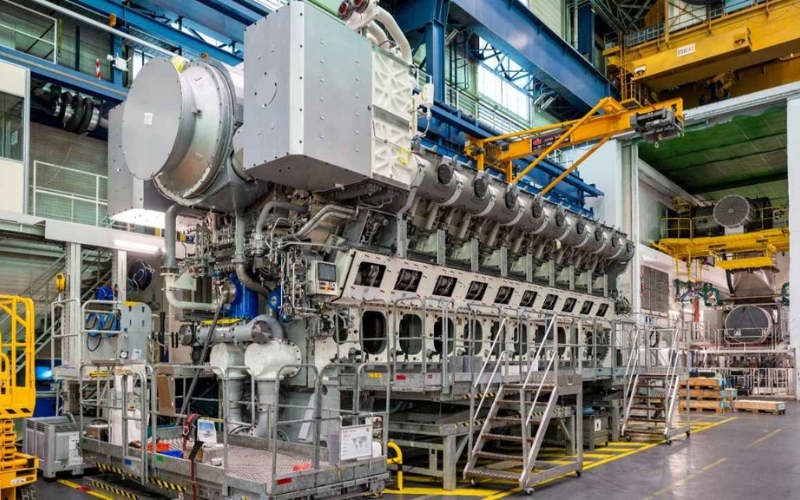
The Everllence 51/60 is the closest like-for-like rival to the Wärtsilä 50 platform. Its two-stage turbocharged version pushes output past 20 MW and holds full rated power even on hot days or at elevation. But it's heavy: the high-power version weighs about 345 tonnes, versus about 310 tonnes for the standard engine.
The HiMSEN H35/40G from Hyundai sits in a much smaller power class. You would need about 68 of the largest in-line version to match the 282 MW that 15 Wärtsilä 50SG engines deliver in Wärtsilä's latest data center order. That's more units to maintain, but it also means finer redundancy steps. Hyundai also builds a V-configured H35/40GV for higher outputs.
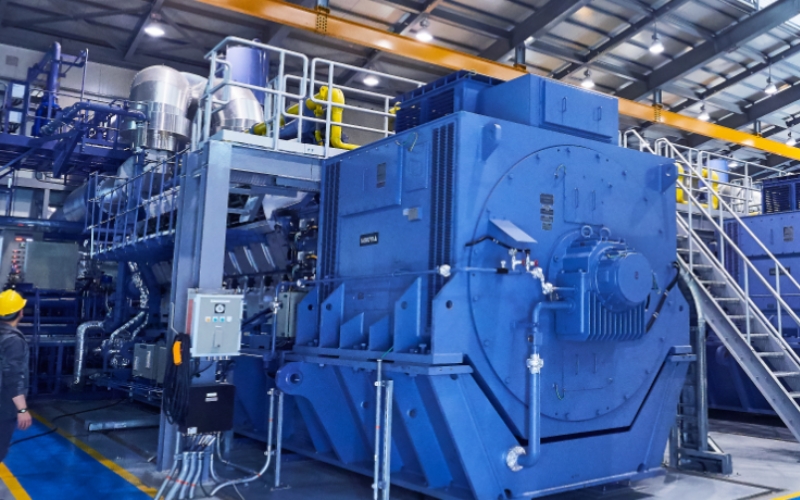
So which one should you pick? If you need liquid fuel at scale, the Wärtsilä 50 diesel engine is the only one of the three built for it. If you have firm gas, the Everllence 51/60 and the Wärtsilä 50SG compete head-to-head. And if you want many small, identical blocks, the HiMSEN H35/40G is worth a look.
What does a Wärtsilä 50 cost in 2026, and how long are lead times?
Wärtsilä doesn’t publish list prices for the Wärtsilä 50 engine, and every quote is project-specific. Lead times for new engines in 2026 commonly run around two years from order to factory release, and many large orders are scheduled for delivery in 2028 to 2030.
What drives the price
A Wärtsilä 50 quote can cover anything from a bare generating set to a full engineering, procurement, and construction plant. The big swing factors are scope (genset only, auxiliaries, or full plant), fuel system (heavy fuel oil treatment adds cost), emission controls, site conditions, and whether you bundle a long-term service agreement.
For a reality check, look at turbine benchmarks. The EIA’s Annual Energy Outlook 2026 assumptions put an aeroderivative simple-cycle plant at about $2,275 per kW and an industrial frame simple-cycle plant at about $1,158 per kW in 2025 dollars. EIA raised simple-cycle turbine costs by about 40% for this edition because of supply shortages and tight labor markets.
Engine plants aren’t in that EIA table, so use it as context, not a price. The takeaway is that every form of fast, dispatchable capacity got more expensive between 2023 and 2026.
Order sizes give you another clue. Wärtsilä’s €292 million order from Liberty Energy for Wärtsilä 34SG engines serving data centers shows the scale of 2026 commitments. Deliveries on that order start in 2029 and run through 2030.
Lead times for new engines
Wärtsilä’s own North American team pegged factory availability at around two years in early 2026. The same discussion put engines at 10% to 15% more fuel-efficient than simple-cycle turbines, which compounds fast on a large plant.
Recent orders confirm the pattern. The 282 MW data center order booked in the third quarter of 2026 is scheduled for delivery in 2028, and demand keeps climbing: Wärtsilä’s first-half 2026 report showed combined order intake up 45% to €2,813 million in the second quarter, with two straight record quarters in Energy.
Capacity is coming, but not this year
Wärtsilä is expanding its Vaasa, Finland factory, where it builds every engine type in its portfolio. It announced a 35% capacity increase in February 2026, due in the first quarter of 2028. In May 2026, it added a further 30% increase due in the first quarter of 2029, for a total of 65% above 2025 levels.
What does that mean for you? If you need power in 2027, a new-build Wärtsilä 50 is likely not your fastest route.
How do you buy a low-hour or refurbished Wärtsilä 50, and why would you?
You buy low-hour or refurbished Wärtsilä 50 engines to get power in months instead of years. The secondary market holds preserved, never installed, and lightly used units that never show up in any OEM backlog.
Why the secondary market matters in 2026
Heavy-duty gas turbines ordered today can face delivery as late as 2031. Combined-cycle lead times have stretched to roughly five years. That pressure pushes buyers straight into reciprocating engines, where queues are shorter but competition for available units is fierce.
Meanwhile, real plant sits idle. On your behalf, Acquire.Fi can source Wärtsilä generating sets mothballed after projects stalled before startup, combined heat and power units parked when the factory they served shut down, and entire stations whose owners prefer a sale over another decade of operation. We help buyers procure equipment that never hits public listings. Our team can also piece together a matched fleet of identical engines from several different sellers when one owner can’t fill the order.
The risks you need to manage
Used engines carry risks that new engines don’t. Watch for:
- Hidden wear: Hours on paper don’t always match condition inside the engine.
- Poor preservation: Idle engines without proper preservation can corrode.
- Fuel history: An engine that ran for years on heavy fuel oil wears differently from one on light fuel oil.
- Frequency mismatch: A 50 Hz set runs at 500 rpm and a 60 Hz set at 514 rpm, so moving between grids needs an engineering review.
- Regulatory status: In the US, the date an engine was ordered sets its construction date under Subpart IIII, and modification or reconstruction can change which rules apply.
A step-by-step buying process
Buying a refurbished or low-hour Wärtsilä 50 through Acquire.Fi follows the four stages of our order book. No stage opens until the one before it is complete. That sequencing keeps your money, your identity, and the seller's data safe until both sides have earned the next step.
- Tell the desk what your site needs. Give us the megawatts and engine count you're after, whether your grid runs at 50 Hz (500 rpm) or 60 Hz (514 rpm), your fuel plan, location, and the date you need power. The brief takes a couple of minutes, carries no commitment, and is never published.
- Pass the two-way background check. Before any names change hands, we confirm that the buyer and seller are who they say they are and have the authority and funding to transact. Your brief then runs against the units on our book and Wärtsilä engines that owners have kept off the open market. You'll hear back within a working day, even if that means telling you nothing suitable exists yet while we keep hunting.
- Open the engine's files in confidence. Introductions happen only once both sides are cleared under a nondisclosure agreement that binds you and the seller equally. The seller then sets the release schedule for the data pack, maintenance and oil analysis history, preservation records, and site photos.
- Prove the engine, then sign. Before anything binding gets signed, your engineers walk the engine, put a borescope through the cylinders, and reconcile the hour meter against the logbooks, with your lawyers reviewing the paperwork. Only then does the deal move to contract, with funds held in escrow and a heavy-lift carrier booked for a generating set this size. We remain your point of contact until the engine is synchronized and producing power.
The payoff is simple. A verified, well-preserved Wärtsilä 50 can put firm megawatts on your site years before a new-build slot opens up.
Sources
- Wärtsilä 50 diesel engine - https://www.wartsila.com/energy/engine-power-plant-solutions/engine-power-plant-products/wartsila-50-diesel-engine
- Engine power plant products - Wärtsilä Energy - https://www.wartsila.com/energy/engine-power-plant-solutions/engine-power-plant-products
- Wärtsilä 50DF dual fuel engine for power plants - Wärtsilä Energy - https://www.wartsila.com/energy/solutions/engine-power-plants/wartsila-50-liquid-fuel-power-plants
- Future-proofing Wärtsilä engine power plants for decarbonized energy systems - Wärtsilä Energy - https://www.wartsila.com/energy/sustainable-fuels/future-proofing-flexible-wartsila-engine-power-plants-for-decarbonised-energy-systems
- Wärtsilä secures extensive U.S. power plant order and service agreement, showcasing end-to-end project expertise - https://www.wartsila.com/media/news/03-06-2026-wartsila-secures-extensive-u-s-power-plant-order-and-service-agreement-showcasing-end-to-end-project-expertise-3757689
- Wärtsilä chosen for a major U.S. power plant project addressing critical energy demand driven by data center development - https://www.wartsila.com/media/news/29-01-2026-wartsila-chosen-for-a-major-u-s-power-plant-project-addressing-critical-energy-demand-driven-by-data-center-development-3711601
- Wärtsilä continues to expand its data center footprint with new 790 MW order in Texas, the next Data Center Alley - https://www.wartsila.com/media/news/23-04-2026-wartsila-continues-to-expand-its-data-center-footprint-with-new-790-mw-order-in-texas-the-next-data-center-alley-3744599
- Wärtsilä to supply 282 MW onsite power solution for a U.S. data center as AI growth intensifies demand for reliable power - https://www.wartsila.com/media/news/05-10-2026-wartsila-to-supply-282-mw-onsite-power-solution-for-a-u-s-data-center-as-ai-growth-intensifies-demand-for-reliable-power-3797450
- Wärtsilä’s 34SG engine makes its data center debut with new 412 MW U.S. project - https://www.wartsila.com/media/news/16-04-2026-wartsila-s-34sg-engine-makes-its-data-center-debut-with-new-412-mw-u-s-project-3740972
- Wärtsilä secures new order to power next wave of AI-driven data center growth in the U.S. - https://www.wartsila.com/media/news/29-06-2026-wartsila-secures-new-order-to-power-next-wave-of-ai-driven-data-center-growth-in-the-u-s--3767555
- Wärtsilä’s Half-year Financial Report January–June 2026 - https://www.wartsila.com/media/news/21-07-2026-wartsila-s-half-year-financial-report-january-june-2026-3773763
- Wärtsilä to further expand its production capacity in Finland by 35% to meet global increase in demand in energy and marine - https://www.utilitydive.com/press-release/20260216-wartsila-to-further-expand-its-production-capacity-in-finland-by-35-to-mee-1/
- Wärtsilä to further expand its technical production capacity by an additional 30% to meet the growing global demand in the energy and marine industries - https://www.wartsila.com/sgp/media/news/26-05-2026-wartsila-to-further-expand-its-technical-production-capacity-by-an-additional-30-to-meet-the-growing-global-demand-in-the-energy-and-marine-industries-3754327
- Start your engines for reliable data center onsite power - DCD - https://www.datacenterdynamics.com/en/marketwatch/start-your-engines-for-reliable-data-center-onsite-power/
- Wärtsilä bags two orders in Brazil - Gas to Power Journal - https://gastopowerjournal.com/news/brief-news/wartsila-bags-two-orders-in-brazil/
- No Turbine? Data Centers Find Faster Path With Natural Gas Reciprocating Engines - Natural Gas Intelligence - https://naturalgasintel.com/news/no-turbine-data-centers-find-faster-path-with-natural-gas-reciprocating-engines/
- V51/60G - Everllence - https://www.everllence.com/docs/default-source/energy-factsheets/evr-000013en_l3_v51-60g_preview.pdf?sfvrsn=652074c4_4
- Hyundai Total LNG to Power Solution - https://korindo-energy.com/wp-content/uploads/2020/05/Hyundai-Total-LNG-to-Power-Solution-Korindo-Energy.pdf
- Short-Term Energy Outlook, October 2026 - U.S. Energy Information Administration - https://www.eia.gov/outlooks/steo/archives/oct26.pdf
- Assumptions to the Annual Energy Outlook 2026: Electricity Market Module - U.S. Energy Information Administration - https://www.eia.gov/Outlooks/Aeo/assumptions/pdf/EMM_Assumptions.pdf
- New Source Performance Standards for Stationary Compression Ignition Internal Combustion Engines - U.S. EPA - https://epa.gov/stationary-engines/new-source-performance-standards-stationary-compression-ignition-internal-0
- Stationary Compression Ignition Internal Combustion Engines (CI ICE) - Subpart IIII - Nebraska Department of Water, Energy, and Environment - https://dwee.nebraska.gov/node/3830
- Directive (EU) 2015/2193, Article 2: Scope - legislation.gov.uk - https://www.legislation.gov.uk/eudr/2015/2193/article/2?view=plain
- Limitation of emissions of certain pollutants into the air from medium combustion plants - European Parliament Legislative Observatory - https://oeil.europarl.europa.eu/oeil/en/document-summary?id=1413962
- Environmental, Health, and Safety Guidelines for Thermal Power Plants - International Finance Corporation - https://www.ifc.org/content/dam/ifc/doc/2000/2008-thermal-power-ehs-guidelines-en.pdf
- NFPA 37-2021, Standard for the Installation and Use of Stationary Combustion Engines and Gas Turbines - ANSI Webstore - https://webstore.ansi.org/standards/nfpa/nfpa372021
- ISO 8528-1:2018 - International Organization for Standardization - https://www.iso.org/standard/68539.html
- Guidelines for the Lubrication of Medium Speed Diesel Engines (CIMAC Recommendation 29) - https://www.cimac.com/cms/upload/Publication_Press/Recommendations/Recommendation_29.pdf