.webp)

Key takeaways:
- The Siemens SGT 600 is a proven 24.5 MW industrial gas turbine with more than 363 units sold and a 99.5% fleet reliability rate.
- The machine fits phased AI data halls, colocation builds, cogeneration plants, and crypto mining sites converting to high-performance computing. Its 25 to 74 MW block sizes let you add capacity as demand grows rather than stranding capital.
- At 9 ppm nitrogen oxides, the Siemens SGT 600 meets the U.S. Environmental Protection Agency's 2026 limit for medium-size turbines without an added catalyst system. Its wide fuel range, including up to 60% to 75% hydrogen, lets you burn off-gas or stranded gas profitably.
- New Siemens SGT 600 units are booked out until fiscal 2028.
- Preserved, low-hour, and never-installed units on the secondary market can get you powered in months rather than years.
The Siemens SGT 600 gas turbine is a 24.5 MW industrial workhorse and in 2026 has quietly become one of the fastest routes to firm on-site power. New production slots are booked years ahead. That makes every preserved, low-hour, or never-installed Siemens SGT 600 a strategic asset.
Here’s why that matters to your business. Maybe you build AI capacity or host a cogeneration plant. Maybe you’re converting a Bitcoin mine to high-performance computing. Either way, your power date sets your revenue date. A machine you can energize in 2027 beats a better machine arriving in 2030.
What is the Siemens SGT 600 gas turbine?
The Siemens SGT 600 is a twin-shaft industrial gas turbine rated at 24.5 MW of electric output in simple cycle. Siemens Energy sells it for power generation and combined heat and power. It also serves combined cycle plants, oil and gas sites, and mechanical drive duty.
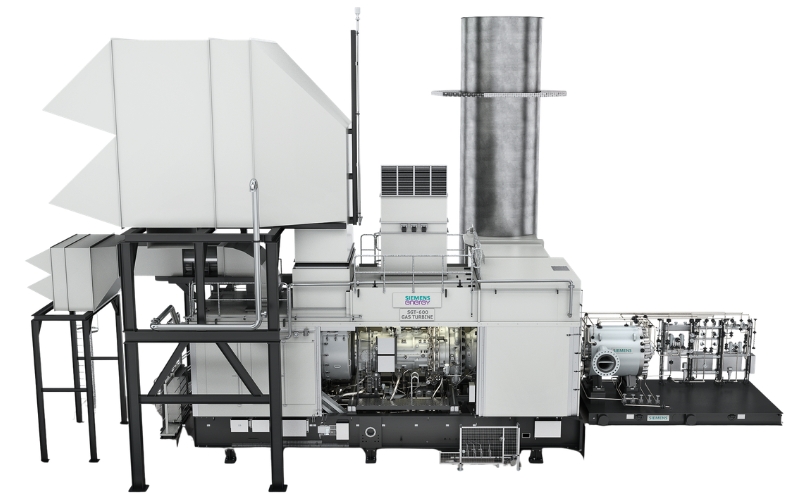
The platform has serious mileage behind it. The 363+ units sold have logged roughly 13 million operating hours with a reliability rate of 99.5%.
Siemens SGT 600 gas turbine specifications
Siemens Energy publishes these standard rating-condition figures for the power generation version:
- Electrical output: 24.5 MW at 50 or 60 Hz, which means one design serves both European and North American grids.
- Gross efficiency: 33.6%, with a heat rate of 10,720 kJ/kWh (10,161 Btu/kWh).
- Exhaust: 543°C at a mass flow of 81.3 kg/s, which is hot enough to raise useful steam.
- Nitrogen oxide emissions: 9 ppm or lower on natural gas with dry low emissions combustion.
- Fuel gas pressure: 24.5 bar(a), or 355.5 psi(a), at the site boundary.
- Package: about 152,000 kg and 18.8 m long by 4.6 m wide by 4.0 m tall, delivered as a single lift.
Two Siemens SGT 600 gas turbine specifications deserve extra attention. The low fuel gas pressure can shrink or eliminate on-site gas compression. The single-lift package cuts crane time and site work, which matters more than an extra point of efficiency when you’re racing a deadline.
A name change is coming
Siemens Energy announced on July 14, 2026, that it and Siemens Gamesa will move under a new brand called Omterra. Expect future quotes for the Siemens SGT 600 to carry the new name.
What are the Siemens SGT 600 use cases and notable deployments in 2026?
The Siemens SGT 600 gas turbine earns its keep in industrial power and heat, combined cycle plants, and oil and gas sites. Mechanical drive rounds out the classic list. In 2026, AI demand added a new job. Developers now use mid-size industrial turbines as modular, firm power blocks they can deploy in phases.
Reference projects that prove the platform
Siemens Energy points to three reference sites that show what the machine can handle:
- Braskem, São Paulo, Brazil (2022): two units with dry low emissions combustion built for up to 60% hydrogen co-firing at 25 ppm nitrogen oxides.
- Profertil, Bahía Blanca, Argentina (2015): one unit in a cogeneration setup that lifted urea output by 11% and ammonia by 9% on the same energy input.
- Yamama Saudi Cement, Riyadh (2006): nine dual-fuel units running through high heat, blown sand, and mineral dust.
AI hyperscalers
A single Siemens SGT 600 won’t anchor a gigawatt campus, since a 2x1 combined cycle block tops out around 74 MW. But that block size fits early data halls and on-site bridge power while a utility interconnection crawls through review. Once grid power arrives, those turbines become backup.
Colocation builders
Colocation economics reward capacity that grows with tenant demand. A 1x1 combined cycle block delivers 36.5 MW, so you can add power in roughly 25 to 37 MW steps instead of stranding capital.
Siemens Energy designed the Siemens SGT 600 to handle abrupt swings in demand. That matters when a tenant’s AI chip cluster ramps up hard and a battery system smooths the rest.
Cogeneration hosts
Cogeneration hosts care about the exhaust as much as the electricity. At 543°C, the Siemens SGT 600 runs hotter at the exhaust than the other machines in this article. More heat means more steam per megawatt, which is exactly how Profertil got more product from the same fuel.
Crypto miners converting to high-performance computing
Bitcoin miners own the thing AI companies want most: sites with power already attached. Bernstein reported in June 2026 that miners had signed 17 deals worth more than $110 billion, contracting about 6 GW of power to AI customers. That’s roughly 10% of all U.S. AI data centers under construction.
But here’s the catch. Mining load can switch off when power is expensive, while high-performance computing tenants expect near-continuous uptime. Converted sites often need firm on-site generation to back up the grid.
The Siemens SGT 600 fits that gap surprisingly well. Five running units cover about 120 MW at standard rating conditions. A sixth unit gives you N+1 redundancy, so one machine can sit in maintenance without cutting capacity.
What plant configurations does the Siemens SGT 600 support?
The Siemens SGT 600 runs in four setups. Simple cycle and combined cycle cover pure power, while combined heat and power and mechanical drive serve industrial sites. Siemens Energy offers standardized 1x1 and 2x1 combined cycle plants under the SCC-600 name.
Simple and combined cycle
Simple cycle is the fastest and cheapest way to get electrons out of the machine, which makes it the natural choice for bridge power. Adding a heat recovery boiler and a steam turbine pushes efficiency past 50%. Siemens Energy lists these figures for two-pressure plants without reheat:
- SCC-600 1x1: one gas turbine producing 36.5 MW gross at 50.7% plant efficiency.
- SCC-600 2x1: two gas turbines producing 74.2 MW gross at 51.6% plant efficiency.
What does that buy you? About 50% more electricity from the same gas. For a baseload data center that runs around the clock, the fuel savings compound every single month.
Combined heat and power
Combined heat and power sends the steam into industrial processes instead of only making electricity. Your useful output per unit of fuel climbs well above any power-only setup.
Mechanical drive
Industrial buyers can skip the generator entirely. The mechanical drive version delivers 25.2 MW at 34.6% efficiency. It runs from 50% to 105% of nominal speed, or 3,850 to 8,085 rpm, to drive compressors and pumps directly. The same core engine powers both versions, so spare parts carry across.
How fuel flexible is the Siemens SGT 600?
The Siemens SGT 600 burns a much wider range of gases than a standard pipeline-gas turbine. Siemens Energy lists the following limits by volume:
- Ethane and propane: up to 100%.
- Butanes and heavier alkanes: up to 15%.
- Nitrogen: up to 40%.
- Hydrogen: Siemens Energy quotes up to 60% in one part of its product page and up to 75% in another, so confirm the figure for your exact configuration.
- Hydrogen sulfide: around 3% to 3.5%, depending on which section of the page you read.
The machine also runs on No. 2 diesel. It can switch between gas and liquid fuel while carrying load. That makes it a strong pick if your site needs a backup fuel tank for resilience.
Why should you care? Fuel flexibility turns cheap or stranded gas into revenue. Refineries can burn off-gas, and miners sitting on wellhead gas can power computing instead of flaring it.
What do emissions and permitting look like for the Siemens SGT 600?
The Siemens SGT 600 achieves 9 ppm nitrogen oxides or lower on natural gas between 50% and 100% load. On No. 2 diesel, it reaches 63 ppm or lower without water injection.
The 2026 federal rule
In January 2026, the U.S. Environmental Protection Agency finalized new emission standards for stationary combustion turbines. The final rule appeared in the Federal Register on January 15, 2026 as 40 CFR part 60, subpart KKKKa. It applies to any turbine whose construction or rebuild began after December 13, 2024, including modified units.
The rule sorts turbines by heat input. The Siemens SGT 600 burns roughly 250 to 280 million Btu per hour at full load. That puts it inside the medium band of 50 to 850 million Btu per hour.
Here’s what the Environmental Protection Agency fact sheet sets for new natural gas turbines in that band:
- High utilization (running above 45% of its possible annual output): 15 ppm nitrogen oxides with combustion controls alone.
- Low utilization: 25 ppm nitrogen oxides.
- Temporary turbines: 25 ppm, but the unit loses temporary status if it stays in place longer than 24 months.
Now compare that with the big frames. Large turbines above 850 million Btu per hour running at high utilization must add a post-combustion catalyst and meet 5 ppm. A Siemens SGT 600 at 9 ppm meets the medium-band limit without that extra hardware, saving capital and permitting time.
What still needs your attention
Federal limits are a floor, and state air districts can set tighter rules. You cannot swap one temporary turbine for another to extend past 24 months. Ask your permit engineer how a relocated or preserved unit will be classified before you sign anything.
How does maintenance and service work for the Siemens SGT 600?
The Siemens SGT 600 runs 34,000 equivalent operating hours between hot section inspections. The machine needs only 14 scheduled maintenance days over a 17-year service cycle.
Fast swaps instead of long outages
Crews can service the machine on site or pull the gas generator for shop work. A gas generator swap takes about 24 hours.
For a data center, that changes the redundancy calculation entirely. A spare gas generator in the yard turns a major service event into a roughly one-day swap.
Built for technicians
Crews can replace burners from outside the engine. Split casings and multiple borescope ports let technicians inspect the compressor without tearing it down.
Service programs
Siemens Energy offers long-term service programs, overhauls, and spare parts. Its remote diagnostic service compares your machine’s data against the wider fleet to catch faults early.
How does the Siemens SGT 600 compare with Baker Hughes NovaLT16, Kawasaki L30A, and Solar Turbines Titan 250?
The Siemens SGT 600 trades a few points of efficiency for hotter exhaust, broad fuel tolerance, and a fleet of more than 363 units. The Kawasaki L30A and Solar Turbines Titan 250 lead on simple-cycle efficiency. The Baker Hughes NovaLT16 leads on hydrogen.
What the numbers mean for you
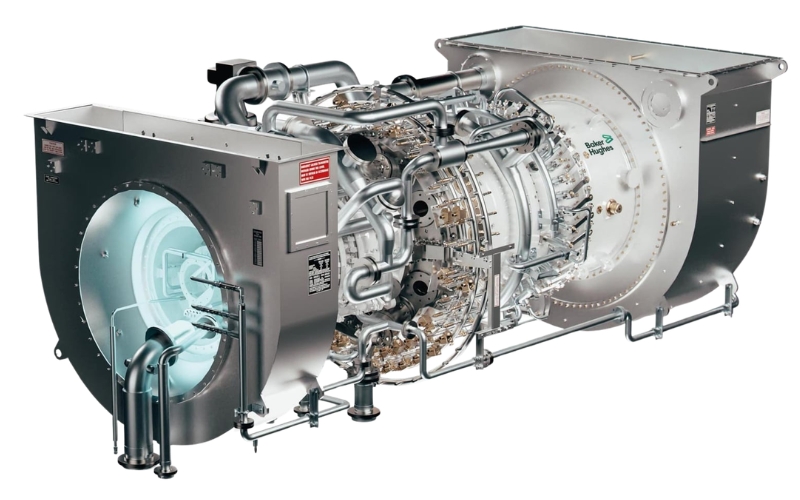
The Baker Hughes NovaLT16 is the smallest machine here at 16.9 MW. It can start up on 100% hydrogen without a pilot fuel. Pick it if hydrogen is a near-term plan rather than a press release.
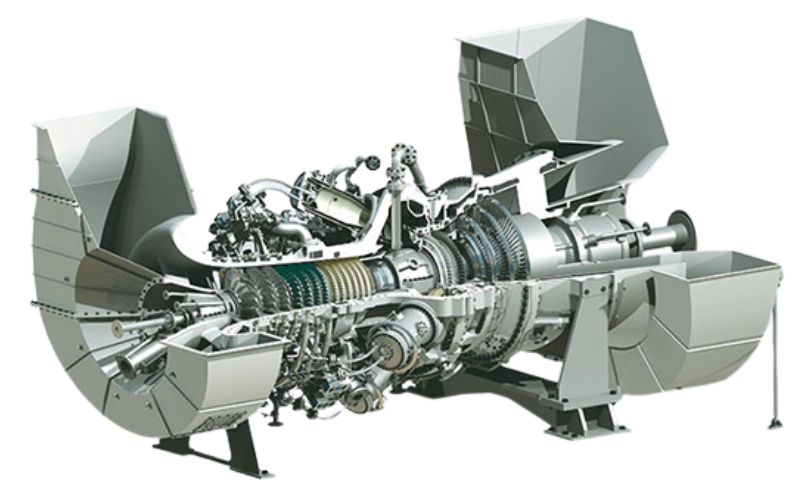
The Kawasaki L30A turns 40.1% of its fuel energy into electricity, a figure no rival in the 20 to 35 MW range beats. It runs six years between overhauls. If fuel is your biggest operating cost, start here.
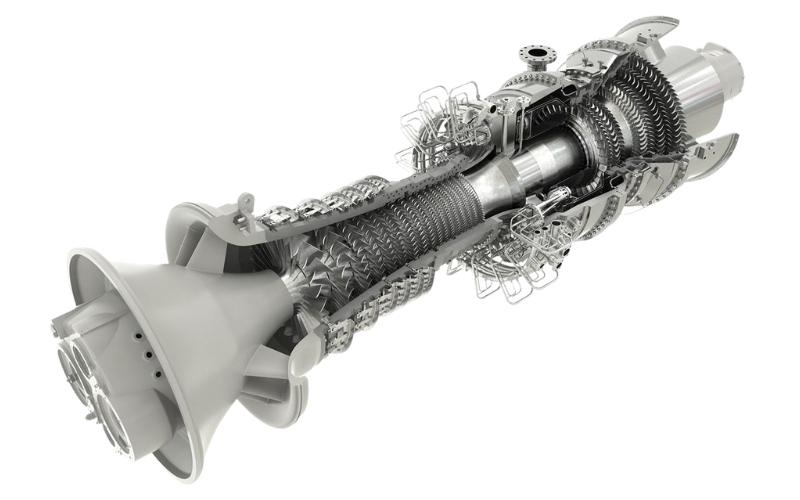
The Solar Turbines Titan 250 produces 23,100 kWe at 40% shaft efficiency. It squeezes half again as much output as its Titan 130 into a package of the same size. Its 465°C exhaust supports up to 135 tonnes of steam per hour in cogeneration.
So where does the Siemens SGT 600 gas turbine come out ahead? It wins when your fuel is messy, your exhaust heat has a buyer, or your lender wants a long operating record. It loses when every point of efficiency drops straight to your bottom line.
What is the Siemens SGT 600 lead time in 2026?
Siemens Energy has no open factory capacity before fiscal 2028, according to its June 2026 investor call. The 2029 and 2030 slots are filling quickly too. Buyers are paying extra to jump the line, showing delivery dates now outrank fuel economy.
The backlog explains why. Siemens Energy closed its fiscal third quarter with a firm gas turbine backlog of 69 GW. It has capacity for about 80 medium-sized gas turbines a year and plans to reach roughly 100 by 2028.
Should you buy a new Siemens SGT 600 or one from the secondary market?
Buying a new Siemens SGT 600 gets you current controls, factory testing, and a clean warranty. The catch is time. Siemens can't take new orders until 2028, and new units ordered at that time will roughly take 5 years before they can be delivered.
Buy secondary if your revenue depends on a fixed power date. Plenty of deployable equipment sits idle. Scrapped developments strand brand-new units that never reached a foundation. Shuttered industrial hosts often mothball their turbines under the maker’s storage protocol.
What to verify before you buy
Secondary units vary widely in condition. Run every candidate through this checklist:
- Hours and starts: Confirm operating hours and start counts against original logs.
- Borescope inspection: Have an independent adviser inspect the compressor and hot section.
- Preservation records: Ask for documentation showing the unit was stored to manufacturer instructions.
- Frequency and voltage: Check the 50 or 60 Hz rating and generator voltage against your grid or site design.
- Controls and service: Confirm the control system is supportable and the unit qualifies for a Siemens Energy service program.
How do you buy refurbished and preserved Siemens SGT 600 units with Acquire.Fi?
The Acquire.Fi gas turbine order book enables AI hyperscalers, colocation builders, cogeneration hosts, crypto miners converting to HPC to accelerate Siemens SGT 600 procurement. You describe the unit you need, let our team vet a seller, and close after your own checks. The form is quick and has no obligation:
- Describe what you need. Enter your target capacity and grid frequency on the buyer requirement form. Add your timeline, site location, and unit count.
- Let Acquire.Fi vet both sides. Our team will check who you are and who the seller is, then search public and private inventory for a fit. Expect a reply by the next business day.
- Get introduced confidentially. After both parties pass the checks, a confidentiality agreement covers the first conversation. The seller decides what to share and when, from inspection reports to run-hour logs.
- Verify the unit and sign. Your own engineers examine the turbine and confirm its operating history. Payment then moves through escrow under a signed purchase agreement.
You pay nothing up front. Acquire.Fi earns a fee only when a transaction actually completes. If you need a matched set of five to ten units, we can assemble one from several sellers.
Holding a unit you won’t run? Preserved cogeneration packages and idle stations have screened buyers waiting. You can list your equipment or site and keep your name confidential until you sign off on a buyer.
The bigger picture matters here. Power has become the gating factor for AI and high-performance computing. It now limits industrial growth too, and new turbine slots already stretch into 2030. Every Siemens SGT 600 that moves from storage to a working site adds firm capacity years ahead of the factory queue. Start your search now, while the right units are still on the market.
Sources
- SGT-600 gas turbine - fuel flexibility & maximized uptime - https://www.siemens-energy.com/global/en/home/products-services/product/sgt-600.html
- Siemens Energy begins preparations for the launch of an independent brand - https://www.siemens-energy.com/global/en/home/press-releases/omterra-brand-announcement.html
- Fermi Inc. fiscal year 2025 shareholder letter (Form 8-K exhibit 99.1) - https://www.sec.gov/Archives/edgar/data/2071778/000207177826000007/frmiex991fy2025shletter.htm
- Bitcoin Miners Emerge as ‘Power Landlords’ of AI Boom, And Revenue Will Surge: Bernstein - https://decrypt.co/370047/bitcoin-miners-power-landlords-ai-boom-revenue-surge-bernstein
- Federal Register: New Source Performance Standards Review for Stationary Combustion Turbines and Stationary Gas Turbines - https://www.federalregister.gov/documents/2026/01/15/2026-00677/new-source-performance-standards-review-for-stationary-combustion-turbines-and-stationary-gas
- Fact Sheet: New Source Performance Standards for Stationary Combustion Turbines: Final Rule - https://www.epa.gov/system/files/documents/2026-01/correct_fact-sheet-nsps-stationary-combustion-turbines.pdf
- NovaLT16 Gas Turbine | Baker Hughes - https://www.bakerhughes.com/gas-turbines/novalt-technology/novalt16
- L30A-01D/DLH Gas Turbine | Kawasaki Heavy Industries - https://global.kawasaki.com/en/corp/sustainability/green_products/L30A-01D_DLH.html
- Titan 250 | Solar Turbines - https://www.solarturbines.com/en_US/products/power-generation-packages/titan-250.html
- Gas turbine prices soar 195% as market faces supply-demand crisis - https://www.woodmac.com/press-releases/gas-turbine-prices-soar-195-as-market-faces-supply-demand-crisis/
- Cost to construct new gas plants surges by 66% as data center demand strains supply chain - report - https://www.datacenterdynamics.com/en/news/cost-to-construct-new-gas-plants-surges-by-66-as-data-center-demand-strains-supply-chain-report/
- Data centers drive record surge in GE Vernova power equipment orders as turbine slots tighten through 2030 - https://www.power-eng.com/gas/turbines/data-centers-drive-record-surge-in-ge-vernova-power-equipment-orders-as-turbine-slots-tighten-through-2030/
- Siemens Energy lifts global gas turbine outlook on data center demand - https://www.spglobal.com/energy/en/news-research/latest-news/electric-power/063026-siemens-energy-lifts-global-gas-turbine-outlook-on-data-center-demand
- Siemens gas turbine backlog nears 70 GW as company expands manufacturing - https://www.utilitydive.com/news/siemens-gas-turbine-backlog-nears-70-gw-as-company-expands-manufacturing/827390/




.webp)