.webp)

Key takeaways:
- The Siemens SGT 800 gas turbine delivers 45 to 62 MW at up to 41.1% simple-cycle efficiency. Its 596 °C exhaust makes it a strong fit for combined cycle and cogeneration plants.
- It runs on gas, diesel, or both, switching fuels under load. It can handle blends with up to 75% hydrogen and needs only 27 to 31 bar(a) of gas pressure, often removing the need for an on-site compressor.
- Under EPA's 2026 turbine rule, the SGT 800 falls in the medium class. A baseload unit tuned to 15 ppm NOx can meet the US federal limit without a catalyst.
- New units have lead times of three years or more, and GE Vernova is already booking 2031 delivery slots. If you need power by 2027 or 2028, a new factory order probably won’t get you there.
- A refurbished SGT 800 from a secondary market lets you skip the factory queue.
The Siemens SGT 800 gas turbine is one of the most bankable 45 to 62 MW machines to build a power plan around in 2026. The catch? New units have a factory queue of three years or more, so a preserved or low-hour unit may be your fastest path to firm power.
Why should you care now? Whether you run an AI campus, a colocation build, or a Bitcoin mine turning into a high-performance computing site, your bottleneck isn’t GPUs anymore. It’s megawatts you can actually energize.
What is the Siemens SGT 800 gas turbine?
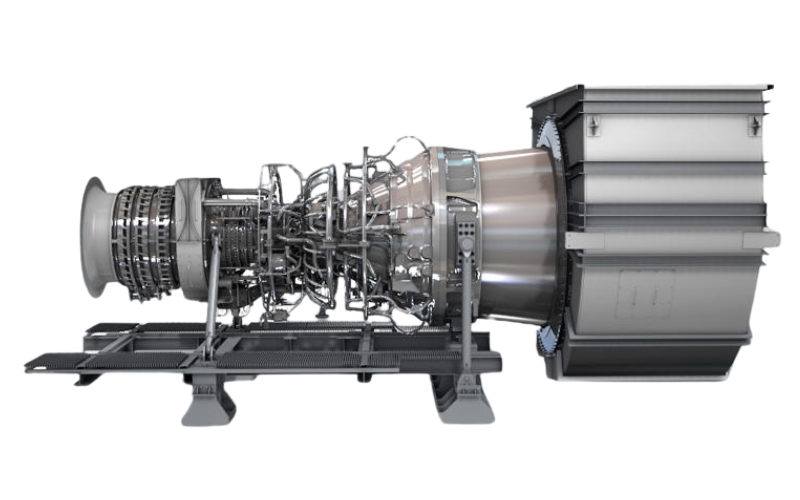
The Siemens SGT 800 gas turbine is a single-shaft industrial gas turbine that produces between 45 and 62 MW in simple cycle. Siemens Energy builds it for power generation, combined heat and power, and oil and gas duty. The fleet is in 620 installations and has more than 20 million combined operating hours.
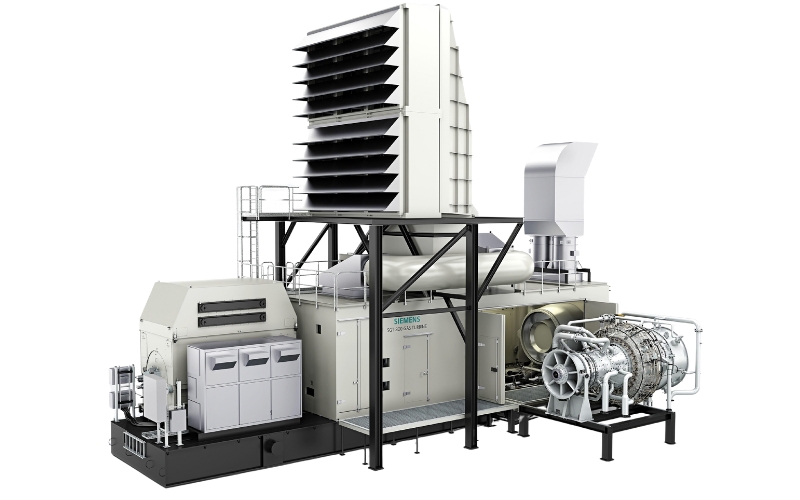
The machine itself is refreshingly simple. Its two-bearing rotor holds fifteen compressor stages and three turbine stages. Fewer parts mean fewer things that could break.
Another great feature is its hot exhaust. At the 62 MW rating, exhaust leaves at about 596 °C, which makes the turbine a natural steam maker for combined cycle and cogeneration. If your site can use heat, you squeeze far more value out of every unit of gas.
Where the Siemens SGT 800 fits your power plan
Siemens Energy has already built a data center playbook around this turbine. Its joint data center power concept with Eaton uses multiple Siemens SGT 800 units in a standard 500 MW plant with redundancy and battery storage. The partners say that design lets you skip diesel backup gensets and cuts CO2 emissions by about 50%.
What configurations and package solutions does the Siemens SGT 800 come in?
The Siemens SGT 800 ships in two package styles: a classic package and a single-lift package. You can get either one for 50 Hz or 60 Hz grids, with standard options for very hot and very cold climates.
Classic package
The classic package puts the gas turbine and gearbox on one base frame. Mechanical auxiliary systems sit on a separate skid inside the same enclosure, where your crews can also run inspections and overhauls.
Single-lift package
The single-lift package arrives factory-assembled and takes up less floor space. You can order just the driver unit and set the generator on its own foundation, or take the whole train on one skid with three mounting points, which suits power barges such as Siemens Energy's SeaFloat plants.
Why does that matter? Single-lift means faster installation and commissioning. You can swap the core engine in about 48 hours.
Plant scopes from package to turnkey
Siemens Energy sells the Siemens SGT 800 in four scopes of supply: package, power island, power block, or turnkey power plant. Pick the one that matches how much of the build you want to own.
For combined cycle, Siemens Energy markets the SCC-800 plant in 1x1, 2x1, and 3x1 layouts. A 2x1 block delivers up to 182 MW, and Siemens Energy claims cogeneration efficiency above 92% with supplementary firing.
What are the Siemens SGT 800 specifications?
The current Siemens SGT 800 specifications span five ratings from 45.3 MW to 62.5 MW of gross power output. Every rating runs at 6,600 rpm, burns gas or liquid fuel, and works on 50 Hz or 60 Hz grids through a gearbox.
These are ISO figures on natural gas with no inlet or exhaust losses. Real-world output drops on hot days. That’s why the hot-climate option exists.
Combined cycle and physical Siemens SGT 800 specifications
At the 62 MW rating, the pressure ratio is 21.1:1 and exhaust flow is 135.5 kg/s. A 1x1 combined cycle block produces 89 MW at 59.6% gross efficiency, while a 3x1 block reaches 273 MW.
A standard package weighs about 300,000 kg. With the generator included, the 62 MW standard package measures 25.4 m long and 7.2 m wide. The single-lift version is narrower at 4.7 m.
Buying used Siemens SGT 800? Many units on the secondary market carry older ratings. An earlier Siemens brochure for the turbine lists the 47.5 to 57 MW ratings and a 10-minute start capability, so match the nameplate to the right data sheet before you model returns.
How fuel-flexible is the Siemens SGT 800?
The Siemens SGT 800 gas turbine runs on gas only, liquid only (diesel No. 2), or dual fuel, and it can switch fuels while carrying load. That means a pipeline hiccup doesn't have to take your data hall offline.
Siemens Energy says the turbine tolerates gas with lots of inerts, hydrogen, or heavy hydrocarbons without shortening maintenance intervals. The engine's dry low emission burners can burn up to 75% hydrogen by volume.
Low gas pressure and hydrogen readiness
The turbine needs a gas supply pressure of only 27 to 31 bar(a), or 390 to 450 psi(a). That’s a big deal for remote sites because it often removes the need for an on-site gas compressor.
Siemens Energy was also the first company to earn TÜV SÜD's "H2-Ready" certification for a power plant concept built on this turbine, which gives your investors a credible decarbonization story.
What do emissions and air permitting look like for the Siemens SGT 800?
Every Siemens SGT 800 carries a dual-fuel dry low emission combustion system. Siemens Energy publishes 15 to 25 ppmvd NOx at 15% oxygen on gas, single-digit CO, and a combustor capable of reaching 9 ppm NOx.
It stays low on liquid fuel too, without water injection. For a water-stressed site, that's one less utility to permit.
The 2026 US federal turbine rule
The U.S. Environmental Protection Agency (EPA) finalized new performance standards for stationary combustion turbines in January 2026, published as 40 CFR part 60, subpart KKKKa in the Federal Register. The rule covers turbines built, modified, or reconstructed after December 13, 2024.
According to the EPA fact sheet on the final rule, medium turbines between 50 and 850 MMBtu/h of heat input face a 15 ppm NOx limit above a 45% capacity factor. Below that, the limit is 25 ppm. EPA only based its tightest 5 ppm limit, for large high-utilization turbines, on selective catalytic reduction.
At its 62 MW rating, the Siemens SGT 800 burns roughly 520 MMBtu/h of fuel on a lower heating value basis. That puts it in the medium class. A baseload unit tuned to 15 ppm can meet the federal floor without a catalyst. Your state air agency can still demand tighter limits, so budget for that conversation early.
The EU floor under the Industrial Emissions Directive
In the EU, each Siemens SGT 800 counts as a large combustion plant. At about 152 MW of fuel input per unit, it sits far above the 50 MW line where the Medium Combustion Plant Directive stops applying.
Annex V of the Industrial Emissions Directive caps new gas turbines at 50 mg/Nm³ NOx and 100 mg/Nm³ CO on natural gas. Those limits apply above 70% load. Simple-cycle turbines above 35% efficiency get a higher NOx cap scaled to their efficiency. Honestly, that matters less than you'd think, because the Annex V numbers are only a backstop.
Plants of 100 MW fuel input or more must also measure NOx and CO continuously. Expect stack monitoring from day one.
How reliable is the Siemens SGT 800, and what does maintenance involve?
Siemens Energy reports 99.1% average fleet reliability for the Siemens SGT 800 gas turbine core engine and auxiliary systems in 2024.
Major overhauls come at up to 60,000 equivalent operating hours, based on either time or start cycles. You choose on-site maintenance or modular overhaul with the classic package, or off-site work with a 48-hour core engine swap on the single-lift package. A vertically split compressor casing also lets technicians replace parts on site.
What this means for a refurbished unit
The 60,000-hour interval is your yardstick when valuing a used turbine. A unit fresh out of a major overhaul is close to new in maintenance terms, while one at 55,000 hours since its last major comes with an overhaul bill attached.
How does the Siemens SGT 800 compare with heavy-duty gas turbines in its class?
The Siemens SGT 800 beats both the GE Vernova 6B and the Mitsubishi Power H-25 on output and efficiency. The 6B wins on fuel ruggedness, and the H-25 wins on compact cogeneration steam.
Siemens Energy quotes gross figures, GE Vernova quotes net, and Mitsubishi Power quotes ISO base ratings, so treat the gaps as directional.
Fuel economics in plain numbers
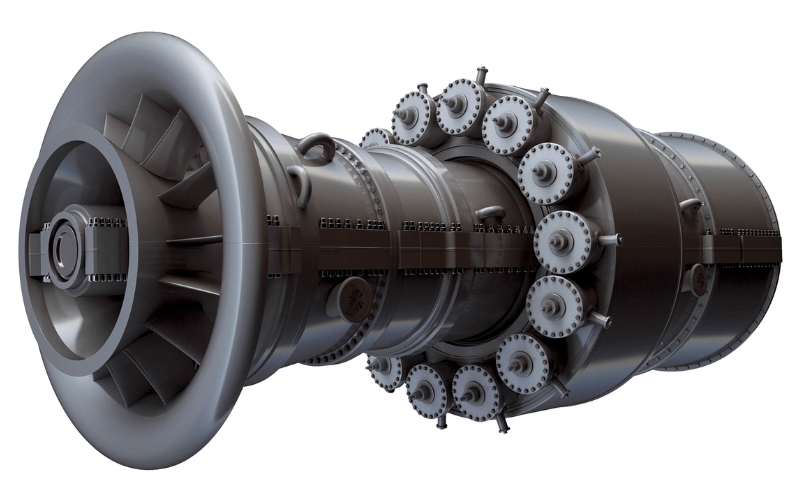
On paper, the GE Vernova 6B needs about 23% more fuel per MWh than the 62 MW Siemens SGT 800 rating. Every 100,000 MWh you generate, that gap is roughly 202,000 GJ, or about 191,000 MMBtu of gas. At an assumed $3 per MMBtu, you'd spend roughly $575,000 more on fuel.
Where the GE 6B and Mitsubishi H-25 still shine
The 6B has more than 1,200 units installed since 1978 and handles heavy oils, naphtha, syngas, and up to 100% hydrogen with standard combustion. It also offers island mode and black start, which frankly makes it a beast for remote industrial sites.
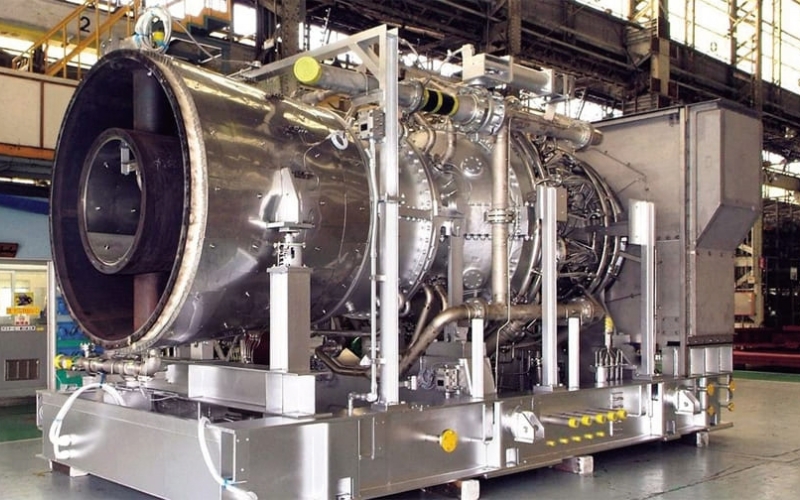
The Mitsubishi Power H-25 is smaller at 41 MW. It produces 79 tons per hour of steam in cogeneration, but it takes 22 minutes to start and ramps at 3.4 MW per minute. Of these three heavy-duty gas turbines, the Siemens SGT 800 gas turbine gives you the most megawatts per unit.
How does the Siemens SGT 800 compare with aeroderivatives in its class?
The Siemens SGT 800 matches the GE Vernova LM6000 and the Mitsubishi Power FT4000 on simple-cycle efficiency at about 41%. The aeroderivatives win on start speed, while the Siemens SGT 800 wins on exhaust heat for steam and on price per kW.
Start speed versus steam.
The GE Vernova LM6000 reaches full power in about 5 minutes and claims more than 99% start reliability. The Mitsubishi Power FT4000 SWIFTPAC hits full power 10 minutes from a cold start, and its 140 MW version pairs two engines on one generator.
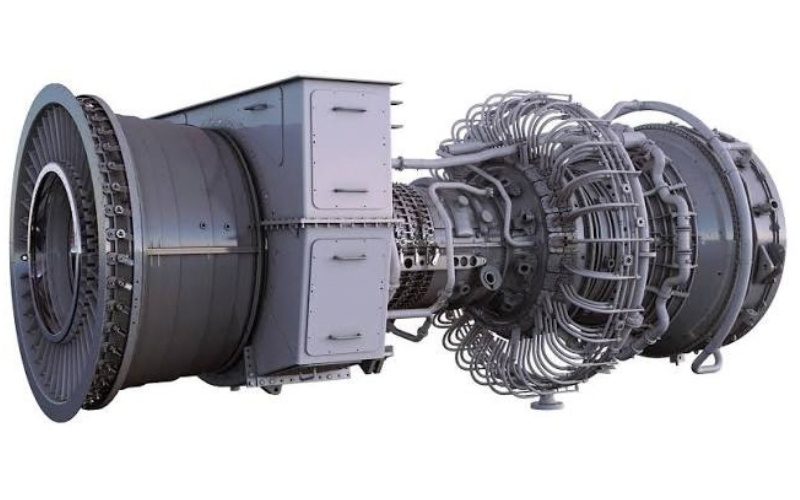
But the FT4000's exhaust runs at only 422 to 431 °C, versus 596 °C for the top Siemens SGT 800 rating. That gap shows up directly in your steam output.
Water, cost, and the 2026 pricing gap
The FT4000 controls NOx with water injection, so you need a reliable supply of treated water. The Siemens SGT 800 stays dry on both gas and liquid fuel.
Cost matters even more. BNP Paribas Equity Research estimated about $790 per kW for heavy-duty turbines and about $1,800 per kW for aeroderivatives, as Utility Dive reported in its GE Vernova Q2 2026 coverage. For a 60 MW block, that spread works out to about $60 million before you pour a foundation.
What is the Siemens SGT 800 price and lead time in 2026?
Siemens Energy doesn't publish a list of Siemens SGT 800 prices. The best public benchmark is BNP Paribas Equity Research's July 2026 estimate of about $790 per kW for heavy-duty gas turbines, as reported by Utility Dive.
Applied to a 62.5 MW unit, that benchmark implies roughly $49 million for the turbine alone. Treat that as a rough illustration rather than a quote. Industrial-class units, package scope, and contract terms all move the number in today's heavy-duty gas turbine market.
Lead times for new units
Siemens Energy CFO Maria Ferraro said in August 2026 that lead times across the company run three years or more, per Utility Dive's report on Siemens Energy's 69 GW backlog. Siemens Energy plans to lift medium gas turbine capacity from about 80 units today to about 100 units by 2028.
GE Vernova is already taking reservations for 2031 deliveries. If your energization date is 2027 or 2028, a new factory slot probably won't save you.
Why are heavy-duty gas turbines like the Siemens SGT 800 in such demand in 2026?
Heavy-duty gas turbines are sold out in 2026 because data center power demand is outrunning grids on both sides of the Atlantic. GE Vernova, Siemens Energy and Mitsubishi Heavy Industries dominate heavy-duty supply, and all three are booking years ahead.
The International Energy Agency's April 2026 data center analysis found data center electricity demand jumped 17% in 2025 and expects it to double by 2030. Capital spending by five large technology companies passed $400 billion in 2025 and is set to rise another 75% in 2026.
The US grid can't keep up.
U.S. developers plan just 6.3 GW of new gas-fired capacity in 2026 out of a record 86 GW of total additions, according to the EIA's February 2026 capacity outlook. That's tiny next to the load hyperscalers are chasing.
Europe's data center load is climbing fast.
European data centers used 87 TWh of electricity in 2024, and that figure should hit 134 TWh by 2030, according to ENTSO-E's May 2026 data center report. The association of European grid operators sees 199 to 254 TWh by 2035.
Europe already has more than 10,500 data center facilities with about 12.7 GW of IT power. Roughly 9.9 GW of that sits inside the EU27, and the growth is honestly just getting started.
Europe's real bottleneck is the grid connection.
Almost 80% of European data center operators now rank access to electricity as their biggest challenge, per the same ENTSO-E report. Even the quickest grid connections take a few years, and crowded hubs like Frankfurt and Dublin can top a decade.
So what's the workaround? ENTSO-E points to "bring your own generation" deals, where the data center builds dispatchable power on site. In one US case the report cites, pairing on-site generation with flexible grid access got a campus fully running three to five years sooner.
Ireland pushes even harder. Its recent rules require new data centers to bring on-site generation for their full capacity, plus new renewables covering 80% of their energy use. A 50 to 62 MW machine like the Siemens SGT 800 gas turbine is built for exactly that kind of on-site block.
The heavy-duty gas turbine market is booked solid.
Siemens Energy's Gas Services unit booked 102 gas turbines in the first quarter of fiscal 2026, its best order quarter ever, per the Siemens Energy Q1 FY2026 earnings release. The US supplied 40% of those orders, and Europe supplied 35%.
GE Vernova ended the second quarter of 2026 with 116 GW of gas turbine backlog and slot reservations, as Turbomachinery Magazine covered in its record-quarter roundup. That's a heavy-duty gas turbine market running at full tilt, and buyers who wait are paying for it in time.
How do you buy a refurbished Siemens SGT 800, and why should you?
You buy a used Siemens SGT 800 on the secondary market, where owners sell refurbished, preserved, and low-hour units that are already built. Acquire.Fi's Gas Turbine Order Book works that market by matching screened buyers with machines sitting outside the factory queues.
Why go this route? Speed. A refurbished unit can typically reach your site within 12 months, while a new heavy-duty unit can take five years or more to arrive.
Where do used Siemens SGT 800 units come from?
Most used Siemens SGT 800 units come from three places discussed below. Each source tends to produce a different kind of machine, so knowing the backstory tells you what to inspect.
Owners upgrading to newer ratings
The fleet spans almost 30 years of uprates, from 43 MW units in 1997 to today's 62 MW rating. That gap pushes some owners to swap older machines for newer ones rather than keep running them. Units that leave service this way usually ran under a long-term service program and kept good records. The trade-off is hours, so check where each one sits against the 60,000-hour overhaul interval.
Industrial hosts that shut down
Paper mills, chemical parks and industrial estates are classic cogeneration hosts for this turbine. When the host shuts down, its on-site power plant often has no reason to keep running. Turbines from closed sites can be surprisingly low-hour. But they may have sat idle for months, so ask for preservation records and a recent borescope before you trust the nameplate.
Power producers reshaping their fleets
Independent power producers and utilities sell plants when contracts expire, portfolios get restructured, or a site is repurposed. Sometimes you get a single genset, and sometimes you get a full combined cycle block with steam turbine and heat recovery steam generator.
How to buy used Siemens SGT 800 with Acquire.Fi
The process runs in four stages. Each one protects you before real money moves:
- Post your requirement: share capacity, frequency, and timeline plus your site and unit count in a two-minute form that commits you to nothing.
- Get screened and matched: the desk verifies both sides and replies within one business day with a match or a straight "nothing yet."
- Review under a nondisclosure agreement: the seller releases specification packs, inspection reports, and hours records in stages.
- Inspect and close: you run a physical inspection, borescope, and hours check with your own advisers. Then you move through the purchase agreement, escrow, and logistics.
Posting is free, and Acquire.Fi gets paid a success fee only when a deal closes. Nobody learns who you are until you sign off on a particular introduction.
What drives a refurbished Siemens SGT 800 price
A used Siemens SGT 800 price swings with condition and scope. These factors move the number most:
- Hours since the last major overhaul: Distance from the 60,000-hour interval sets your near-term maintenance bill.
- Rating and vintage: A 45 MW unit and a 62 MW unit are very different assets.
- Frequency: A 50 Hz unit on a 60 Hz site usually means gearbox and generator changes.
- Preservation records: Manufacturer-documented preservation protects value on units that sat idle.
- Scope: A bare genset prices far below a full cogeneration or combined cycle block.
What should you check during diligence on a used Siemens SGT 800?
Diligence on a used Siemens SGT 800 comes down to proving three things: the hours are real, the hardware is intact, and the unit fits your site. Bring your own turbine engineer, because the seller's paperwork is a starting point, not a verdict.
Work through these checks before you sign a purchase agreement:
- Compare equivalent operating hours and start counts against the 60,000-hour major overhaul interval. That tells you how soon your first big maintenance bill lands.
- Ask for every inspection and overhaul report, plus any long-term service program history. Gaps in the paper trail usually mean gaps in the maintenance.
- Have your engineer scope the compressor, combustor, and turbine stages yourself. Look hard at blade coatings, cracking, and foreign object damage.
- If the unit sat idle, confirm it was preserved to Siemens Energy instructions. Humidity control and rotor turning matter more than the seller's word.
- Match the rating to the correct data sheet and check whether an uprate is possible.
- Confirm 50 Hz or 60 Hz, and inspect the gearbox and generator as closely as the core engine.
- Verify gas-only or dual-fuel configuration and the NOx tuning your permit will need.
- Confirm which control system version it runs, and list every auxiliary, skid, and spare included in the sale.
Fail any one of these, and the cheap turbine stops being cheap.
Your next move
The megawatts you need for 2027 are already built. They just aren't sitting in a factory queue, and matched fleets get harder to find as hyperscalers lock up capacity. So put your target megawatts and grid frequency on one page this week, along with your fuel analysis and energization date. Then post the requirement on Acquire.Fi and start diligence while your competitors are still waiting for a 2031 delivery slot.
Sources
- SGT-800 gas turbine: substantial steam-raising capability - https://www.siemens-energy.com/global/en/home/products-services/product/sgt-800.html
- Eaton and Siemens Energy Join Forces to Provide Power and Technology to Accelerate the Delivery of New Data Center Capacity - https://www.siemens-energy.com/us/en/home/press-releases/eaton-and-siemens-energy-join-forces-to-provide-power-and-techno.html
- SGT-800 gas turbine offers 57 MW and 40% efficiency simple cycle - https://turbomachinerymag.com/view/sgt-800-gas-turbine-offers-57-mw-and-40-effieciency-simple-cycle
- Holistic energy concept increases efficiency of paper mills in Germany - https://press.siemens.com/global/en/pressrelease/holistic-energy-concept-increases-efficiency-paper-mills-germany
- Gas turbine SGT-800: For power generation applications - https://assets.new.siemens.com/siemens/assets/api/uuid:daeb2935-2ea5-4400-a5dc-653de64ca7d3/gas-turbine-sgt-800.pdf
- New Source Performance Standards Review for Stationary Combustion Turbines and Stationary Gas Turbines - https://www.federalregister.gov/documents/2026/01/15/2026-00677/new-source-performance-standards-review-for-stationary-combustion-turbines-and-stationary-gas
- Fact Sheet: New Source Performance Standards for Stationary Combustion Turbines: Final Rule - https://www.epa.gov/system/files/documents/2026-01/correct_fact-sheet-nsps-stationary-combustion-turbines.pdf
- Directive (EU) 2015/2193 on the limitation of emissions of certain pollutants into the air from medium combustion plants - https://eur-lex.europa.eu/eli/dir/2015/2193/oj
- Directive 2010/75/EU on industrial emissions (integrated pollution prevention and control) - https://eur-lex.europa.eu/eli/dir/2010/75/oj
- 6B Gas Turbine | Heavy Duty Gas Turbine | GE Vernova - https://www.gevernova.com/gas-power/products/gas-turbines/6b
- H-25 Series | Mitsubishi Power - https://power.mhi.com/products/gasturbines/lineup/h25
- LM6000 Aeroderivative Gas Turbine | GE Vernova - https://www.gevernova.com/gas-power/products/gas-turbines/lm6000
- FT4000® SWIFTPAC® | Mitsubishi Power - https://power.mhi.com/products/aerogasturbines/lineup/ft4000sp
- GE Vernova gas turbine backlog climbs to 116 GW - https://www.utilitydive.com/news/ge-vernova-gas-turbine-backlog-climbs-to-116-gw/826039/
- Data centre electricity use surged in 2025, even with tightening bottlenecks driving a scramble for solutions - https://www.iea.org/news/data-centre-electricity-use-surged-in-2025-even-with-tightening-bottlenecks-driving-a-scramble-for-solutions
- New U.S. electric generating capacity expected to reach a record high in 2026 - https://www.eia.gov/todayinenergy/detail.php?id=67205
- Siemens Energy - Earnings Release Q1 FY 2026 - https://www.siemens-energy.com/global/en/home/press-releases/earnings-release-q1-fy-2026.html
- Siemens Energy Posts Record Backlog, Joining GE Vernova and Baker Hughes in a Record Quarter for Gas Turbines - https://www.turbomachinerymag.com/view/siemens-energy-posts-record-backlog-joining-ge-vernova-and-baker-hughes-in-a-record-quarter-for-gas-turbines
- Siemens Energy's gas turbine backlog nears 70 GW as company expands manufacturing - https://www.utilitydive.com/news/siemens-gas-turbine-backlog-nears-70-gw-as-company-expands-manufacturing/827390/




.webp)