
Key takeaways:
- Both put 72 GPUs in one liquid-cooled rack. AMD Helios leads on memory, with 31 TB of HBM4 against 20.7 TB for the Vera Rubin NVL72.
- AMD Helios edges ahead on dense FP4 and FP8 math, while Nvidia’s higher headline figure uses sparse math. Neither vendor’s numbers come from an independent side-by-side benchmark yet.
- CUDA has a 15- to 20-year head start over ROCm. AMD is closing the gap with support for mainstream frameworks and a Claude-assisted ROCm push through its Anthropic partnership.
- Expect over 200 kW per rack, up to 240 kW in OEM specs for Vera Rubin and 246 kW in the Helios reference design. Most air-cooled Bitcoin mining halls require a full liquid cooling and power rebuild.
- Analyst estimates for a Vera Rubin rack rose from $3.5M–$4M in July 2026 to over $7M by October, driven by memory costs. Budget in ranges and test cost per token on your own workload.
- Both platforms are shipping in limited volume, with queues stretching into 2027. Allocation goes to buyers who commit first.
- The Acquire.Fi GPU Allocation Order Book matches buyers with unused allocation, with first Vera Rubin deliveries targeted for February 2027. AMD Helios isn’t in its published inventory yet, but you can request it in a buy order.
AMD Helios vs Nvidia Vera Rubin is the first real rack-for-rack fight in AI hardware, and it’s far closer than the market share gap suggests. Both put 72 GPUs in one liquid-cooled rack, and both entered full production in 2026. But each one wins on different numbers.
That matters to your business because the rack you pick sets your memory headroom and software risk. It also sets your power design and delivery date. Choose badly and you either strand a facility built for the wrong rack or sit in a queue while competitors serve tokens.
What is Nvidia Vera Rubin?
Nvidia Vera Rubin is Nvidia’s 2026 AI computing platform. It treats the whole rack as the thing you buy and run, not the single chip. Its flagship system is the Vera Rubin NVL72, which joins 72 Rubin GPUs and 36 Vera CPUs over sixth-generation NVLink, per the Nvidia Vera Rubin NVL72 product page.
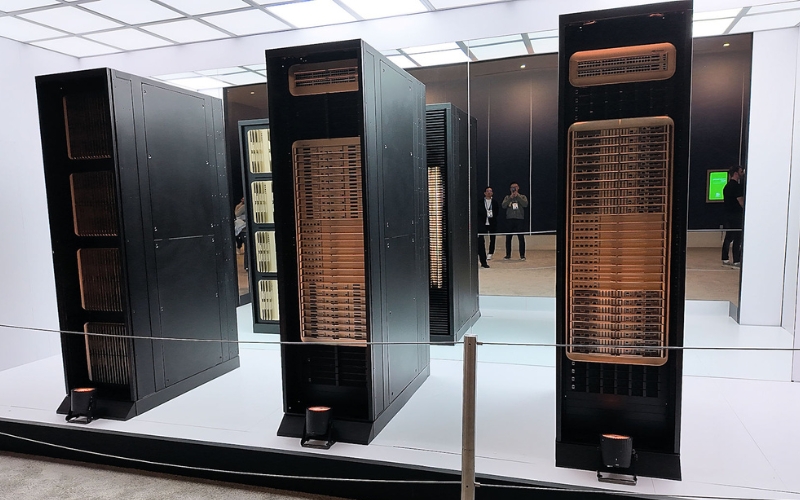
The rack is only one piece of the system. The Nvidia Vera Rubin platform bundles five rack types that work together as one AI supercomputer:
- Vera Rubin NVL72: The GPU rack for training and inference.
- Vera CPU rack: 256 Vera CPUs per rack for reinforcement learning sandboxes, tool calls, and orchestration.
- Groq 3 LPX: An inference rack that adds fast on-chip memory for low-latency, long-context work.
- BlueField-4 STX: A storage rack built around Nvidia’s data processing units.
- Spectrum-6 SPX: The Ethernet networking rack that links everything together.
Nvidia aimed this design squarely at agentic AI and reasoning models. Those workloads chain hundreds or thousands of steps per prompt. So they lean hard on memory, networking, and inference cost.
Where does Nvidia Vera Rubin stand in production?
Nvidia Vera Rubin is in full production. Nvidia announced the ramp at GTC Taipei on May 31, 2026. More than 350 factories in 30 countries are now building Vera Rubin systems, per Nvidia’s full production announcement.
That breadth is good news for you. More system builders means more quotes to compare and a deeper spare parts pool once racks are on your floor.
And Nvidia is already pushing past the single rack. The same announcement introduced Spectrum-X Ethernet Photonics, a co-packaged optics switch line that Nvidia rates at five times the power efficiency of networks built on traditional transceivers.
What is AMD Helios?
AMD Helios is AMD’s first rack-scale AI system, launched at AMD Advancing AI 2026 in San Francisco on July 23, 2026. Each rack pairs 72 Instinct MI455X GPUs with EPYC “Venice” CPUs and Pensando “Vulcano” AI network cards, per the AMD Helios product page.
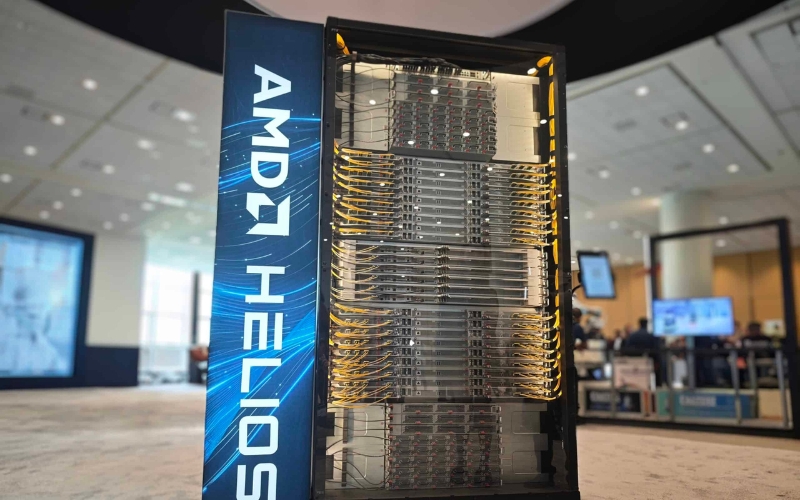
Here’s the detail most buyers miss. AMD Helios is a blueprint rather than a finished product sold directly by AMD. OEM and ODM partners such as Dell and HPE turn that blueprint into systems sold under their own names.
Your quote and warranty come from the system builder, so vet the integrator as carefully as you vet the silicon.
Who is buying AMD Helios?
AMD Helios already has frontier-scale buyers. Microsoft committed to deploy Helios racks in its Azure data centers, per CNBC’s report on the Helios launch. Meta, OpenAI, and Oracle signed on as customers before that.
Each Helios rack holds more than 4,600 Zen 6 CPU cores and 31 TB of high-bandwidth memory, per HPCwire’s coverage of the MI455X and Helios launch. AMD also launched the Instinct MI430X at the same event as a separate GPU aimed at traditional HPC work.
That split matters if you plan to sell scientific simulation rather than AI inference. AMD Helios is tuned for AI math first, while the MI430X carries AMD’s HPC story.
How do the rack architectures compare?
Both racks hold 72 GPUs, so comparing AI racks on GPU count alone misses the real differences. They use different rack standards. Nvidia builds on its own third-generation MGX NVL72 design, while AMD builds on the double-wide Open Rack Wide standard from the Open Compute Project.
How Nvidia builds the Vera Rubin NVL72
Nvidia pairs its chips into superchips, with two Rubin GPUs and one Vera CPU in each. The rack uses cable-free modular trays and involves more than 80 MGX ecosystem partners. Nvidia also presents the design as a smooth step up from earlier NVL72 generations.
For you, that continuity is the selling point. If your team already runs Blackwell racks, the mechanical and operational learning curves are shorter.
How AMD builds the Helios rack
Each AMD Helios compute tray carries four MI455X GPUs and a Venice CPU. Four scale-up cartridges link all 72 GPUs into one domain. Integrated power, cooling, and network connections let technicians swap a sled without recabling.
The MI455X itself is built on a 2nm process, per Phoronix’s report from the launch. So AMD is shipping one of the most advanced chip processes on the market inside its first-ever rack.
The double-wide format is the hidden site question. An AMD Helios rack is wider than a standard rack position. Measure your aisles and row layouts before you sign anything.
How does compute performance compare?
AMD Helios leads on dense 4-bit and 8-bit math, while the Vera Rubin NVL72 has the bigger headline number using sparse math. AMD rates Helios at 2.9 exaflops of FP4 and 1.4 exaflops of FP8. Nvidia lists the Vera Rubin NVL72 at 3,600 petaflops of sparse NVFP4, 2,520 petaflops of dense NVFP4, and 1,260 petaflops of dense FP8.
Why sparse and dense numbers matter
Sparse figures assume the model can skip zero values, which raises the peak number on paper. Dense figures count every value and provide a fairer basis for any AI rack comparison.
AMD’s own footnotes compare Helios against Nvidia’s dense NVFP4 figure. That’s where the 15% compute lead comes from: 2.9 exaflops against 2.52 exaflops.
But AMD’s MX formats and Nvidia’s NVFP4 aren’t identical 4-bit formats. Treat peak FLOPS as a first filter and nothing more.
What the vendor throughput models show
AMD modeled Helios against the Vera Rubin NVL72 on the Kimi K2 Thinking model with 32K input and 8K output tokens. Results show up to 15% more per-GPU throughput at low interactivity and 12% at medium. At high interactivity, the modeled lead is 10%, per AMD’s Helios launch blog.
Nvidia frames its gains against its own prior generation instead. For mixture-of-experts training, a Vera Rubin NVL72 needs just a quarter as many GPUs as a GB200 NVL72. It also produces up to 10 times the tokens from each megawatt.
Notice the problem? Neither vendor’s figures come from an independent side-by-side benchmark. Your own workload test is the only number that should go into your financial model.
What about classic HPC math?
Nvidia lists 2,400 teraflops of FP64 per Vera Rubin NVL72 rack. AMD doesn’t list FP64 on the Helios spec page and points HPC buyers to the MI430X instead.
If you’re a crypto miner pivoting into scientific computing for universities or energy firms, that detail decides which platform fits. AI inference tenants care about FP4 and FP8; simulation tenants care about FP64.
How do memory specs compare?
High-bandwidth memory is the stacked memory that sits right beside every GPU. AMD Helios wins memory capacity by a wide margin. Each MI455X carries 432 GB of HBM4 against 288 GB on each Rubin GPU, so a Helios rack holds 31 TB against 20.7 TB for the Vera Rubin NVL72.
Bandwidth is closer than capacity
AMD lists up to 23.3 TB/s of memory bandwidth per MI455X. Nvidia’s current spec table lists 19.2 TB/s per Rubin GPU and 1,400 TB/s per rack.
Both vendors revised their published figures during 2026. Check the exact numbers in your quote rather than a launch slide.
Nvidia’s answer to the memory gap
Nvidia leans on a second memory tier. Each Vera Rubin NVL72 rack carries up to 54 TB of LPDDR5X CPU memory, linked to the GPUs over NVLink-C2C at 1.8 TB/s per superchip.
Nvidia also pairs the NVL72 with Groq 3 LPX racks, which add fast on-chip memory for million-token contexts. That’s a multi-rack fix, though, and it adds racks to your floor plan.
AMD’s Venice CPU brings up to 256 cores and 1.6 TB/s of memory bandwidth to the host side. If your tenants serve large mixture-of-experts models with long contexts, more memory per GPU can mean fewer GPUs per model copy.
How does networking compare?
Nvidia runs a proprietary, tightly integrated fabric, while AMD bets on open standards built on Ethernet. That’s the clearest philosophical split when you look at AMD versus Nvidia AI racks.
Scale-up inside the rack
Scale-up networking links the 72 GPUs inside one rack, so they act like one giant accelerator. Nvidia’s NVLink 6 delivers 216 TB/s per rack on its current spec table. AMD’s UALink over Ethernet delivers 260 TB/s of aggregate bandwidth across its four scale-up cartridges.
On paper, AMD Helios wins this row. But Ethernet was never designed to stitch GPUs together. Initial Helios systems run UALink over Ethernet rather than native UALink, per Tom’s Hardware’s look at the Helios interconnect. Delivered performance on that fabric is the open question independent tests still need to answer.
Scale-out between racks
Scale-out networking connects racks into a cluster. AMD Helios delivers 43 TB/s per rack through 800 Gbps Vulcano network cards aligned with the Ultra Ethernet Consortium. The Vera Rubin NVL72 delivers 32.4 TB/s of bidirectional bandwidth through ConnectX-9 SuperNICs, with Quantum-X800 InfiniBand or Spectrum-X Ethernet on top.
Nvidia publishes its figure as bidirectional. Ask both vendors to quote scale-out bandwidth on the same basis before comparing them.
What the split means for your team
Open Ethernet lets your network engineers source switches from several vendors and use skills they already have. Nvidia gives you one vendor accountable for the whole stack, which many operators find surprisingly valuable when a training run stalls at 3 a.m.
How do the software ecosystems compare?
Software is where AMD versus Nvidia AI racks diverge most for smaller operators. CUDA remains Nvidia’s biggest advantage, and ROCm is still AMD’s biggest challenge. CUDA has a 15- to 20-year head start, and almost every AI tool and codebase still defaults to it, per Network World’s analysis of the Helios launch.
How far has ROCm come?
ROCm is open source and now covers the frameworks most teams actually use. AMD lists day-zero ROCm support for these tools:
- PyTorch
- TensorFlow
- JAX
- ONNX Runtime
- vLLM
- Triton
AMD is also using frontier AI to close the gap faster. Anthropic engineers will put Claude to work tuning code for Instinct GPUs and accelerating ROCm itself, per AMD’s Anthropic partnership announcement. The deal covers up to 2 gigawatts of Helios capacity built on MI450 Series GPUs, with the first gigawatt rolling out in early-to-mid 2027.
What does Nvidia’s software stack add?
Nvidia sells the full operating layer around the rack, not just CUDA. Its DSX platform covers AI factory design and operations, and its DOCA software runs security services directly on BlueField-4.
Which software path fits your tenants?
Who will actually rent your racks? If your tenants arrive with custom CUDA kernels, AMD Helios requires porting work that someone has to pay for.
But if your tenants run mainstream PyTorch and vLLM inference, the gap gets much narrower. That’s why hyperscalers with large in-house software teams tend to be the earliest AMD buyers.
What power, cooling, and support systems does each rack need?
Both racks need direct liquid cooling and over 200 kW of power per rack. That puts both platforms out of reach for most air-cooled halls, including typical Bitcoin mining facilities built around air-cooled ASICs.
Power and cooling for Nvidia Vera Rubin
A single Vera Rubin NVL72 rack can easily draw more than 200 kW, per Tom’s Hardware’s tour of Nvidia’s engineering lab. Nvidia also demonstrated an 800 VDC sidecar feeding power straight into the rack.
OEM specs line up with that figure. GIGABYTE’s Vera Rubin NVL72 pod specification lists up to 240 kW per rack, four 110 kW power shelves, and redundant pumps with A/B power feeds.
Nvidia designs the rack for a 45°C liquid inlet temperature. Warm-water cooling can cut how hard your chillers work, which helps sites in hot climates.
Power and cooling for AMD Helios
AMD Helios uses a central power shelf with a vertical busbar and a cooling manifold with quick-disconnect fittings. The first facility blueprint for it came from Schneider Electric.
That reference design supports racks up to 246 kW and AI clusters up to 10.4 MW, per DatacenterDynamics’ coverage of the Schneider Electric and AMD design. Its retrofit layout places ten 246 kW IT racks and seven 45 kW network racks in one liquid-cooled pod.
Here’s the part converters should study closely. The liquid loop removes up to 84% of rack heat, and the design offers rear-door heat exchangers as a retrofit option, per Fierce Network’s report on the Helios blueprint. The leftover heat still needs air handling, so you can’t fully decommission your fans.
Read more about the AI infrastructure challenges beyond the chip in this article.
Security and serviceability
Nvidia builds its third-generation Confidential Computing into the Vera Rubin NVL72, along with an upgraded reliability engine that keeps the whole rack resilient. Former Bitcoin miner IREN is among the cloud providers adopting Nvidia Confidential Computing, per Nvidia’s May 31 production announcement.
AMD Helios relies on a hardware root of trust with continuous attestation, plus encrypted memory and interconnects. Its modular sleds are built for fast, low-disruption swaps.
How do cost per token and rack price compare?
On price, AMD Helios vs Nvidia Vera Rubin is a moving target. Neither Nvidia nor AMD publishes a rack list price, and analyst estimates swung widely during 2026. Budget in ranges and treat every figure below as an estimate until you hold a signed quote.
Rack price estimates in 2026
Futurum estimated AMD Helios at $5 million to $5.5 million per rack and the Vera Rubin NVL72 at more than $7 million, per CNBC’s October 2026 report on Nvidia’s truck-shippable racks.
That same report covered Nvidia’s new DSX Pod, which ships seven Vera Rubin racks in one container. Nvidia expects it to cut the time a new AI data center needs to start serving tokens from six months to 14 days.
Memory prices are rising fast, and AMD Helios carries 50% more HBM4 per rack. Watch for memory cost pass-through in AMD quotes too.
Cost per token figures from each vendor
Nvidia rates the Vera Rubin NVL72 at 10% of a GB200 NVL72’s cost for every million tokens, measured on Kimi-K2-Thinking with 32K input and 8K output tokens. AMD models up to 30% more tokens per dollar for Helios against the Vera Rubin NVL72 on the same Kimi K2 Thinking profile, using July 2026 modeling from AMD’s own performance lab, per Futurum’s analysis of Helios and Vera Rubin parity.
Look closely at the baselines. Nvidia compares against its older rack, while AMD compares against Nvidia’s newest one.
The practical move is simple and the only honest way to compare AI racks. Ask each vendor to run your model at your target latency, then divide the quoted rack price by the tokens you actually get.
What are lead times for Nvidia Vera Rubin and AMD Helios in 2026?
Both platforms are shipping in limited volume, and both queues stretch into 2027. For timing, an AI rack comparison comes down to who committed first. Supply, not demand, is the constraint for each of them.
Nvidia Vera Rubin lead times
Nvidia slated production shipments for fall 2026. By late August, Vera Rubin racks were already running at partners including CoreWeave and Google Cloud, per Futurum’s review of Nvidia’s second quarter of fiscal 2027.
The same review frames Nvidia’s demand as supply-constrained. Nvidia’s procurement commitments jumped to $279 billion, mostly for memory, and customers were told some AI server prices would rise over 15%.
So who gets served first? Allocation follows commitment, and hyperscalers absorb OEM capacity before everyone else.
Read more about the AI chip supply chain bottleneck in this article.
AMD Helios lead times
AMD Helios entered full production at launch, with shipments starting at the end of the third quarter and ramping into 2027, per Fierce Network’s report from AMD Advancing AI 2026.
The largest AMD deployments sit further out. Anthropic’s first Helios gigawatt begins deploying during H1 2027, and that capacity is spoken for.
How do you buy Nvidia Vera Rubin and AMD Helios racks ahead of the market?
You can buy Nvidia Vera Rubin and AMD Helios racks through the Acquire.Fi GPU Order Book. Get started by placing a buy order that names your platform and quantity. State where the racks will go and when you need them. From there, our desk pairs you with a seller who holds the slot or hardware. We screen both parties and stay on the deal until the rack is installed and working at your site.
The process runs in four steps, and you can start with a single rack:
- Submit your order: Filling it takes a couple of minutes and carries no fee. Nothing binds you until identity checks and your funding evidence clear.
- Get qualified: Expect a price estimate and a target ship window by the next business day. After that, you pass identity checks and sign a statement of how and where the hardware will be used.
- Lock your allocation: Showing your funding and paying a 30% deposit in U.S. dollars turns the order into a confirmed slot. For Vera Rubin, putting down more earns an earlier place in line, and the money is held toward your purchase, not kept by us.
- Take delivery: Top-tier manufacturers assemble each rack for your order and stress-test it before it leaves the factory. Start with a single trial rack, then grow into a full cluster without renegotiating.
We take care of the Nvidia allocation sign-off for you. Buyers must be screened end users based in the U.S., the EU, South Korea, or Japan. Integrators and resellers can place orders too, as long as they name the final customer.
What about AMD Helios?
Right now, everything listed in our order book is Nvidia hardware. That covers HGX B300 servers, the GB300 NVL72, and early Vera Rubin slots. If you want AMD Helios, name it in your buy order. We match it against any holder who lists Helios systems or slots, and you’ll hear back either way.
Why buy through the secondary market?
Because position in the queue matters more than demand. Standard channels make most buyers wait behind hyperscalers, even for previous-generation racks.
Not every committed slot gets used, though. Builds slip, financing shifts, and power arrives late. Those unused allocations are the fastest route to hardware for neoclouds and colocation developers. AI labs and converted miners use the same path.
Compliance is the other reason. In January 2026, the U.S. Commerce Department eased license review for exports to China and Macau only for chips below a set performance threshold, per the Federal Register rule on advanced computing commodities. Rubin-class and MI455X-class hardware sit far above that line, so every legitimate sale needs to know exactly who you are and where the rack is going.
Why this decision matters beyond 2026
The AMD Helios vs Nvidia Vera Rubin choice reaches well past one purchase order. The racks you secure now decide which models your tenants can serve, which customers you can sign, and what your facility is worth when the next generation lands.
So run a real AI rack comparison against your own workload, power budget, and tenant mix. Then lock in your position while the 2027 queue is still forming.
Sources
- Infrastructure for Scalable AI Reasoning | NVIDIA Vera Rubin Platform - https://www.nvidia.com/en-us/data-center/technologies/rubin/
- Rack-Scale Agentic AI Supercomputer | NVIDIA Vera Rubin NVL72 - https://www.nvidia.com/en-us/data-center/vera-rubin-nvl72/
- NVIDIA Vera Rubin Ramps Into Full Production to Power Agentic AI Factories Worldwide - https://nvidianews.nvidia.com/news/vera-rubin-full-production-agentic-ai-factory
- AMD Helios Rackscale Solution – Powering Frontier AI - https://www.amd.com/en/products/rackscale-solutions/helios.html
- AMD launches Helios, its first rack AI system to rival Nvidia, adding Microsoft as newest buyer - https://www.cnbc.com/2026/07/20/amd-helios-microsoft-ai-nvidia.html
- AMD Takes On Nvidia with MI455X GPUs and Helios Racks - https://www.hpcwire.com/?p=193881
- AMD Launches Instinct MI455X, Helios AI Rack - https://www.phoronix.com/news/AMD-Instinct-MI455X-Helios
- AMD Launches Helios™: The Highest Performing Rackscale AI Infrastructure Solution - https://www.amd.com/en/blogs/2026/amd-launches-helios-the-highest-performing-rackscale-ai-infrastructure-solution.html
- AMD’s Helios MI455X AI platform breaks cover, initial systems use UALink-over-Ethernet interconnects - https://www.tomshardware.com/tech-industry/artificial-intelligence/amds-helios-mi455x-ai-platform-breaks-cover-initial-systems-use-ualink-over-ethernet-interconnects-amds-vera-rubin-rival-surfaces-but-the-downsides-of-ethernet-could-hamstring-performance
- Helios marks AMD’s biggest AI infrastructure push yet - https://www.networkworld.com/article/4199402/helios-marks-amds-biggest-ai-infrastructure-push-yet.html
- AMD and Anthropic Announce Strategic Partnership to Deploy up to 2 Gigawatts of AMD Instinct MI450 Series GPUs - https://newsroom.amd.com/news/amd-anthropic-strategic-partnership/
- Behind the scenes at Nvidia’s Engineering SuperLab: Vera Rubin NVL72 running OpenAI workloads, 800VDC demonstrated, and more - https://www.tomshardware.com/tech-industry/artificial-intelligence/behind-the-scenes-at-nvidias-engineering-superlab-vera-rubin-nvl72-running-openai-workloads-800vdc-demonstrated-and-more
- AI DLC POD NVIDIA Vera Rubin NVL72 | GIGABYTE - https://www.gigabyte.com/Enterprise/GIGAPOD-Pod-Scale/AI-DLC-POD_NVIDIA-Vera-Rubin-NVL72
- Schneider Electric and AMD collaborate to enable fast, resilient, and efficient AMD Helios rackscale solution cluster deployment - https://www.datacenterdynamics.com/en/product-news/schneider-electric-and-amd-collaborate-to-enable-fast-resilient-and-efficient-amd-helios-rackscale-solution-cluster-deployment/
- Schneider Electric, AMD unveil Helios AI blueprint - https://www.fierce-network.com/cloud/schneider-electric-amd-unveil-helios-ai-blueprint
- AMD’s Helios AI Rack Challenges NVIDIA with HBM4 Memory Edge; Microsoft Joins as Latest Customer - https://www.trendforce.com/news/?p=61243
- Nvidia announces plug and play Vera Rubin racks that can be shipped on a truck - https://www.cnbc.com/amp/2026/10/21/nvidia-announces-vera-rubin-racks-that-can-be-shipped-on-a-truck-.html
- AMD Helios Reaches Parity with Vera Rubin NVL72: Can Open Standards Outflank NVIDIA? - https://futurumgroup.com/insights/amd-helios-reaches-parity-with-vera-rubin-nvl72-can-open-standards-outflank-nvidia/
- NVIDIA Q2 FY 2027: AI Infrastructure Demand Extends Into FY 2028 - https://futurumgroup.com/insights/nvidia-q2-fy-2027-ai-infrastructure-demand-extends-into-fy-2028/
- AMD launches full-stack AI compute for agentic era - https://www.fierce-network.com/cloud/amd-launches-full-stack-ai-compute-agentic-era
- Revision to License Review Policy for Advanced Computing Commodities - https://www.federalregister.gov/documents/2026/01/15/2026-00789/revision-to-license-review-policy-for-advanced-computing-commodities