.webp)

Key takeaways:
- The GE TM2500 delivers up to about 37 MW from a trailer, installs in about 14 days, and reaches full power in 5 minutes.
- The DLE variant runs without water or bolt-on emissions hardware at roughly 40% efficiency, while the SAC variant has the larger installed fleet.
- New turbines are scarce and expensive, with GE Vernova's backlog at 116 GW and EPRI reporting average prices up from $2,000/kW to $3,000/kW.
- Refurbished units arrive within about 12 months versus three to four years for new ones, which makes the secondary market the fastest route to power.
- You can buy refurbished second-hand GE TM2500 fleets using Acquire.Fi Gas Turbine Order Book.
The GE TM2500 is the quickest route to roughly 35 MW of firm, dispatchable power in 2026. It rolls onto site on trailers, installs in about two weeks, and reaches full load in five minutes, while new heavy-duty frames are booked out for years.
If you fund, build, or run power assets, speed is the whole game. GE Vernova reported 116 GW of gas turbine backlog and slot reservations in the second quarter of 2026. Every month waiting for an OEM slot is a month your data center, mine, or grid contract earns nothing. Few machines on the market can close that gap like a GE TM2500 gas turbine.
What is the General Electric TM2500?
The GE TM2500 is a trailer-mounted aeroderivative gas turbine generator set built by GE Vernova. The "TM" stands for trailer-mounted, and the package delivers up to 37 MW in simple cycle at roughly 40% efficiency.
GE Vernova pairs the turbine trailer with containerized balance-of-plant equipment. The OEM says a complete package can feed the grid within 30 days of contract signature.
Why does "aeroderivative" matter to you?
An aeroderivative turbine starts life as a jet engine design and gets adapted for ground-based power. You get a lighter, more compact machine that starts fast and handles frequent cycling far better than a heavy-duty frame.
That trade-off is the point. You give up some scale of a 300 MW frame but gain the ability to place firm capacity exactly where and when you need it.
Who actually uses it?
Utilities, independent power producers, oil and gas operators, island grids, and now AI data center developers all run the GE TM2500. GE Vernova counts more than 350 units installed worldwide, which makes it one of the most widely deployed mobile turbines on the planet.
Where did the GE TM2500 come from?
The GE TM2500 traces its roots to the CF6 jet engine, the same engine family that powers the Boeing 747 and 767. GE adapted that core into the LM2500 industrial turbine, then packaged it on trailers for fast, relocatable power.
The product has been in the field for about 30 years. Many buyers still search for it as the General Electric TM2500 because it carried the General Electric badge for most of its life before GE Vernova spun off as a standalone company in April 2024.
Which GE TM2500 variants can you buy today?
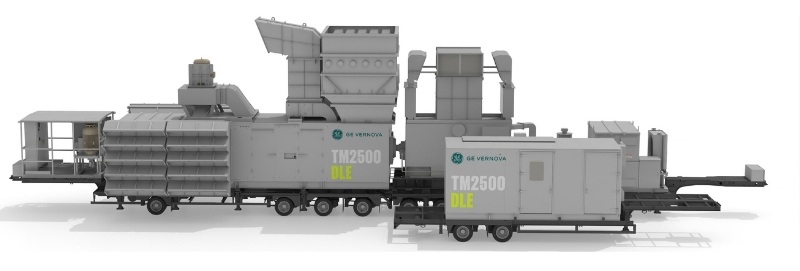
GE Vernova currently sells two GE TM2500 configurations: the TM2500 SAC and the TM2500 DLE. Both share the same trailer footprint and five-minute start, but they burn fuel in different ways.
TM2500 SAC
SAC stands for single annular combustor. This workhorse configuration powers most of the installed fleet and typically relies on water injection to control nitrogen oxide (NOx) emissions. You get slightly more output at 60 Hz but pay with a higher heat rate and need a water supply on site.
TM2500 DLE
DLE stands for dry low emissions. GE Vernova calls it the first TM2500 that runs without water. Its combustor keeps the exhaust clean on its own, so you do not need bolt-on emissions hardware. Simple-cycle efficiency rises to roughly 40%, better than many grids deliver.
So which one fits you? If you are in a water-stressed region or need tight air permits, the DLE is the easier sell. If you are buying used and need speed above all, the SAC fleet offers far more units to choose from.
Ratings above are OEM net figures at ISO conditions on natural gas, excluding balance of plant. Your real-world numbers will shift with altitude, ambient temperature, and fuel quality.
What are the GE TM2500 technical specifications?
The GE TM2500 runs at 50 Hz or 60 Hz, produces up to about 37 MW in simple cycle, and starts in five minutes. The power plant has combined-cycle ratings, which surprise a lot of buyers who think of it as a peaker only.
How does it perform in combined cycle?
Add a heat recovery steam generator and a steam turbine, and the economics change fast. These are the OEM plant ratings that matter for baseload planning:
- 1x1 combined cycle: About 47.5 MW to 51.5 MW net, depending on variant and frequency, with a ramp rate of 30 MW per minute.
- 2x1 combined cycle: About 96 MW to 104 MW net, with a ramp rate of 60 MW per minute.
- Turndown and restart: Minimum plant load of 35% and a 30-minute hot start in rapid-response mode.
- Efficiency ceiling: The DLE variant reaches about 55% net efficiency in combined cycle.
That 55% figure is the so-what for operators. It means a pair of trailer-mounted units can run a respectable baseload block, not just fill evening peaks.
How is the package laid out?
The turbine and generator ride on a trailer, and the balance of plant ships in containers. Installation roughly takes about 14 days. You can scale capacity in blocks of roughly 37 MW as demand grows.
Controls run on GE Vernova's Mark VIe platform, supported with ongoing software and hardware upgrades. For a used buyer, that controls version is one of the first things to check because an outdated system can turn a cheap unit into an expensive retrofit.
How fuel-flexible is the GE TM2500?
The GE TM2500 burns natural gas, liquefied petroleum gas (LPG), and distillate liquid fuel, and the OEM rates it for hydrogen blends of up to 35%. GE Vernova breaks down how its aeroderivatives handle different fuels in its aeroderivative fuel flexibility white paper.
Why should you care? Fuel risk kills more bridge-power projects than hardware. A unit that can switch from pipeline gas to trucked distillate keeps running when a gas lateral is late or a supply contract falls through.
What does fuel switching save?
GE Vernova says replacing a diesel genset with a gas-fired GE TM2500 can cut operating costs by up to $8 million a year. For an island utility or remote mine paying for trucked diesel, that figure alone can carry the business case.
Where does it fit in the energy transition?
The GE TM2500 plays two roles in a lower-carbon grid. It replaces dirtier fuels, and it firms up renewables when the sun and wind drop off.
- Turning flare gas into power: In Yemen, PetroMasila deployed a TM2500 to burn gas that was previously flared, cutting flared methane by 50% and supplying enough power for about 50,000 homes.
- Firming a renewables-heavy grid: Australia's Territory Generation chose the TM2500 for its Channel Island Power Station to back up a Northern Territory grid targeting 50% renewables by 2030.
How clean is the GE TM2500, and how hard is it to permit?
The GE TM2500 DLE cuts NOx, carbon monoxide, and particulates without aftertreatment and releases almost no unburned methane. GE Vernova's methane slip calculator claims reciprocating gas engines can leak unburned methane at nearly 150 times the rate of a gas turbine.
That matters if you report Scope 1 emissions to investors. Methane is a far more potent greenhouse gas than carbon dioxide over the short term, so a low-slip turbine makes your emissions story easier to defend.
Can you push NOx even lower?
Yes. When California needed emergency capacity, GE Vernova fitted four TM2500 units for the state's Department of Water Resources with selective catalytic reduction (SCR). The result was a NOx rating of 2.5 ppm, compared with a typical 15 ppm for comparable units.
How reliable is the GE TM2500, and what does maintenance look like?
GE Vernova backs the GE TM2500 with a stated 99% reliability rate and more than 8 million fleet operating hours. Across its broader family of mobile, dual-fuel aeroderivative models, the OEM reports roughly 140 million accumulated hours.
For you, those hours are the real asset. A deep fleet means spare engines, known failure modes, and technicians who have seen every fault code. This keeps your downtime short and your lenders calm.
How long does an outage take?
The aeroderivative design lets you swap the engine instead of repairing it in place. GE Vernova's repairs and maintenance team offers outages as short as two days through module and engine exchanges, plus engine leasing while your core goes to the shop.
Compare that with a heavy-duty frame, where a major inspection can sideline the whole unit for weeks. This difference shows up directly in your capacity payments and uptime guarantees to tenants.
What service options can you lock in?
GE Vernova sells Fleet360 multi-year agreements that bundle parts, outages, and monitoring into a predictable cost. You can also buy Mark VIe controls upgrades and performance upgrades that extend asset life.
If you are buying a used unit, ask whether it can move onto an OEM service agreement. That answer affects your insurance, financing terms, and resale value later.
How does it hold up in harsh conditions?
The GE TM2500 has a long record in punishing environments. In Algeria, 38 TM2500 units supply the Sahara region, where summer peaks reach 113 degrees Fahrenheit. This is about as rough a duty cycle as you'll find.
How does the GE TM2500 compare with the Siemens Energy SGT-A45 TR and other aeroderivatives?
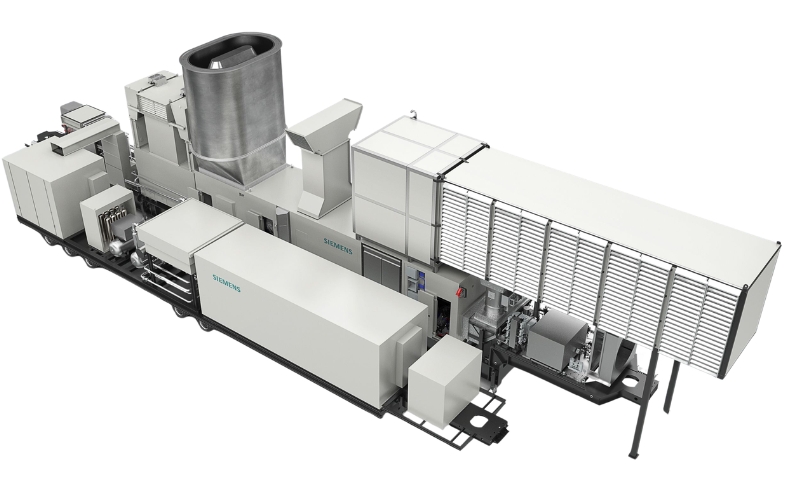
The Siemens Energy SGT-A45 TR packs more output per mobile unit, while the GE TM2500 wins on fleet size and track record. Siemens introduced the SGT-A45 TR in March 2017 as a 44 MW gas turbine for mobile power generation, built around Industrial Trent 60 core components from Rolls-Royce aero-engine technology.
Siemens' pitch is simple. If each package delivers 44 MW instead of about 35 MW, you hit your capacity target with a shorter row of trailers. Siemens argues this brings down your cost per kilowatt.
Read the efficiency row with care. GE Vernova quotes net plant figures including inlet and exhaust losses, while the Siemens SGT-A45 TR data sheet quotes ISO dry ratings with zero installation losses. On a like-for-like basis, the gap is narrower than the headline suggests.
Which one should you pick?
Pick the SGT-A45 TR if you need maximum megawatts per pad and can wait for a smaller pool of units. Pick the GE TM2500 if you need units now, want the deepest parts and service network, or plan to buy on the secondary market where a fleet of 350-plus units gives you more choices.
What about other aeroderivatives?
GE Vernova's own LM6000 is the step up for fixed sites. It sits in the 40 MW-plus class with about 60 million operating hours and more than 1,300 units shipped, but it isn't a trailer-mounted package, so you trade mobility for scale.
The LM2500XPRESS is another GE Vernova option for modular fixed installations. Pratt & Whitney, Solar Turbines, and Kawasaki units also trade in the secondary market, but few of them offer the GE TM2500's drive-on, drive-off mobility at the 35 MW scale.
Why are aeroderivative gas turbines like the GE TM2500 in such demand in 2026?
Aeroderivatives are in demand because AI data centers need power faster than grids and heavy-duty turbine factories can deliver. GE Vernova booked 61 aeroderivative turbine orders in the second quarter of 2026 alone and credited aeroderivative volume and pricing for leading its Power segment revenue growth.
The grid is the bottleneck. At the 2026 Turbomachinery and Pump Symposia, Opportune's Dan Romito pointed to a gas turbine backlog of about 260 weeks and argued behind-the-meter power gives developers back control over their timelines.
Who is buying, and for what?
The buyer list in 2026 looks very different from five years ago. These are the use cases driving orders for the GE TM2500 right now:
- AI data center bridge power: Fermi America's first-quarter 2026 investor presentation lists 124 MW of GE TM2500 turbines in its power ramp for the third quarter of 2027.
- Grid emergencies and winter reserve: Utilities and governments park units as insurance against drought, heat waves, and fuel shocks, as Switzerland and California did.
- Island grids: Bahamas Power and Light added a 34 MW TM2500 installed in 42 days to cover peak tourist demand.
- Oil, gas, and mining: Remote operators use the turbine to burn associated gas and cut diesel spend.
- Disaster recovery: Units deploy after hurricanes, plant shutdowns, and grid failures, then move on to the next job.
What are hyperscale buyers actually asking for?
They want fleets, not single machines. Live hyperscaler-backed mandates for LM6000, LM2500, and TM2500-class aeroderivatives are bought in matched sets, and a typical data center program asks for somewhere between five and ten units of the same model.
That preference for identical units is the hidden driver of value. A matched fleet shares spares, training, and controls logic, so matched sets of the same model and configuration draw the strongest buyer interest.
What is the GE TM2500 price, and how long are lead times in 2026?
GE Vernova doesn't publish a GE TM2500 price, because every quote depends on scope, fuel system, emissions package, and delivery slot. What you can track is the market, and the market has moved sharply against buyers.
In March 2026, the Electric Power Research Institute (EPRI) reported that average gas turbine prices jumped from about $2,000/kW to $3,000/kW in just six months. EPRI blamed sustained strain across the global manufacturing supply chain more than inflation.
What does that mean for a 35 MW unit?
Here's a rough illustration, not a quote. Apply EPRI's averages to a 35 MW package, and you land somewhere between $70 million and $105 million.
Your actual GE TM2500 price will swing with balance-of-plant scope, SCR, fuel treatment, and whether you buy new, lease, or go secondary. Treat any number without a defined scope as noise.
How long will you wait for a new unit?
EPRI puts large gas turbines at more than five years from order to delivery, and smaller units at 18 to 36 months. Add packaging, transport, permitting, and commissioning, and new-build projects commonly stretch to three or four years before you see first power.
The OEM numbers explain why. GE Vernova's gas equipment backlog and slot reservations grew from 83 GW at the end of 2025 to 100 GW in the first quarter of 2026, then to 116 GW by June, with a target of at least 125 GW by year-end. The company is adding factory output, aiming for 20 GW a year in the third quarter of 2026, 24 GW in 2028, and 30 GW in 2030.
Is Siemens Energy any faster?
Not really. Siemens Energy posted record orders of €17.9 billion in its fiscal third quarter (April to June 2026), pushing total backlog to €162 billion. Its Gas Services unit posted a book-to-bill ratio of 2.65, with data centers named as a key driver.
When two of the three biggest turbine OEMs book new work far faster than they deliver it, you're not going to negotiate your way to the front of the line. You need a different supply channel.
How do you buy a used GE TM2500, and why should you?
You buy a used GE TM2500 because it gets power to your site in months instead of years. On today's secondary market, refurbished gas turbines take up to 12 months to deliver, while new units take three to four years to arrive.
That gap is worth real money. If your data hall earns revenue the day it energizes, two or three years of earlier power can outweigh almost any discount you'd squeeze out of an OEM.
Where do used TM2500 units come from?
Most secondary supply comes from assets their owners no longer need. Typical sources include rental fleets rotating stock, independent power producers restructuring, reserve and emergency contracts that expire, and projects that were canceled before commissioning.
Much of this equipment never hits a public listing. When you search for a GE TM2500 for sale, the best units often trade privately before anyone posts them.
How do you buy through the Acquire.fi order book?
The Acquire.fi Gas Turbine Order Book moves you from a posted requirement to a commissioned unit in four stages. Posting is free, and the desk only gets paid a success fee when a deal closes.
- Post your requirement: Enter your target megawatts, frequency, site location, delivery window, and unit count. The form is short and non-binding, and none of it goes public.
- Get screened and matched: The desk confirms who you are and that your mandate is real, then hunts through its own book and off-market sources like asset owners, liquidators, MRO shops, and decommissioning projects. You hear back within one business day, even when the honest answer is that nothing fits yet.
- Meet the seller under NDA: After both sides clear screening, you sign a mutual NDA. The seller then decides what to share and when, starting with spec packs, inspection reports, hours logs, and photos.
- Inspect, sign, and close: Your own engineers run the physical inspection, borescope, and hours check before you sign a purchase agreement and fund escrow. The desk stays on the deal through shipping and commissioning.
Building a multi-hall campus? Fleet-sized requests get pooled across several owners rather than turned away, so you're not stuck with one seller's inventory.
What should you check during diligence?
Stage four is where deals live or die. Before you fund escrow, work through these points with your technical adviser:
- Lock your spec: Confirm frequency (50 Hz or 60 Hz), SAC or DLE, fuel system, and how many identical units you need.
- Verify the records: Match engine serial numbers to operating hours, start counts, and maintenance history.
- Inspect the hot section: Commission an independent borescope inspection before you sign anything binding.
- Check preservation: For idle or never-installed units, ask for OEM preservation documentation.
- Audit the controls: Confirm the controls platform version and what a Mark VIe upgrade would cost.
- Test the permit fit: Map the unit against your state's air rules and EPA's 24-month temporary-turbine window.
- Secure service coverage: Ask whether the unit qualifies for an OEM service agreement or engine exchange program.
Skip the hot-section inspection, and frankly you're gambling. A clean set of logbooks means nothing if the turbine blades tell a different story.
What should you do next if you need GE TM2500 capacity?
Move now because available units get absorbed by fleet buyers long before most people see them. The OEM queues will ease eventually as GE Vernova and Siemens Energy add capacity, but every project that waits for 2030 hands its market share to someone who found power in 2027.
The bigger shift is structural. Speed to power has become a competitive moat for hyperscalers, a pricing lever for independent power producers, and a source of hard-asset returns for investors who can source equipment others can't.
Sources
- GE Vernova reports second quarter 2026 financial results and raises 2026 financial guidance - https://www.sec.gov/Archives/edgar/data/1996810/000199681026000147/gevpressrelease2q26.htm
- GE Vernova reports first quarter 2026 financial results and raises 2026 guidance - https://www.sec.gov/Archives/edgar/data/0001996810/000199681026000063/gevpressrelease1q26.htm
- TM2500 Aeroderivative Gas Turbine | GE Vernova - https://www.gevernova.com/gas-power/products/gas-turbines/tm2500
- TM2500 Aeroderivative Package Fact Sheet | GE Vernova - https://www.gevernova.com/content/dam/gepower-new/global/en_US/downloads/gas-new-site/products/gas-turbines/gev-aero-fact-sheets/GEA35745-GEV-TM2500-Product-Factsheet.pdf
- Aeroderivative Fuel Flexibility White Paper | GE Vernova - https://www.gevernova.com/content/dam/gepower-new/global/en_US/downloads/gas-new-site/products/gas-turbines/GEA34108-Aero-Fuel-Flexibility-Whitepaper.pdf
- Methane Slip Calculator | GE Vernova - https://www.gevernova.com/gas-power/future-of-energy/methane-slip-calculator
- Aeroderivative Gas Turbine Repairs and Maintenance | GE Vernova - https://www.gevernova.com/gas-power/services/gas-turbines/repairs-maintenance
- LM6000 Aeroderivative Gas Turbine | GE Vernova - https://www.gevernova.com/gas-power/products/gas-turbines/lm6000
- GE Vernova's TM2500 Accelerates Diesel-to-Gas Transition in Yemen | GE Vernova - https://www.gevernova.com/gas-power/resources/case-studies/tm2500-petromasila-yemen-diesel-to-gas-transition
- TM2500 and Channel Island Power Station: Supporting Hydrogen | GE Vernova - https://www.gevernova.com/gas-power/resources/case-studies/channel-island-power-station
- Inventive NOx Scrubbing Reduces Emissions for California | GE Vernova - https://www.gevernova.com/gas-power/resources/case-studies/california-emergency-power
- Boosting Power Delivery in Algeria with TM2500 Aeroderivative Turbines | GE Vernova - https://www.gevernova.com/gas-power/resources/case-studies/tm2500-algeria
- Providing Cheaper, Cleaner, and Faster Power in Paradise | GE Vernova - https://www.gevernova.com/gas-power/resources/case-studies/bahamas-power-and-light
- Swiss Federal Office of Energy Will Call On GE's Aeroderivative Turbines for Reserve Power This Winter | GE News - https://www.ge.com/news/reports/swiss-federal-office-of-energy-will-call-on-ges-aeroderivative-turbines-for-reserve-power
- Electric Power Rapidly Deployed to Meet Urgent Demand: The New 44-Megawatt Gas Turbine for Mobile Power Generation | Siemens - https://press.siemens.com/global/en/feature/new-44-megawatt-gas-turbine-mobile-power-generation
- SGT-A45 TR Mobile Unit Data Sheet | Siemens - https://assets.new.siemens.com/siemens/assets/api/uuid:2f68d394-fe3c-49b0-b78f-646987696386/datasheet-sgt-a45-tr-e.pdf
- 5-Year Waits and Rising Costs: How Demand Is Redefining the Gas Turbine Market | Utility Dive - https://www.utilitydive.com/news/5-year-waits-and-rising-costs-how-demand-is-redefining-the-gas-turbine-mar/813385/
- Siemens Energy Posts Record Backlog, Joining GE Vernova and Baker Hughes in a Record Quarter for Gas Turbines | Turbomachinery Magazine - https://www.turbomachinerymag.com/view/siemens-energy-posts-record-backlog-joining-ge-vernova-and-baker-hughes-in-a-record-quarter-for-gas-turbines
- TPS 2026: AI Data Centers, Gas Turbines and a Turbomachinery Legend | Turbomachinery Magazine - https://www.turbomachinerymag.com/view/ai-data-centers-gas-turbines-and-a-turbomachinery-legend
- Fermi Inc. First Quarter 2026 Investor Presentation (Form 8-K Exhibit 99.2) | US SEC - https://www.sec.gov/Archives/edgar/data/0002071778/000207177826000027/fermiex99_2x1q2026invest.htm




.webp)